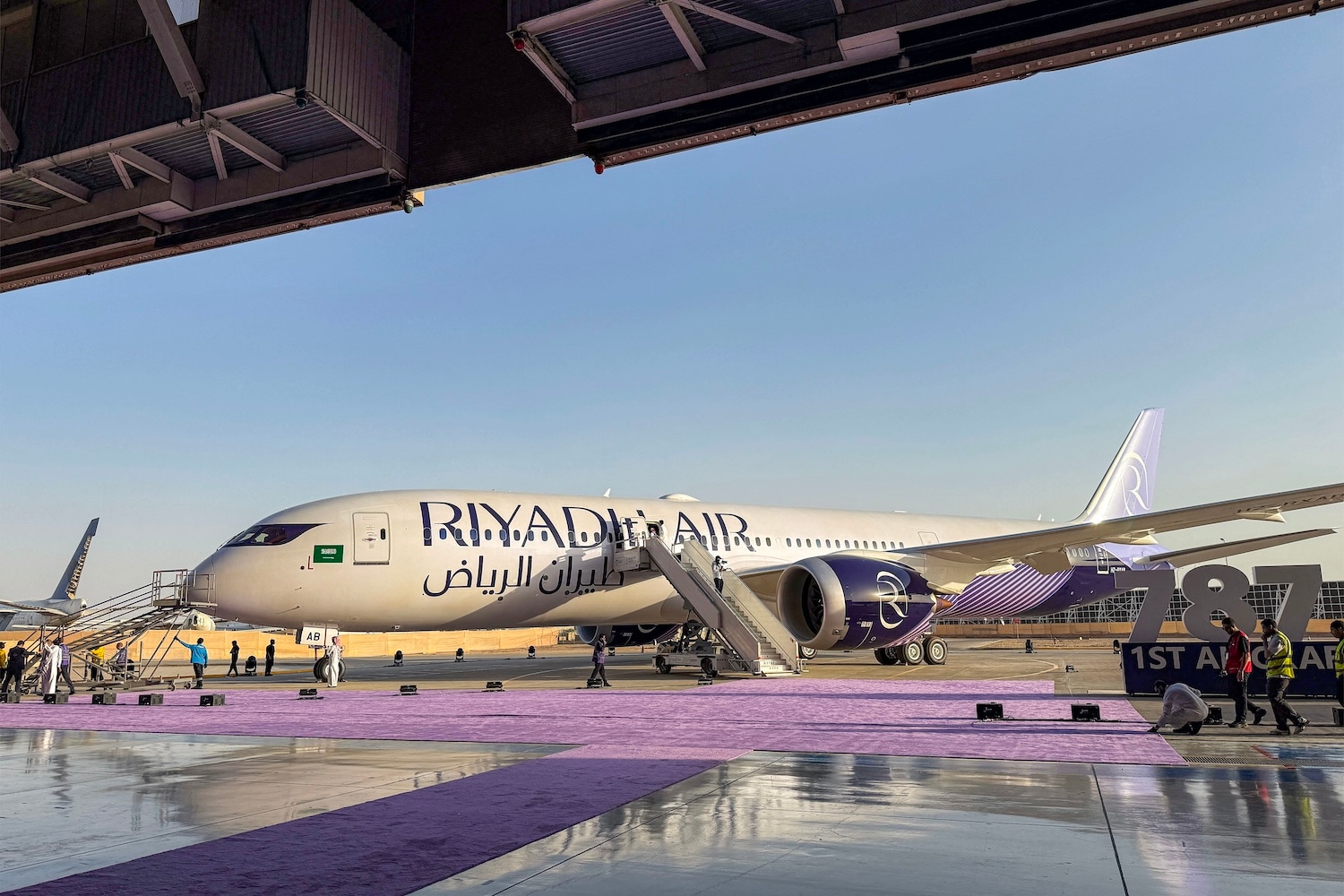
Starting an airline from scratch is a logistical nightmare. Doing it with a backlog of 157 aircraft orders while a regional war rages next door sounds like corporate suicide. Yet, Saudi Arabia is pressing the launch button anyway.
After a year of grueling delays, Riyadh Air is finally moving from high-concept marketing to actual tarmac operations. The carrier opens its doors to the public on July 1, 2026, with an inaugural Boeing 787-9 Dreamliner flight from Riyadh to London Heathrow.
For the last three years, CEO Tony Douglas has been selling a dream of a legacy-free, digitally native airline built to smash the Gulf triopoly of Emirates, Qatar Airways, and Etihad. But dreams don't pay for multi-billion-dollar Boeing and Airbus bills. Now that the first few Dreamliners have actually touched down in Riyadh, the real test begins.
The aviation market the carrier enters looks nothing like the optimistic, post-pandemic boom era of 2023 when the company was founded. It is fractured, expensive, and volatile.
The Price of Waiting for Boeing
Riyadh Air was originally supposed to take to the skies in 2025. Then reality hit.
The global supply chain slowdown hit Boeing especially hard. The US Federal Aviation Administration dragged its feet on certification processes, inspecting everything from brand-new cabin configurations to business-class sliding doors. Riyadh Air's highly customized interiors sat on the factory floor while bureaucrats ticked boxes.
The delay cost the airline a full year of prime market positioning. Honestly, it could have been worse. The carrier used that dead time to build out digital booking infrastructures from scratch, entirely avoiding the buggy, legacy passenger service systems that plague older airlines.
But you can't fly a digital infrastructure. You need metal.
The airline recently took delivery of its first three custom-built 787-9 Dreamliners. Three more are arriving this month, and another two in July. From August onward, Douglas says planes will drop at a steady clip of one per month. By the end of 2026, the first narrow-body Airbus A321neos should start trickling in.
The current firm order book is a massive statement of intent:
- 60 Boeing 787-9 Dreamliners (with an option for 50 more)
- 60 Airbus A321neos
- Commitments for wide-body Airbus A350-1000s and Boeing 777-9s
That is 157 aircraft locked in, built to serve an aggressive roadmap targeting 22 destinations by March 2027 and expanding to more than 100 cities by 2030.
Flying Directly Into a Regional Storm
The conventional wisdom says this is the worst possible time to launch an international network carrier in the Middle East. The ongoing US-Israel-Iran conflict has sent regional aviation into a total tailspin.
Established players like Emirates and Qatar Airways have spent months rewriting flight paths, absorbing massive fuel spikes, and dealing with sudden airspace closures. Flight schedules across the Gulf have faced brutal cancellations. Emirates has reportedly only been able to recover about 75% of its pre-conflict capacity due to the constant operational friction.
But Riyadh Air's leadership sees a bizarre upside to the chaos.
Douglas has publicly argued that Riyadh has emerged as a structurally safer, more stable transit geography during this specific conflict compared to its neighbors. Because Saudi Arabia has managed to insulate its airspace from the worst of the regional closures that paralyzed Dubai and Doha earlier this year, the carrier is positioning itself as the calm eye of a very messy storm.
It is a risky wager. High jet fuel prices are already eating into industry margins worldwide, and cautious international tourists are thinking twice before booking transit flights through the Middle East.
The Real Target is Not Just Passengers
Most people look at Riyadh Air and assume it is trying to clone Emirates. That misses the entire point of why the Saudi Public Investment Fund is writing these checks.
Dubai built Emirates to turn a tiny city-state into a global crossroads. Saudi Arabia does not need to do that; it already has a massive domestic population and its own geographic scale. Riyadh Air is the economic engine behind Vision 2030, a state project explicitly designed to break the kingdom's reliance on oil.
The state wants 150 million annual visitors by 2030. It wants them spending money in local hotels, visiting new mega-projects, and doing business in the capital. Right now, more than 80% of travelers flying into Saudi Arabia arrive on foreign carriers. The country is essentially exporting its transport economy to regional rivals.
Current Market Reality vs. Vision 2030 Goal
[Existing Setup] -> Travelers fly foreign carriers -> Capital leaks to Dubai/Doha
[Riyadh Air Setup] -> Direct routes to Riyadh -> Cash stays in the Saudi economy
By establishing Riyadh Air as a dedicated premium carrier for the capital, the government is forcing a shift. It leaves the country's older flag carrier, Saudia, to focus heavily on religious tourism out of Jeddah, while Riyadh Air handles high-spending business travelers and luxury tourists.
The airline is already setting up alliances to fuel this pipeline, recently signing a partnership with Air India to secure immediate connectivity to one of the fastest-growing aviation markets in the world. Following the initial London route, cities like Dubai, Jeddah, Cairo, Madrid, New York, and Tokyo will join the network.
Can You Buy Loyalty From Scratch
The product itself looks impressive on paper. The cabin design features privacy walls, lie-flat business suites, and a premium economy product that early reviewers claim rivals the legacy business class of yesteryear.
But premium hard products can be bought by anyone with a multi-billion-dollar bank account. What can't be bought overnight is an alliance network.
Riyadh Air is launching without a formal global alliance membership like Star Alliance or Oneworld. It is trying to bypass this by stitching together a web of bilateral codeshare agreements. It is a smart, nimble strategy for 2026, but it means passengers won't immediately get the seamless frequent-flyer perks they enjoy on established carriers.
To combat this, the airline launched its own loyalty program, Sfeer, offering aggressive day-one perks like free in-flight Wi-Fi to founding members. They want to lock in corporate travelers early before the novelty wears off.
What Happens Next
The true test for Riyadh Air will not happen on July 1 when the first purple-liveried jet lands at Heathrow. The real test arrives in 2028 and 2029.
By then, the fleet will number in the dozens, the honeymoon phase will be over, and the carrier will have to compete on pure operational execution against seasoned, ruthless incumbents who have spent thirty years perfecting the art of long-haul transit.
If you are tracking this industry or managing corporate travel budgets, look out for these immediate milestones over the next six months:
- Monitor the delivery schedule. Watch if Boeing meets its one-plane-per-month commitment through December. If deliveries stall again, Riyadh Air's 22-destination target for early 2027 will collapse.
- Watch the ticket pricing. Expect aggressive promotional fares on the London, Dubai, and Madrid routes this autumn as the airline tries to steal market share from British Airways and Emirates.
- Track codeshare expansions. Look for looming announcements regarding US and European carrier partnerships. Those alliances will dictate how easily North American business travelers can book seamless connections into Riyadh.