Fifty-eight years is an absurdly long time. To put that into perspective, when the London Knights started their current NHL draft run, humans hadn't walked on the moon yet. The internet didn't exist. The NHL had just expanded beyond its original six teams.
Yet, every single summer since 1969, at least one kid wearing a London Knights jersey has heard his name called by an NHL franchise.
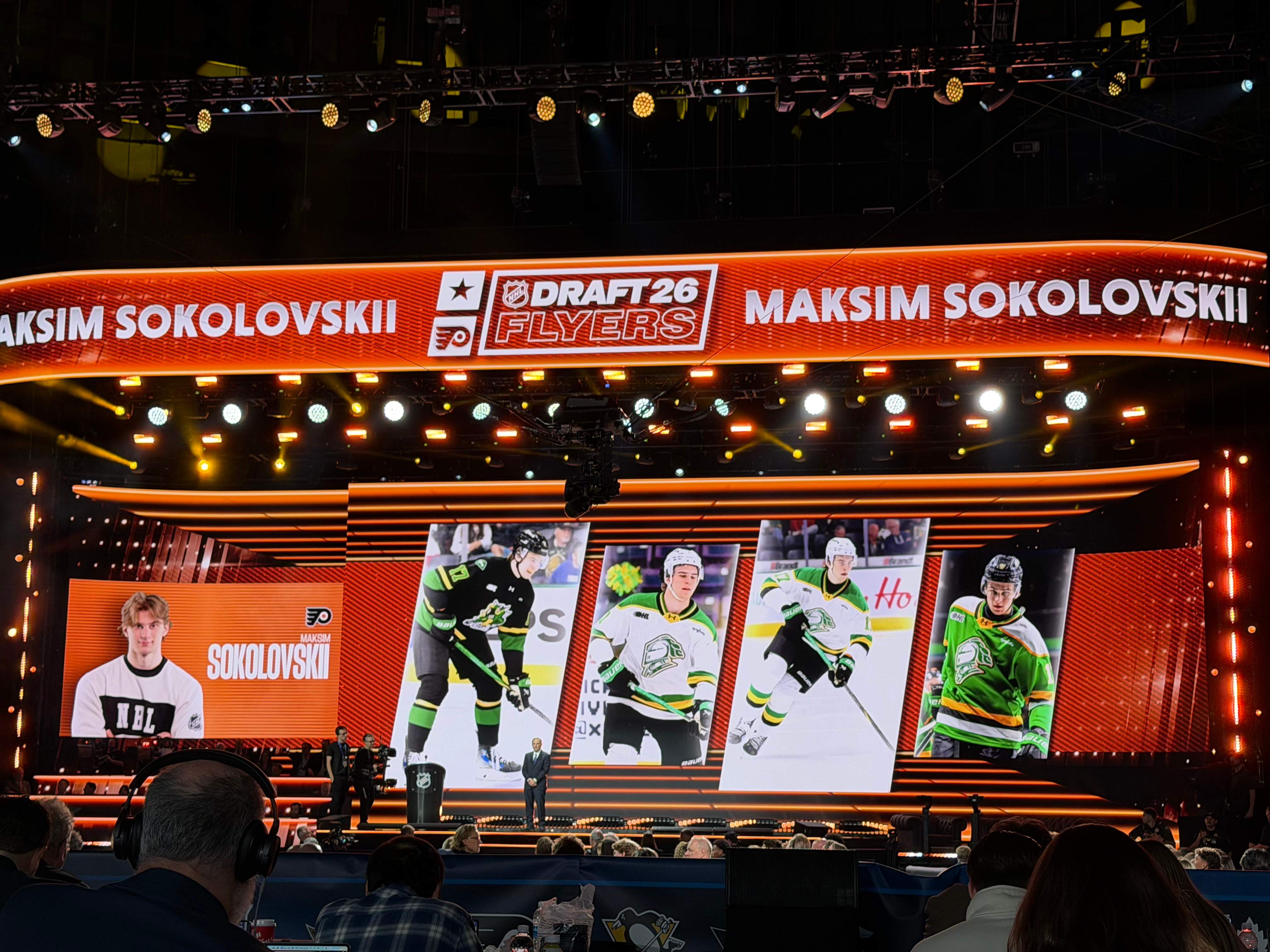
The streak survived the transition from hotel ballrooms to massive football stadiums. It survived the shift from regional scouting to advanced data analytics. It survived changes in ownership, coaching staffs, and entire generations of hockey styles. On June 26, 2026, inside the arena in Buffalo, New York, the streak hit its latest milestone. When the Philadelphia Flyers took towering defenseman Maksim Sokolovskii at number 27 overall, the counter officially ticked to 58 consecutive years.
By the time the weekend wrapped up, three more Knights joined him. Ottawa snatched up winger Jaxon Cover at 32nd overall. Dallas took Ryan Brown in the fifth round, and Boston grabbed Jacob Vandeven just two picks later.
If you think this is just a statistical anomaly or a stroke of good luck, you don't understand how major junior hockey works. This is a factory by design.
The Anatomy of the 2026 Draft Class
Look at the players who kept the streak alive this year. They aren't cookie-cutter prospects. They represent the exact mix of high-ceiling projects and raw athletic bets that NHL scouts crave.
Take Maksim Sokolovskii. He stands 6-foot-8 and tips the scales at 240 pounds. He is a massive, left-handed shutdown defender who was born in Kazakhstan and spent his draft year refining his game under the microscopic pressure of the Ontario Hockey League. During the first half of the season, he was mostly a physical presence, putting up modest numbers with two goals and six assists in 44 games.
NHL scouts don't draft junior stats. They draft physical toolkits.
Flyers General Manager Daniel Briere liked Sokolovskii enough to trade back from the 21st pick to the 27th pick, betting that the big defender would still be on the board. The gamble paid off. Briere openly admitted that playing in London heavily influenced the selection. NHL teams know that if a kid survives the expectations in London, he can handle the professional grind. Sokolovskii will head back to the Knights for another season to play top-minute roles, a development path specifically requested by Philadelphia brass.
Then there is Jaxon Cover. His path to the 32nd overall pick sounds like a movie script. He grew up in the Cayman Islands playing roller hockey on hot asphalt. He didn't even lace up a pair of ice skates until five years ago.
Think about that. Five years ago, Cover was learning how to stop on an ice surface. Now he is an Ottawa Senators first-round pick.
Cover exploded for 52 points in 67 games with London, proving that his late start didn't stunt his offensive instincts. Ottawa amateur scouting director Don Boyd noted that while the background is a fantastic narrative, the Senators picked him because his pure skill set projects as a top-six NHL winger. He plays a heavy, fast game that fits perfectly with the modern professional style.
How the Machine Began in a Montreal Hotel Room
To understand how deep this run goes, you have to look back at how it started. The year was 1969. The NHL held its amateur draft at the Queen Elizabeth Hotel in Montreal.
The atmosphere was nothing like the modern spectacle. There were no flashing lights, no digital draft boards, and absolutely no players in attendance. General managers sat around tables littered with ash trays and paper coffee cups, shouting names into microphones.
That day, the Knights saw four of their own selected.
- Gilles Gilbert went to the Minnesota North Stars
- Bert Wilson was selected by the New York Rangers
- Guy Delparte went to the Montreal Canadiens
- Neil Nicholson was taken by the Oakland Seals
Gilbert went on to play over 400 games in the NHL, famously backstopping the Boston Bruins during their dominant runs in the 1970s. That single draft set a standard. It established the London Knights as a premier destination for players who wanted an express ticket to the professional ranks.
Compare London to the rest of the Ontario Hockey League. The next closest draft streak belongs to the Ottawa 67's. Their run stands at 24 years. That is a fantastic achievement for any junior program, but it is less than half of what London has put together. The gap between London and the rest of the league isn't shrinking. It is widening. In the past four seasons alone, the Knights have produced seven first-round NHL draft picks.
The Hunter Era and the Professional Standard
You cannot talk about London's modern dominance without focusing on Mark and Dale Hunter. Since taking over the franchise in 2000, the Hunter brothers have run the Knights exactly like an NHL organization.
They don't treat their players like kids. They treat them like employees in a high-performance business.
The Hunters have a reputation for identifying talent that other teams overlook. They recruit aggressively, convincing elite American and European players to skip the college route and come to southwestern Ontario. They understand that NHL executives value structure, accountability, and tactical awareness over empty junior point totals.
When an NHL team drafts a player out of London, they know exactly what they are getting. They are getting a prospect who knows how to play without the puck. They are getting a kid who has spent years practicing in front of sellout crowds of 9,000-plus fans at Canada Life Place, facing media scrutiny that mirrors a Canadian NHL market. The transition from London to the pros is remarkably smooth because the structural expectations are identical.
Look at the recent pipeline. Players like Oliver Bonk and Denver Barkey were drafted into the Flyers organization from London because Briere and his staff trust the developmental environment. The Knights teach players how to win. They made it to the Memorial Cup in 2025, and even in developmental years where they fall short in the playoffs—like their tough series loss to the Sault Ste. Marie Greyhounds in the spring of 2026—their players still demonstrate the habits that make pro scouts salivate.
The Local Hockey Boom in Southwestern Ontario
The 2026 draft didn't just highlight the players currently on the Knights roster. It showcased the massive hockey ecosystem that has grown around the city of London.
Local connections were everywhere in the draft order. Ryan Roobroeck, a dominant forward from London, went 35th overall to the Chicago Blackhawks. Jacob Vandeven, who played for the Komoka Kings in the Greater Ontario Hockey League just outside the city, went to Boston. Beckham Edwards, another Komoka native, went to Detroit. Eric Frossard, a London local, was selected by Anaheim.
This regional talent surge is a direct result of having a flagship franchise in the backyard. Kids in southwestern Ontario grow up watching the Knights. They play in local minor hockey systems like the London Jr. Knights, coached by former OHL champions like Danny Syvret. The coaching philosophies filter downward, creating a self-sustaining cycle of elite player production.
The development loop is incredibly tight. Ryan Beaulieu was selected 14th overall by London in the 2026 OHL Priority Selection. His father, Josh Beaulieu, won a Memorial Cup with the Knights back in 2005. The heritage is built into the walls of the rink. Players don't just arrive in London to play hockey; they enter a multi-generational legacy.
What Other Junior Programs Miss
Most junior teams cycle through predictable waves. They build up for a two-year run at a championship, trade away all their young assets for veterans, and then spend the next three years at the bottom of the standings while trying to rebuild their draft capital.
London refuses to participate in that cycle.
They manage their roster with a ruthless efficiency. If a veteran player doesn't fit their long-term competitive culture, they move him for future draft picks before the trade deadline. Look at Ben Wilmott. The Knights traded him to the Barrie Colts right before the 2026 trade deadline. It was a tough move, but it cleared space for younger players to get vital ice time. Wilmott went on to help Barrie reach the OHL finals and got drafted in the third round by the Vegas Golden Knights. London still gets credit for his early development, while their own roster stayed young, fast, and competitive.
The real secret to the 58-year streak is that London never takes a year off to lose purposefully. They don't believe in tanking for high draft picks. They believe that a winning environment develops prospects better than high ice time on a losing team.
Your Next Steps for Following the Pipeline
If you want to understand where the NHL is heading, you need to watch what happens in London over the next twelve months. Do these three things to keep ahead of the scouting curve.
First, track the progression of Maksim Sokolovskii. Watch his ice time during the first two months of the 2026-27 OHL season. If Philadelphia's plan works, his offensive production should take a significant leap as he takes on top-pairing responsibilities.
Second, watch Jaxon Cover's development as an Ottawa prospect. His rapid development curve suggests he hasn't even come close to his ceiling yet. His performance on the power play this winter will show if his high-end skill can transfer to the next level.
Third, keep an eye on the incoming 2026 OHL draft class, particularly Ryan Beaulieu. The next wave of the streak is already on campus, and the evaluation for the 2028 NHL draft starts right now.