The ground doesn't care about your morning routine. At around 11 a.m. Eastern Time on Friday, July 17, 2026, a violent rupture deep beneath the Pacific Ocean reminded millions of people of that exact reality. A major 7.3 magnitude earthquake struck just off the coast of southern Mexico, near the border town of Puerto Madero in Chiapas. It sent a jolt of panic through southern Mexico, Guatemala, and El Salvador.
If you live in a seismically quiet zone, a 7.3 magnitude might just sound like a big number on a screen. It isn't. It is a massive release of energy that can split concrete, twist metal, and completely alter the local sea level within minutes. This specific quake triggered an immediate tsunami warning for coastlines within 300 kilometers of the epicenter. If you liked this post, you should check out: this related article.
Most mainstream media reports give you the same quick summary. They mention the numbers, list a few cities that shook, and move on. They miss the bigger picture. This earthquake isn't just an isolated news event. It is a stark reminder of the terrifying lottery that communities along the Middle America Trench play every single day.
The Sudden Shaking in Chiapas
The U.S. Geological Survey initially clocked the event as a 7.4 magnitude tremor before later revising it to a 7.3. That slight mathematical drop doesn't mean the shaking felt any lighter on the ground. The epicenter was located roughly 48 kilometers southwest of Aquiles Serdan, sitting at a shallow depth of just 15 kilometers. For another look on this development, refer to the latest update from Reuters.
Shallow earthquakes are dangerous. When a fault ruptures close to the surface, the seismic waves don't have time to lose energy before they hit human infrastructure. The energy slams straight into foundations. This event wasn't a lone shock either. A smaller 4.7 magnitude tremor hit the area earlier in the morning, acting as a quiet prelude, while a sharp 5.3 aftershock followed shortly after the main event.
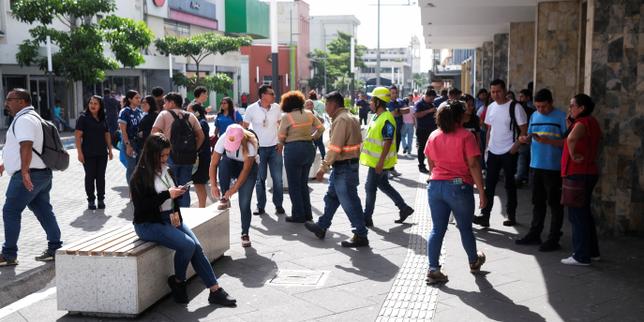
In Tapachula, the closest major city to the southern border, the experience was harrowing. People reported that the shaking started as a mild vibration before rapidly intensifying into violent, rolling motions. Administrative staff at a local public hospital recounted how they had to abandon their desks and flee down the stairs to find safety in an open courtyard. In Guatemala City, workers ran out into the streets during the peak of rush hour as office buildings swayed back and forth. Even hundreds of miles away in Mexico City, skyscrapers creaked.
Beneath the Surface of a Constant Threat
To understand why this keeps happening, look at a tectonic map. Mexico sits on one of the worst geological intersections on the planet. Five different tectonic plates collide, grind, and subduct beneath each other here. You have the Cocos, North American, Pacific, Rivera, and Caribbean plates all locked in a slow-motion wrestling match.
The southern region near Chiapas is dominated by the subduction of the Cocos plate underneath the North American and Caribbean plates. The Cocos plate is heavy. It slides downward into the Earth's mantle, but it doesn't slide smoothly. It gets stuck. Friction holds the rocks together while the massive forces of planetary drift keep pushing. Stress builds up for years, decades, or centuries. Eventually, the rock snaps. That snap is the earthquake you feel.
Locals live with the ghost of past catastrophes. Everyone remembers September 19, 1985, when an 8.0 magnitude earthquake destroyed parts of Mexico City and killed over 10,000 people. By an eerie quirk of fate, another deadly 7.1 magnitude quake struck on that exact same date in 2017, just hours after the country finished its national safety drills. This latest Chiapas event didn't reach those horrific levels of destruction, but it proved that the system is fully loaded and capable of snapping at any moment.
What a Tsunami Warning Actually Means for Coastal Residents
When a massive block of the ocean floor shifts during an earthquake, it acts like a giant paddle pushing the water column upward. The U.S. Tsunami Warning System immediately flagged the risk, warning that waves between 0.3 and 1 meter above normal tide levels could hit the coasts of Mexico and Guatemala.
A one-meter wave sounds small to a casual observer. If you go to the beach, you jump over one-meter waves for fun. A tsunami wave is entirely different. It isn't a normal wind-driven wave that breaks and recedes in a few seconds. A tsunami is a dense wall of water moving at the speed of a jet airliner. It carries millions of tons of energy and keeps coming, flooding inland without stopping.
Mexico's Navy Secretary, Raymundo Morales, quickly stepped in to manage the panic, stating that sea levels were only expected to rise by about half a meter and that serious maritime impact wasn't anticipated. Even with those reassuring words, local mayors in border towns like Suchiate ordered strict monitoring of the coast. They told people to stay away from the beaches. They know that the ocean can be unpredictable after a major seismic displacement.
True Stories from the Ground
The real impact of a disaster is found in the small details of daily life. Across Chiapas and western Guatemala, the immediate aftermath was defined by confusion. Power lines whipped around wildly, knocking out electricity in several rural communities. Cell phone networks jammed instantly as thousands of people tried to call their families at the exact same moment.
In some coastal fishing villages, residents didn't wait for an official government alert. They saw the intensity of the shaking, remembered the lessons passed down from older generations, and immediately started walking uphill. That is survival instinct in action. It is often faster and more reliable than a text message alert from a centralized bureaucracy.
Misconceptions About Earthquake Early Warning Systems
One of the biggest complaints from residents in Mexico City during this event was a lack of sound. The famous Mexican earthquake alert system, SASMEX, didn't trigger its public sirens in the capital. People want to know why.
The government explanation is simple but frustrating. The sensors calculate the energy radiated during the first few seconds of a rupture. Because the epicenter was far away in the south and the initial energy signature didn't cross the specific mathematical threshold required to threaten the capital with severe structural collapse, the sirens stayed silent.
This highlights a dangerous misconception. Many people think early warning systems are perfect shields. They aren't. They are bound by the laws of physics. If you are right on top of the epicenter, the seismic waves will hit you before the digital alert can even process. If you are far away, the system might decide you aren't in enough danger to warrant disrupting an entire metropolis. You can't rely completely on technology to tell you when to protect yourself.
Your Immediate Action Plan When the Ground Starts Moving
If you ever find yourself in a highly active seismic zone like southern Mexico, you need to know exactly what to do without thinking. Hesitation kills. Here is the concrete, practical reality of surviving a major quake.
First, forget the old myth about running out of a building while the ground is actively moving. Unless you are in a poorly constructed mud-brick hut that is instantly pancaking, trying to run down stairs or out into the street while everything is shaking violently is a great way to get hit by falling glass, breaking facades, or tumbling power lines.
Second, practice the Drop, Cover, and Hold On technique immediately. Drop to your hands and knees so the shaking doesn't throw you to the floor. Cover your head and neck under a sturdy piece of furniture like a heavy wooden table. Hold onto it so it doesn't slide away from you.
Third, if you are near a coast and you feel a quake that lasts longer than twenty seconds or is strong enough to make standing difficult, don't wait for an official tsunami warning on your phone. Walk briskly inland and move to high ground immediately. The earthquake itself is your warning.
The Chiapas event of July 17, 2026, ended without reports of mass casualties or catastrophic structural failures. We got lucky this time. The tectonic plates shifted just enough to terrify us, but not enough to break us. The next time the fault line slips, we might not get that same grace period. Pay attention to the ground beneath your feet.