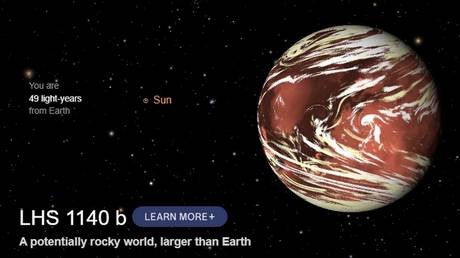
Astronomers finally broke through the cosmic wall. For years, every time we turned our best instruments toward rocky planets in the habitable zones of other stars, we came up empty. They looked like bare, airless rocks stripped naked by their host stars.
That just changed.
A team led by Collin Cherubim at Harvard University confirmed the direct detection of an atmosphere on a rocky super-Earth named LHS 1140 b. Located just 49 light-years away, this planet sits comfortably in the Goldilocks zone of its star—the sweet spot where liquid water can exist. But the real kicker isn't just that it has an atmosphere. It's what that atmosphere is doing.
Scientists caught the planet leaking helium into space.
The Core Finding Most News Outlets Missed
Most mainstream reporting focuses heavily on the word "Earth-like." Let's be clear: you wouldn't want to breathe the air on LHS 1140 b. The upper atmosphere is dominated by helium. It's a completely different environment from Earth's nitrogen-oxygen blanket.
The real scientific victory here is about survival.
LHS 1140 b orbits a red dwarf star. These stars are notorious neighbors; they routinely blast nearby planets with harsh X-rays and extreme ultraviolet radiation that should boil away an atmosphere within its first few hundred million years. Yet, LHS 1140 b has held onto its gas for more than 3 billion years.
Planet Profile: LHS 1140 b
- Mass: 5.6 times Earth's mass
- Size: 1.73 times Earth's radius
- System Age: Over 3 billion years
- Orbital Period: 24.7 days
- Atmospheric Signature: Escaping helium gas
The discovery relied on the transit method using the WINERED spectrograph on the Magellan Clay telescope in Chile. As the planet crossed in front of its star, the starlight filtered through the planet's outer gas envelope. The helium absorbed very specific wavelengths of light, leaving behind an unmistakable chemical barcode.
Why the Atmosphere is Changing on Human Timescales
If you think space discoveries are static, this system will surprise you. When the team looked at LHS 1140 b in 2024, the helium leak was blazing hot and clearly visible. When they checked back in 2025, the helium escape signature vanished.
This tells us the atmosphere is highly dynamic and variable. The stellar flares from the red dwarf hit the planet in pulses, heating the upper atmosphere and causing it to puff up and bleed off gas in waves. It is incredibly rare for astronomers to watch an exoplanet's atmosphere transform over the span of just 12 months.
This variability confirms that the planet isn't just a dead rock with a static, frozen envelope. It is an active, evolving world.
What Lies Beneath the Helium Smoke Screen
Nobody thinks LHS 1140 b is just a ball of helium. Because the planet is dense, rocky, and massive, its gravity is strong enough to trap heavier molecules closer to the surface.
Computer modeling suggests the helium we see is just the leaky roof of a much more interesting house. Beneath that helium envelope, the lower atmosphere is likely packed with heavier gases like carbon dioxide, carbon monoxide, and potentially even molecular oxygen or water vapor.
The thickness of the atmosphere provides a modest greenhouse effect. Because LHS 1140 b gets less stellar energy than Earth, it needs that greenhouse blanket to keep its surface from freezing solid. With the atmosphere confirmed, the odds that this world hosts a global liquid ocean or massive ice sheets with liquid interiors just skyrocketed.
Crossing the Cosmic Shoreline
Astronomers use a concept called the "cosmic shoreline" to divide the universe into two kinds of small planets: those that can hold an atmosphere against the onslaught of stellar winds, and those that lose it entirely.
We finally have a clear data point for a rocky planet sitting firmly on the habitable side of that line. In the exact same system, a sister planet called LHS 1140 c orbits much closer to the star. The team checked it for an atmosphere too and found nothing. It is a bare rock. This stark contrast inside a single solar system gives us the perfect laboratory to understand exactly how planetary environments live and die.
The next step is already in motion. The team is securing observation time with the James Webb Space Telescope to pierce through the outer helium layers and look directly at the lower atmosphere. This will tell us once and for all if carbon dioxide and water vapor are waiting underneath.
Keep your eyes on the data releases over the coming year. We are no longer just guessing if habitable-zone rocky worlds can keep their air—we are actively mapping them.