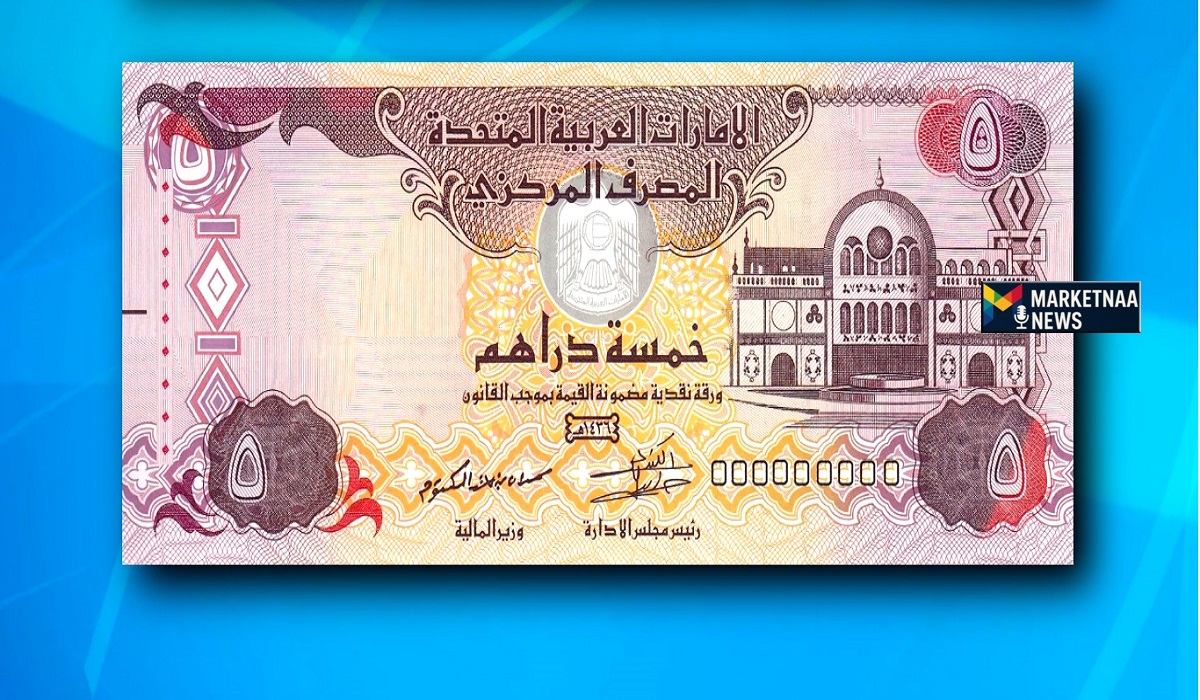
Ahmed sat in a plastic chair outside a small cafe in Dubai’s Satwa district, the humidity of the Gulf evening clinging to his skin like a second layer of clothes. In his hand, he held a smartphone with a cracked screen, the glow illuminating a face etched with the quiet exhaustion of a man who had spent twelve hours laying tile in the desert sun. He was not looking at news from home or photos of his children in Assiut. Instead, his thumb hovered over a currency exchange app, waiting for a flicker of movement in the numbers that governed his life. For Ahmed, and for millions of Egyptian expatriates like him, the daily fluctuation of S'er Al Dirham Moqabel Al Jeneih Al Masri was not a dry financial metric; it was the difference between a month of meat on his family’s table or another thirty days of lentils and bread. It was the invisible bridge connecting the skyscrapers of the Emirates to the dusty fields of Upper Egypt, a bridge that seemed to stretch longer and thinner with every passing season.
The story of this exchange is the story of two nations bound by a shared language and a disparate fortune. On one side stands the United Arab Emirates, a global hub of capital where the dirham is pegged to the dollar, providing a bedrock of stability that attracts labor from every corner of the earth. On the other lies Egypt, a civilization of over 110 million people grappling with the immense pressures of debt, inflation, and a currency that has been forced to find its own level in a volatile global market. When the Central Bank of Egypt made the historic decision to float the pound in March 2024, the immediate shock was felt not in the boardrooms of Cairo, but in the hands of the workers in Dubai, Sharjah, and Abu Dhabi. They watched as the value of their hard-earned savings shifted overnight, a silent recalibration of their dreams and their sacrifices.
The Human Cost of S'er Al Dirham Moqabel Al Jeneih Al Masri
To understand the gravity of these shifts, one must look at the sheer scale of the Egyptian diaspora. According to data from the Central Agency for Public Mobilization and Statistics, millions of Egyptians live abroad, with a significant portion concentrated in the Gulf. These workers are the lifeblood of the Egyptian economy, sending home billions of dollars in remittances annually. In 2023, these inflows reached approximately $22 billion, a figure that rivals the revenues of the Suez Canal. Yet, these billions are composed of hundreds of millions of small, individual choices. Every time a nurse in a Dubai hospital or an engineer in an Abu Dhabi firm looks at the exchange rate, they are performing a complex mental calculation. They are weighing the cost of a daughter’s university tuition against the price of their own rent in a foreign land.
The volatility experienced throughout late 2023 and early 2024 created a period of profound uncertainty. Before the devaluation, a parallel market had emerged, a shadow world of back-alley exchanges and whispered rates that often diverged wildly from the official bank figures. This fragmentation created a paralysis. Families in Egypt waited for the rate to peak before asking for transfers, while workers abroad held onto their dirhams, hoping for a better window. The gap between the official and unofficial rates became a source of national anxiety, a fever dream that only broke when the official rate was finally allowed to align with reality.
The Mechanics of the Float
The decision by the Central Bank of Egypt to allow the pound to trade freely was a move praised by the International Monetary Fund and international investors as a necessary step toward long-term stability. By removing the artificial props that had kept the pound overvalued, the government sought to kill the black market and attract foreign direct investment. For the man on the street, however, the transition felt less like a strategic move and more like a sudden storm. The immediate depreciation of the pound meant that while a single dirham could suddenly buy more Egyptian pounds than ever before, those pounds bought far less at the local grocery store in Cairo.
Inflation in Egypt surged, at points exceeding 35 percent, driven by the rising cost of imports. Egypt is the world’s largest wheat importer, and its food security is inextricably linked to the strength of its currency. When the pound weakens, the price of a loaf of bread or a kilo of sugar rises almost instantly. This creates a cruel paradox for the expatriate worker. While their dirhams are worth more in nominal Egyptian currency, the purchasing power of their families back home is simultaneously being eroded. They are running faster just to stay in the same place.
Architecture of a Regional Partnership
The relationship between the dirham and the pound is not merely a matter of labor and remittances; it is also a story of massive geopolitical investment. In early 2024, the United Arab Emirates announced a landmark $35 billion investment in the Ras El Hekma deal, a project aimed at developing a massive stretch of Egypt’s Mediterranean coast. This was not just a real estate transaction; it was a massive injection of liquidity designed to stabilize the Egyptian economy at its most vulnerable moment. The arrival of these billions allowed the Central Bank to clear a backlog of imports and provide the foreign exchange necessary to support the new, unified exchange rate.
This investment underscores a deeper truth about the modern Middle East. The stability of Egypt is a matter of national security for the Gulf states. A prosperous, stable Egypt serves as a bulwark against regional instability and a vital market for Gulf capital. When the UAE invests in Egyptian infrastructure or telecommunications, it is betting on the long-term viability of the Egyptian state. This high-level financial diplomacy provides the backdrop against which the individual worker's struggle takes place. The macro-level billions are the scaffolding, but the micro-level dirhams are the bricks.
The reliance on Gulf investment has sparked intense debate within Egyptian academic and political circles. Critics argue that such heavy dependence on foreign bailouts can compromise national sovereignty or lead to a "sell-off" of national assets. Proponents, however, point to the desperate need for hard currency to modernize the nation's aging infrastructure and provide jobs for a youth-heavy population. They see the Gulf partnership as a bridge to a more industrialized, export-oriented economy that will eventually rely less on the whims of currency markets and more on its own productive capacity.
The Rhythm of the Exchange
Every morning in the Egyptian capital, the first thing many people do is check their phones. They are not looking for the weather; they are looking for the latest update on S'er Al Dirham Moqabel Al Jeneih Al Masri and its counterparts. This ritual has become a collective national habit, a way of taking the pulse of the country’s health. In the narrow alleys of Islamic Cairo, where artisans have hammered copper for centuries, the price of raw materials is now tied to a screen in a bank window. The copper is often imported, its cost fluctuating with the currency, meaning the price of a traditional lantern is now subject to the same global forces as a tech stock in New York.
This constant monitoring creates a psychological toll. It fosters a sense of "wait-and-see" that can stifle local economic activity. Small business owners hesitate to restock inventory, fearing that the pound will drop again tomorrow, making today's purchases look like a mistake. Consumers delay big purchases, their confidence shaken by the memory of previous devaluations. The stability of the rate in the months following the 2024 float has begun to soothe some of these nerves, but the memory of the volatility remains close to the surface, a scar that twitches when the clouds gather.
Economists like those at the Egyptian Center for Economic Studies often speak of the "real" exchange rate, which accounts for inflation differences between countries. While the nominal rate tells you how many pounds you get for your dirham, the real rate tells you what you can actually do with that money. For the Egyptian family receiving money from Dubai, the nominal gain is often swallowed by the rising cost of electricity, fuel, and education. This is the hidden tax of a devaluing currency—a transfer of wealth from the savers and the wage-earners to the forces of global inflation.
The Hope for Equilibrium
The goal of the current economic reforms is to reach an equilibrium where the currency reflects the true productivity of the nation. For years, Egypt relied on "hot money"—short-term investments in government bonds that could flee at the first sign of trouble. The new focus is on "cold money"—long-term investments in factories, farms, and tourism. The theory is that if Egypt can produce more of what it consumes and export more of what it produces, the pressure on the pound will ease. The dirham will then become a partner in growth rather than a life raft in a storm.
There are signs of this transition taking hold. New industrial zones are rising along the Suez Canal, and the agricultural sector is expanding into the Western Desert. These projects are often funded by the very Gulf capital that flowed in during the crisis. The hope is that one day, the young man in Satwa won't have to spend his evenings staring at a currency app. Perhaps he will be tiled in a factory in Alexandria or a resort in Marsa Alam, earning a wage that doesn't lose its meaning between the time it is earned and the time it is spent.
The human spirit is remarkably resilient in the face of these abstractions. In the cafes of Cairo and the labor camps of the Gulf, life continues. Marriages are planned, houses are built, and children are sent to school. The currency is the medium of this life, the ink in which the story is written, but it is not the story itself. The story is the persistence of a people who have seen empires rise and fall and who know that while the numbers on a screen may change, the value of their labor and the strength of their families remain the only true currency.
Back in Satwa, Ahmed finally put his phone away. The rate had held steady for another day, a small victory in a life measured in increments. He stood up, stretched his aching back, and began the walk to the bus that would take him to his shared room. He thought of his son’s voice on the phone earlier that week, asking when he would be coming home for the Eid holiday. Ahmed had calculated the cost of the flight, the gifts for his sisters, and the repairs needed for the roof of their house. He knew he would stay for another year. The distance between the dirham and the pound was still too wide to cross just yet, but he would keep building, one tile at a time, until the bridge was finally finished. He walked into the darkness, a single figure in a vast global machine, carrying the hopes of a family and the weight of a nation on his shoulders. The city lights shimmered in the distance, indifferent to the math of survival, as the warm wind carried the scent of the sea and the faint, persistent promise of home.