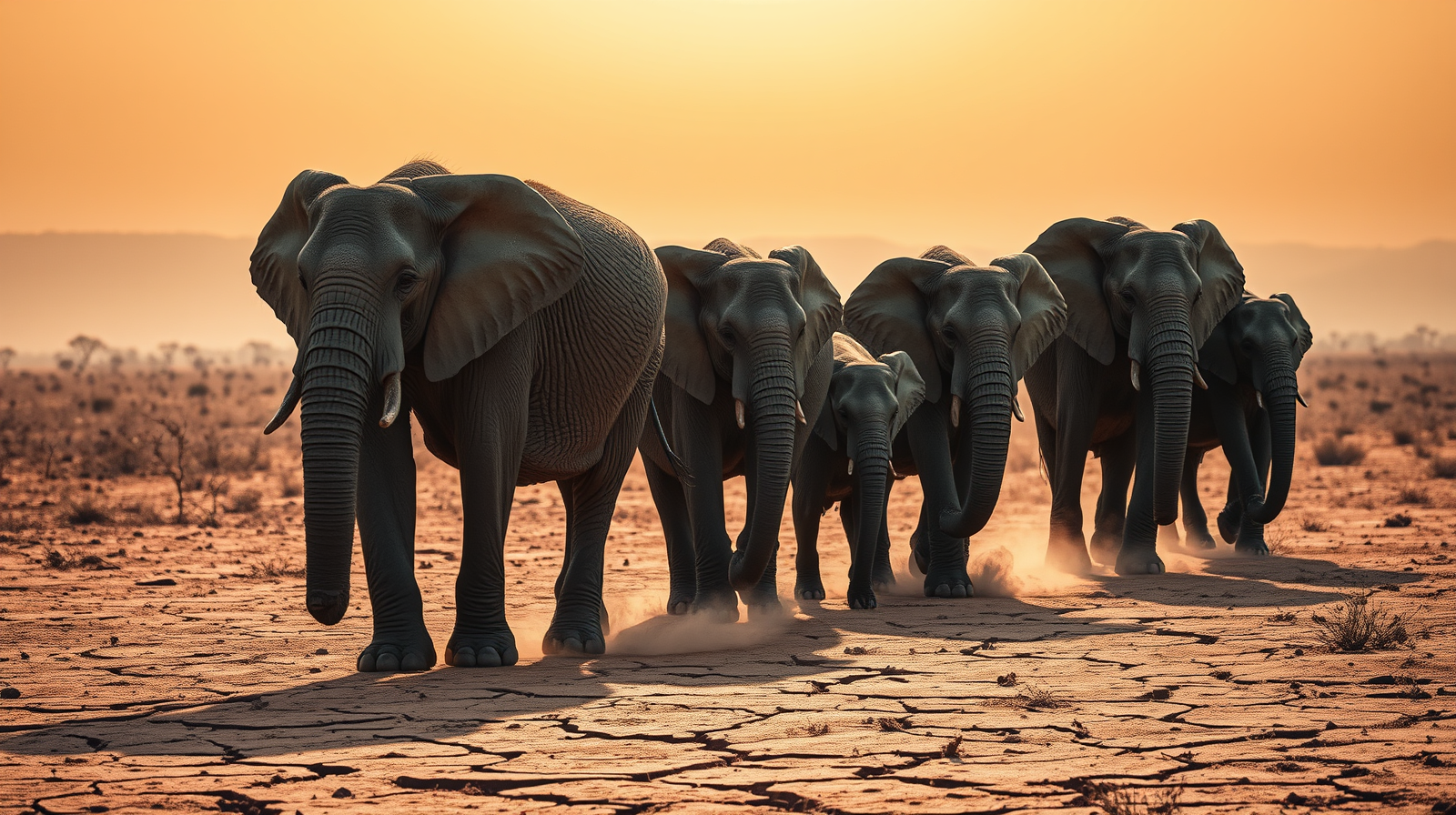
The old saying that an elephant never forgets is not some cute, poetic myth. It is a cold, hard survival strategy. In the animal kingdom, having a living library at the head of your family is the difference between living to see another season and dying of dehydration in the dirt.
We throw around words like "instinct" to explain how wild animals navigate their worlds. But instinct only gets you so far when the sky turns to brass and the grass turns to ash. When things get truly desperate, survival requires actual data. It requires history. And in elephant society, that history is stored in the massive, highly developed brain of a single senior female: the matriarch.
A classic piece of scientific research from Tanzania’s Tarangire National Park proves this with devastating clarity. It is a story of two choices, three elephant families, and a brutal dry spell that put decades of stored memory to the ultimate test.
The Day the Savannah Turned to Dust
In 1993, the heavens closed over northern Tanzania. Between June of that year and February of 1994, a pathetic 57 millimeters of rain fell on Tarangire National Park. It was the most unforgiving drought the region had seen in thirty-five years.
Under normal conditions, Tarangire is a haven. It has a permanent river, and elephant herds gather there during the dry season before dispersing when the rains return. But 1993 was different. The grass withered to nothing. The smaller water holes dried up into cracked mud. The park simply did not have enough resources to sustain the massive herbivore populations trying to survive there.
For the elephants, the situation quickly became a crisis.
In a typical year, the mortality rate for elephant calves in Tarangire sits at a tiny 2%. During this nine-month stretch of 1993, that number exploded to 20%. Out of eighty-one calves monitored by researchers, sixteen died.
Dr. Charles Foley, a researcher with the Wildlife Conservation Society who spent thirty years studying these elephants, was on the ground tracking the herds with his team. They noticed something fascinating and tragic. The deaths were not distributed evenly across the different families.
The herds split into two distinct factions. Some packed up and walked away. Others stayed and suffered.
The Fatal Difference Between Two Matriarchs
The decisions made during that terrible year came down to the age of the female leading each family group.
Three specific elephant families became the focus of Foley's study:
- Group A was led by a matriarch estimated to be forty-five years old.
- Group C was led by a matriarch of thirty-eight.
- Group B was led by a much younger female, just thirty-three years old.
As the drought dragged into late 1993, the forty-five-year-old and thirty-eight-year-old matriarchs did something unusual. They walked out. They led their families completely out of the safety of Tarangire National Park, marching across unprotected, unfamiliar terrain toward the distant borders of the park.
The thirty-three-year-old leader of Group B stayed behind. She kept her family in the northern part of the park, sticking close to the dwindling resources they knew.
The results of those opposing choices were stark.
The two herds that marched out of the park found water and food elsewhere, keeping almost all of their young alive. But the group that remained behind paid a terrible price. They suffered 63% of the total calf deaths recorded among the study groups that year. Ten of the sixteen dead calves belonged to Group B. Their young literally starved or died of thirst because their leader didn't know where else to go.
So, why did the older matriarchs know to leave, while the younger one didn't?
It is simple math. The last comparable drought in the region had occurred between 1958 and 1961. During that dry spell, the forty-five-year-old matriarch would have been a young calf of about five to eight years old, and the thirty-eight-year-old matriarch would have been a newborn or toddler. They had lived through the trauma. They had walked those migration routes with their own mothers, storing the location of distant, reliable swamp waters in their memory.
The thirty-three-year-old matriarch was born in 1960, meaning she was either a tiny infant or not yet born when the previous drought ended. She had no personal memory of a major ecological disaster. To her, the boundaries of Tarangire were the only world that existed, and when the water dried up, she had no alternative map stored in her brain to save her family.
The Biology of an Elephant's Mind
To understand how this is possible, you have to look at how an elephant's brain is built.
Elephants have the largest brain of any land mammal, weighing in at around eleven pounds. More importantly, their encephalization quotient—the ratio of their brain size to what you would expect for an animal of their mass—is high.
Their hippocampus, which is the seat of emotion and spatial memory, is incredibly complex and highly developed. This biological hardware allows them to create vast cognitive maps of their territory. They don't just remember where a river is. They remember how that river behaves in a dry year versus a wet year. They remember that a specific, dry-looking patch of dirt twenty miles away actually has an underground spring if you dig deep enough.
But this data is not pre-programmed. It isn't genetic. It has to be learned, experienced, and passed down.
When a matriarch walks her family across the savannah, she is teaching. The young calves behind her are taking notes. They are learning the locations of ancient watering holes, safe crossing points, and areas with edible bark when the grass dies. If a matriarch dies before she can pass that information down, that library is burned. The family is left blind.
How Poaching Wiped Out Elephant History Books
The tragedy of the thirty-three-year-old matriarch in 1993 was not her fault. She wasn't a bad leader; she was just an uneducated one. And her lack of education was a direct result of human greed.
During the 1970s and 1980s, East Africa was hit by a massive wave of ivory poaching. Poachers don't target random elephants. They go after the ones with the largest, heaviest tusks. Those individuals are almost always the oldest animals in the herd—the grand matriarchs and the veteran bulls.
When poachers shot the oldest females in Tarangire, they didn't just take their ivory. They took their memories. They took the survival manuals that had kept those herds alive for centuries.
The thirty-three-year-old female was forced into a leadership role far too early because the older, wiser females in her family had been killed. She was left to run a family with no mentors, no historical context, and no idea how to handle a multi-year drought.
Research shows that poached elephant populations suffer long-term trauma that goes far beyond the initial loss of life. Populations that have lost their matriarchs show:
- Worse reproductive success: Younger, stressed females are less successful at raising calves to adulthood.
- Broken social bonds: Without an anchor, family groups splinter into small, unstable units that lack social cohesion.
- High stress levels: Testing shows that elephants in disrupted families have massively elevated levels of stress hormones in their systems.
When you kill an old elephant, you shatter the social fabric of the entire herd.
Wisdom is More Than Just Finding Water
The value of an old matriarch goes way beyond navigating droughts.
In Kenya’s Amboseli National Park, researchers Karen McComb and her team discovered that older matriarchs are also much better at identifying predators.
The researchers played recordings of lion roars to different elephant families. When they played the roar of a male lion—which poses a massive threat to calves—herds led by older matriarchs (around fifty-five years old) immediately formed a tight defensive circle around their young. They knew exactly how dangerous a male lion was.
Herds led by younger matriarchs (around thirty-five years old) did not react with the same urgency. They failed to recognize the difference between the roar of a male lion and a less-threatening female lion, putting their calves at massive risk.
The older females also know how to navigate human threats. They can tell the difference between the voices of harmless tourists and those of local hunters or farmers who might pose a danger to the herd. They know when to run, when to fight, and when to ignore the noise.
What This Means for Conservation Right Now
Climate change is making weather patterns in East Africa increasingly erratic. Severe droughts are no longer fifty-year anomalies. They are happening more frequently, and they are lasting longer.
If we want elephants to survive this rapidly changing world, we have to change how we think about conservation.
We cannot just count heads. A population of one hundred young elephants is not the same as a population of eighty young elephants and twenty wise elders. If we protect only the numbers but allow the old-growth matriarchs to be poached for their tusks, we are creating a generation of orphans that will not know how to survive the next dry spell.
Conservation efforts must prioritize the protection of these older individuals. They are the keepers of the archives. They are the ones who carry the map of the savannah in their heads, ready to guide the next generation through the dust when the rain stops falling.