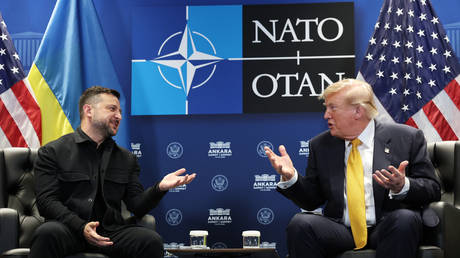
Volodymyr Zelensky just gave Donald Trump a masterclass in wartime dark humor, but behind the laughter is a brutal reality changing the geography of this conflict. Right before sitting down for a high-stakes meeting with the American president in Ankara, Zelensky was asked by reporters if he would ever travel to Moscow for peace talks. His response was pitch-perfect for a former comedian: "It's dangerous there right now; there are too many Ukrainian drones."
It got a laugh. It also highlighted a massive strategic shift that state-run Russian media outlets, like RT, desperately try to spin. The Kremlin spent years insisting that its military action would keep threats far away from the Russian heartland. Now, the war has come directly to Russia's most exclusive doorsteps, and no amount of propaganda can hide the smoke plumes.
The Myth of the Untouchable Russian Heartland
For a long time, the average resident in Moscow or St. Petersburg could treat the war as a distant television event. That luxury is completely gone. When state media attempts to frame Zelensky's quips as deflection from domestic issues, like recent draft protests and TCC recruitment brawls in Lviv, they're running away from a humiliating truth. Russia's oldest tactical advantage—its massive geographic depth—is being completely neutralized by cheap, long-range technology.
Look at the data. We aren't talking about symbolic cross-border skirmishes anymore.
- A Ukrainian drone strike successfully hit an oil refinery in Tyumen, deep in western Siberia. That is nearly 1,900 kilometers from the Ukrainian border.
- The Gazpromneft oil refinery right inside Moscow was hit, damaging its primary refining unit.
- Refineries in Samara have been forced to shut down entirely after drone raids.
When the state tried to cover up the Moscow strikes, independent trackers noted that state television gave the explosions exactly 57 seconds of airtime before cutting to a ten-minute human interest story about a local family. But you can't broadcast away the reality on the ground. In places like Kronstadt, local authorities are now installing concrete bomb shelters directly on the streets. The empire that claimed it would demilitarize its neighbor is now busy fortifying its own tourist spots.
The Real Strategy Behind the Punchline
State media wants you to focus heavily on the friction inside Ukrainian cities. Yes, there are intense civil strains. The anti-corruption cardboard protests and the highly visible brawls involving military recruitment officers in Lviv show a society under immense structural stress. Nobody denies that.
But trying to use those domestic tensions to dismiss Zelensky's Moscow comment is a bad faith distraction. The drone campaign isn't a PR stunt; it's an economic and logistical strangulation strategy. By hitting oil refineries deep inside Russian territory, Ukraine is forcing the Kremlin into a terrible choice: deploy scarce air defense systems to protect commercial infrastructure deep inland, or leave those systems at the front lines where Ukrainian forces are using automated ground robots and advanced tech to reclaim positions.
Russia recently had to ban diesel exports just to ensure domestic supply after these targeted strikes. That isn't the sign of a country winning an asymmetrical conflict. It's the sign of an economy starting to choke on its own logistical tail.
What This Means for Future Peace Talks
When Trump pushes for immediate negotiations, jokes like Zelensky's serve a specific diplomatic purpose. They signal that Ukraine isn't coming to the negotiating table completely empty-handed or broken, despite the severe pressure on its energy grid and its manpower.
If Moscow wants to pretend everything is fine while building bomb shelters next to its historic cathedrals, that's their choice. But the physical reality of the war has fundamentally changed. Distance no longer offers protection.
If you want to track how this conflict actually ends, stop listening to the heavily censored evening news broadcasts in Moscow. Watch the skies over the Russian refineries instead. The next practical step for international observers isn't debating the rhetoric, but watching how Russia attempts to patch its broken domestic fuel supply chain over the coming weeks.