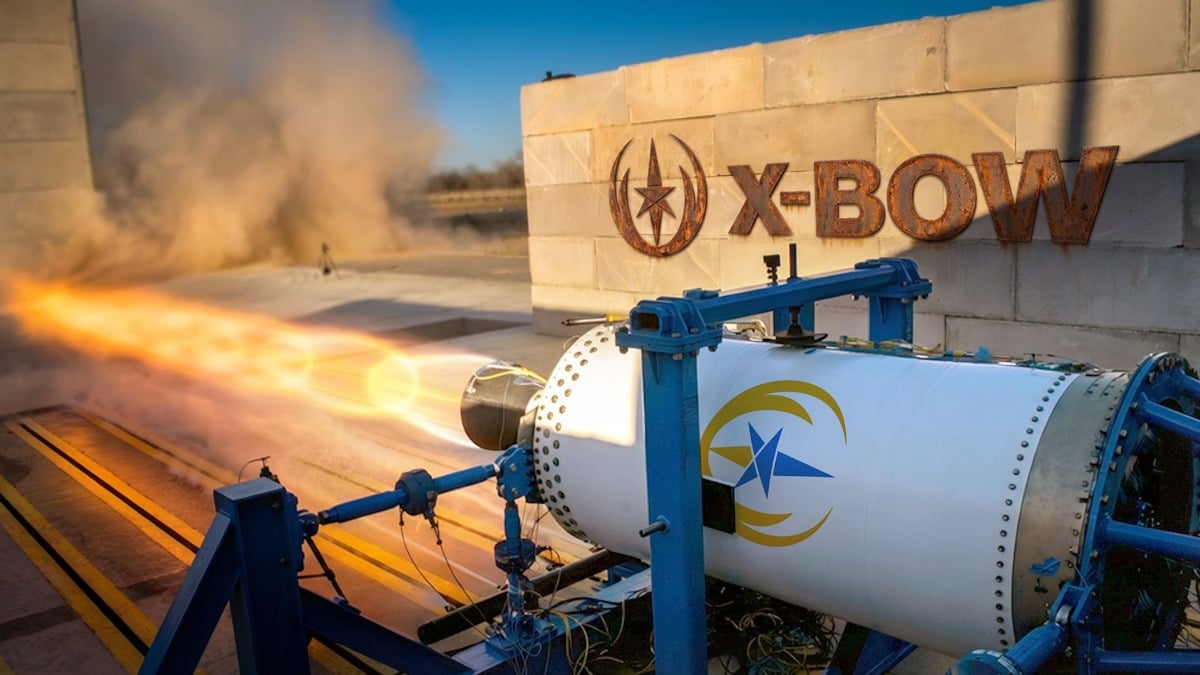
For decades, the United States military had a massive, quiet vulnerability. If you wanted to build a missile, a hypersonic weapon, or a tactical rocket, you had to buy the solid rocket motor from one of two players: Northrop Grumman or L3Harris Technologies. That duopoly created rigid supply chains, sky-high costs, and zero room for rapid innovation.
The Pentagon just signaled that those days are officially over. If you found value in this post, you should look at: this related article.
X-Bow Systems, a defense tech startup out of Albuquerque, New Mexico, just locked down an $11 million contract injection to develop the next generation of solid rocket motors for the Department of Defense. This isn't just another routine procurement contract. It's a calculated chess move by the Pentagon to inject digital manufacturing into a vital sector that has been stuck in the mid-20th century.
The Bottleneck Threatening National Security
To understand why this $11 million contract matters, you have to look at the massive strain on global logistics. Munitions are flying off the shelves. The demand for tactical missiles, cruise missiles, and advanced drone tech has skyrocketed, yet the traditional defense industrial base has struggled to keep pace. For another angle on this event, check out the recent update from Wired.
Traditional solid rocket motor manufacturing is slow, dangerous, and incredibly capital-intensive. It involves casting chemical propellants into massive molds, curing them over days or weeks, and hoping there are no microscopic air pockets inside the grain. A single flaw can cause a rocket to explode on the launchpad.
Because the process is so brittle, scaling up production quickly during a crisis is nearly impossible. If the Pentagon needs double the missiles tomorrow, the traditional primes can't just flip a switch. They lack the capacity.
That's where X-Bow comes in. They don't cast rocket motors. They print them.
Printing Propellant on Demand
X-Bow’s secret weapon is its patented Advanced Manufacturing of Solid Propellant technology. Think of it as industrial-scale 3D printing, but instead of plastic filament or titanium powder, the printers extrude highly energetic solid rocket fuel.
This approach flips the script on traditional aerospace economics.
- Design Iteration: Instead of waiting months to machine a new mold for a different thrust profile, engineers can tweak a CAD file and print a new motor geometry in days.
- Custom Grain Geometries: 3D printing allows for intricate internal structures that traditional casting can't achieve. This means engineers can precisely dictate how a rocket burns, tailoring the thrust to specific mission profiles.
- Footprint Reduction: Traditional rocket factories require sprawling, specialized facilities. X-Bow has condensed its system into what it calls a Rocket Factory in a Box. It's a mobile, containerized manufacturing hub that can be deployed right where it's needed, shortening the supply chain to practically zero.
The company recently hit a major milestone at its Luling, Texas facility, proving end-to-end energetic operations on its Gen-0 industrial scale system. They aren't just making small drone motors anymore. They're scaling up to produce millions of pounds of solid propellant per year.
Behind the Pentagon's Big Bet
The $11 million award focuses on refining these additive manufacturing techniques to meet strict military standards. The Pentagon wants to ensure that these printed motors can handle the extreme environments required by tactical and hypersonic weapons.
This contract is part of a larger, systemic push. Over the last couple of years, X-Bow has quietly embedded itself across the entire defense infrastructure. They secured a massive $64 million contract from the Office of the Assistant Secretary of Defense for Industrial Base Policy to supply solid rocket boosters for the Navy's Conventional Prompt Strike and the Army's Long-Range Hypersonic Weapon systems. They've also successfully flown their "Bolt" family of modular suborbital rockets from White Sands Missile Range.
The military isn't just looking for a cheaper supplier. They're looking for surge capacity. If a conflict breaks out, the ability to rapidly manufacture thousands of solid rocket motors using automated, software-driven factories is the ultimate strategic advantage.
The Digital Architecture of Modern Energetics
Skeptics in the defense industry have long argued that advanced manufacturing techniques lack the consistency required for high-stakes military hardware. If a printed layer has a slight variation, the motor's burn profile changes, risking a catastrophic failure.
X-Bow tackled this challenge by overhauling the digital infrastructure of their production lines. They became the first rocket manufacturer to deploy Lockheed Martin's secure AI platform, Astris AI Factory, directly into their production cycle.
The AI monitors the extrusion process in real-time. It catches micro-anomalies before they become structural flaws, guaranteeing quality assurance that human inspectors using traditional ultrasound methods might miss. By blending automated hardware with defense-grade digital governance, they've managed to meet rigorous military specifications while stripping out the overhead that plagues traditional defense contractors.
What Happens Next
The defense tech landscape is shifting away from monolithic, slow-moving programs toward software-defined, agile hardware. The entry of venture-backed players like X-Bow into the solid rocket motor market shows that the Pentagon is willing to trust non-traditional suppliers with mission-critical systems.
If you're tracking the defense sector, the next milestone to watch isn't the funding announcements. It's the static fire tests. Keep an eye on X-Bow's upcoming qualification runs for the Navy's Mk 72 and Mk 104 rocket motor designs. When printed motors begin consistently clearing those high-threshold military performance reviews, the traditional duopoly won't just be challenged—it'll be obsolete.
To see how this tech is deployed in real-time, read up on the Air Force Research Laboratory's ongoing RE-ARM program, which is actively integrating these automated manufacturing setups into national defense stockpiles.