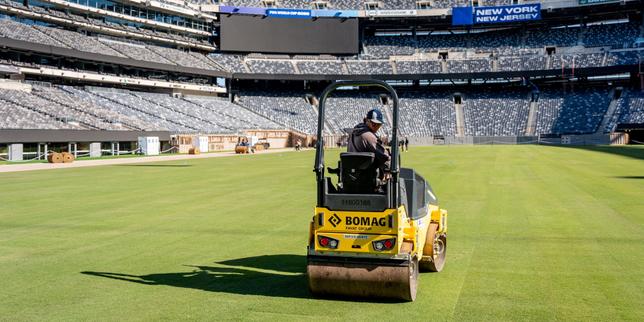
What you see on television isn't what players are feeling under their boots. From the upper decks and high-definition broadcast feeds, the playing surfaces at the 2026 World Cup look like immaculate green carpets. Step onto the pitch at Boston Stadium or New York New Jersey Stadium, though, and the illusion shatters.
Midway through the group stage, a quiet rebellion is brewing among the world's best football nations over the condition of these temporary fields. FIFA spent millions engineering a massive turf transformation across North America. Despite all that cash and scientific planning, the initial reviews from players and managers are far from glowing. Some call it rigid. Others say it's bone-dry.
The real issue stems from a structural clash between two completely different sports. The United States has world-class sports venues, but they were built for the violent, high-impact world of the NFL, not the fluid, rolling physics of global soccer. Forcing an American gridiron stadium to act like a traditional European football pitch takes more than just laying down a few rolls of sod. It requires complex engineering that, right now, is delivering mixed results.
The Hard Truth Under the Grass
To understand why players are complaining, you have to look at what sits beneath the surface. Eight of the host stadiums used in this tournament normally feature artificial turf. Because FIFA mandates 100% natural playing surfaces for the World Cup, these venues had to undergo radical retrofits.
The solution was supposed to be a marvel of modern agronomy. FIFA rolled out a specialized hybrid grass system composed of roughly 90% to 95% natural grass interwoven with 5% to 10% synthetic fibers injected 20 centimeters deep into the root zone. In theory, the roots wrap around these synthetic fibers, creating a durable matrix that survives heavy sliding tackles and intense traffic.
In practice, players are finding the ground unforgiving. Following France’s 3–1 victory over Senegal at New York New Jersey Stadium, midfielder Adrien Rabiot didn't hold back his frustration.
"I don't even know if you can call it grass," Rabiot remarked after the match. "The pitch felt like artificial turf. It was very hard and rigid."
French head coach Didier Deschamps backed up his midfielder, pointing out that an exceptionally hard, solid base layer underneath the grass was altering how the ball bounced and how players moved. It's not just a matter of cosmetic preference. A rock-hard base layer increases the shock absorbed by a player’s joints, leading to quicker fatigue and higher muscle soreness.
The Moisture Vanishing Act
It isn't just the hardness of the base causing headaches. The fields are drying out at an alarming rate during matches, completely changing the tactical speed of the game between the first and second halves.
Norway head coach Ståle Solbakken raised the alarm after his squad secured a 4–1 win against Iraq at Boston Stadium. He noted that the pitch was noticeably dry at kickoff and grew progressively worse as the minutes ticked by.
- Slowing the ball: Passes that would normally zip across a wet European pitch lose momentum rapidly.
- Sticking to the turf: Players have to exert more force just to move the ball, turning technical passing sequences into physical battles.
- Altering tactics: Teams that rely on fast, one-touch passing are forced to play more direct, long-ball football.
"The ball almost stuck to the grass," Solbakken complained. "It's not an excuse, it's simply a fact. The game became much slower because of it."
This sentiment was echoed across the continent by Brazilian star Vinícius Júnior. After Brazil fought to a grueling 1–1 draw against Morocco, the winger pointed directly to the high summer temperatures inside US stadiums. According to the Real Madrid forward, the heat caused the pitch moisture to evaporate almost instantly. By the second half, the ball was moving so slowly that maintaining an attacking rhythm became an uphill battle.
Not Every Stadium is Failing the Test
It would be unfair to say every venue is a disaster. The geographic variation across this tournament is immense, and some stadiums are getting it right.
Take Los Angeles Stadium. Unlike its East Coast counterparts, the field in Southern California earned rave reviews from the host nation. After the United States men's national team ground out a vital Group D victory over Paraguay, defender Antonee "Jedi" Robinson praised the field conditions.
"We were just talking about this in the locker room," Robinson said. "It's probably the best field I've ever played on in the States."
Why the massive discrepancy? The Los Angeles pitch features a blend of Kentucky bluegrass and perennial ryegrass that was grown at a specialized turf farm in Colorado for over a year. It was carefully transported across state lines in climate-controlled, refrigerated trucks and laid down over a different sub-base architecture.
Climate controls play a massive role too. At the fully enclosed AT&T Stadium in Dallas, the ground crews are using 18 massive rows of suspended LED grow lamps that bathe the field in a surreal pink glow for 18 hours a day. It is an expensive, high-tech effort to force photosynthesis where natural sunlight cannot reach. Yet, matching that level of consistency across 16 different cities with wildly different humidity levels, temperature zones, and stadium designs is proving nearly impossible.
The Major Backlash from American Football Players
While international soccer stars complain about the temporary grass being too hard or too dry, athletes in the United States are watching this tournament with a mix of awe and deep frustration.
For years, the NFL Players Association has begged team owners to ditch artificial turf. The union points to internal injury data showing a significantly higher rate of non-contact lower-extremity injuries on synthetic fields compared to natural grass. NFL owners historically pushed back, claiming that maintaining real grass in cold-weather northern cities or multi-use domed stadiums was an operational nightmare.
Then FIFA showed up. The soccer governing body essentially gave wealthy NFL owners an ultimatum: install real grass or lose out on hosting the biggest sporting event on earth. Suddenly, stadiums in Foxborough, East Rutherford, Atlanta, and Charlotte found the money and the technology to make grass work.
JC Tretter, the president of the NFL Players Association, highlighted the growing anger among American football players who see these pristine grass fields being rolled out exclusively for international soccer stars.
"Guys are going to be frustrated," Tretter stated plainly. "That will be a frustrating moment a few months from now where they see how quickly they roll back out the turf field in place of it."
The fact that these stadiums can transform their surfaces when hundreds of millions of dollars in soccer broadcasting rights are on the line proves that the barrier isn't technological. It's financial. Once the World Cup final concludes in July, most of these natural grass fields will be ripped up, thrown away, and replaced with synthetic turf just in time for the NFL preseason in August.
What Happens Next for Ground Crews
Ground crews don't have months to fix these issues. The tournament is moving fast, and the pressure from elite teams will only intensify as the knockout rounds approach.
Fixing a dry, sticky pitch sounds simple on paper: just turn on the sprinklers. In reality, overwatering a temporary grass field laid over a concrete or synthetic base creates a whole new set of dangerous problems. If the water cannot drain efficiently through the sub-base, the top layer of soil turns into mud. Trays of sod can begin to shift and slide under the weight of changing directions, creating massive tripping hazards and risking torn ligaments.
Tournament stadium managers are forced to adjust their preparation windows immediately. Expect to see groundskeepers running aggressive watering schedules exactly 45 minutes before kickoff and intensely soaking the fields during the 15-minute halftime window to combat the drying effects noted by Vinícius Júnior and Solbakken. Crews are also using specialized aeration techniques to poke tiny holes into the hard sub-base, attempting to soften the surface rigidity that drew Rabiot's anger.
The 2026 World Cup was supposed to showcase America's ability to host elite soccer seamlessly. Instead, it's exposing the limits of temporary sports engineering. For the teams trying to survive the group stage, navigating the unpredictable, shifting surfaces beneath their feet has become just as critical as beating the opponent lined up across from them.