Autonomous vehicles want you to believe they're completely ready for prime time. But throw a massive sporting event at them, and things fall apart fast.
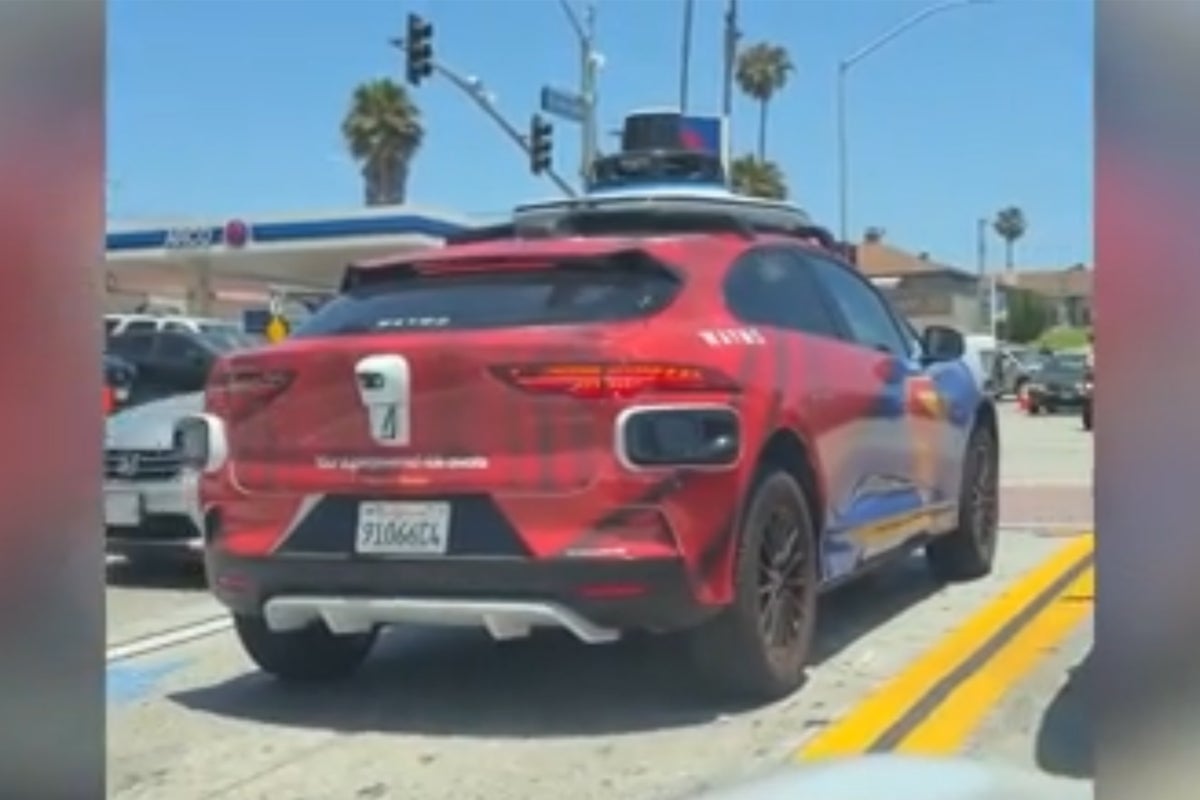
Recently, a Waymo self-driving taxi caught heading into oncoming traffic amid World Cup congestion became the latest viral headache for Alphabet's autonomous car division. It happened right in the middle of the World Cup rush in Inglewood, California, near Los Angeles Stadium. An eyewitness filmed the clean, white Jaguar I-Pace stranded on the wrong side of a double yellow line, staring down a line of baffled human drivers. The robotaxi completely blocked the lane, forced oncoming cars to wait through an entire green light cycle, and eventually made a clunky left turn to escape its own mess.
This isn't an isolated glitch. It's a fundamental flaw in how driverless cars handle human chaos.
When tens of thousands of soccer fans pour out of a stadium, standard traffic patterns vanish. People block intersections. Pedestrians ignore crosswalks. Traffic cops wave hands in patterns no machine learning model has ever seen. In those exact moments, the autonomous brain faces what engineers call an edge case. But for commuters trying to navigate game day, it's just a nightmare.
Let's look at exactly why these multi-million dollar machines freeze when the streets get tight, what the data actually says about their safety, and how you can avoid getting trapped in a gridlocked robotaxi bottleneck.
What Actually Happened in Inglewood
The viral video out of Inglewood shows a classic example of algorithmic panic.
As World Cup crowds swarmed the streets around SoFi Stadium, traffic backed up for miles. Human drivers did what human drivers always do during gridlock. They nudged forward, blocked lanes, and cut each other off to sneak through yellow lights.
The Waymo vehicle was trying to execute a standard left turn. But as the intersection filled with aggressive human drivers failing to yield, the vehicle's path was completely cut off.
A human driver in that situation evaluates the scene, realizes nobody is following the rules, and adapts. Maybe you back up a few feet. Maybe you catch the eye of the driver next to you and wave your way through.
The robotaxi did the exact opposite. It got bullied.
To avoid an immediate collision with a vehicle cutting it off, the Waymo vehicle swerved left. It optimized for one single rule: don't hit the car in front. By prioritizing that rule above all traffic laws, it steered itself directly into the oncoming traffic lane. Once there, it froze.
The car sat motionless, blindingly bright sensors spinning on its roof, while the light turned green for oncoming traffic. A delivery truck couldn't move. Multiple sedans were stuck. The human filming the encounter summed up the collective frustration of the entire block: "Waymo, what are you doing?"
Eventually, the vehicle figured out an exit path and cleared the lane, but the damage to public trust was already done.
The Mechanics of a Robotaxi Brain Freeze
To understand why this happens, you have to understand how a driverless car sees the world. Waymo relies on a massive suite of sensors. It uses LiDAR to shoot lasers out in every direction, mapping the structural world down to the millimeter. It uses radar to track velocity and cameras to read signs and lane markings.
All of that hardware feeds data into a driving policy engine. This engine is a complex system of rules and probabilistic models. It constantly calculates the cleanest, safest path forward.
But these models rely heavily on predictability. They expect cars to stay in lanes. They expect people to stop at red lights. They expect traffic to move in an orderly queue.
Stadium gridlock kills predictability.
When an intersection gets choked with vehicles, the sensory input goes into overdrive. The lasers bounce off a wall of bumpers. Cameras see pedestrians stepping off curbs twenty feet away. The algorithm tries to calculate a path that complies with its strict safety buffers.
Suddenly, it realizes every single available path violates a buffer.
Moving forward means getting too close to a bumper. Moving backward means risking a rear-end collision. Staying still means blocking traffic. When every option looks unsafe to the computer, the software hits a wall. The car halts. It waits for the world to start making sense again.
In the Inglewood incident, the car likely prioritized avoiding a side-impact collision from an aggressive driver. It chose the only open pocket of pavement it could find, which happened to be the oncoming lane. It didn't intentionally break the law. It simply lacked the spatial reasoning to understand that driving into oncoming traffic is vastly more dangerous than letting a human driver cut it off.
Human Traffic Controllers vs Machine Algorithms
The real breaking point for autonomous vehicles isn't the traffic itself. It's the people managing it.
During the World Cup matches in Los Angeles, traffic officers are deployed at almost every major intersection. They don't use standard traffic signs. They use whistles, hand gestures, and neon batons. They change the rules of the road on the fly. They might tell a line of cars to ignore a red light to clear an intersection, or force three lanes of traffic to merge into one across a solid white line.
Robots are notoriously terrible at reading human body language.
A Waymo vehicle looks at a traffic cop and struggles to differentiate between a hand waving them forward and a hand held up to mean stop. If the cop stands at a weird angle, or if their high-visibility vest reflects a LiDAR pulse unexpectedly, the car's perception system can misclassify the human entirely.
When a human officer actively commands an autonomous car to do something that violates its hard-coded map data, the car defaults to safety. It stops. This creates a dangerous paradox. By stopping in the middle of a chaotic intersection to be safe, the robotaxi becomes the biggest hazard on the road.
Local officials have noticed. First responders in cities like San Francisco and Phoenix have logged hundreds of incidents where autonomous vehicles blocked fire trucks, drove into active crime scenes, or refused to move for police officers. When you mix that structural confusion with the sheer volume of a global sporting event, incidents like the one in Inglewood become entirely inevitable.
Real World Numbers on Autonomous Vehicle Safety
Waymo frequently defends its technology by pointing to a massive mountain of safety data. And to be completely fair, their corporate studies show some impressive numbers when compared to human drivers.
- 85% reduction in injury-causing crashes compared to human benchmarks.
- 57% reduction in police-reported crash rates across millions of autonomous miles.
- Zero fatalities recorded across their commercial operations.
These metrics sound incredible on a corporate earnings call. But they hide a massive nuance.
Most human crashes happen because of speed, alcohol, distraction, or fatigue. Robots don't get tired. They don't drink beer, and they don't look at text messages while driving. So, of course they're better at driving down a empty suburban street at 2:00 AM.
Where humans excel is handling the bizarre, high-stress scenarios that happen near stadiums, construction zones, and accident scenes. A human driver rarely turns into an oncoming traffic lane and parks out of pure confusion. Humans make mistakes out of recklessness; robots make mistakes out of structural stupidity.
When an autonomous vehicle fails, it fails in ways that defy human logic. That's why the public reaction to a video like the Inglewood wrong-way drive is so intensely hostile. We can understand a human making a bad turn because they were rushing. We can't tolerate a machine paralyzing a public road because its software couldn't solve a math problem.
How to Protect Yourself as a Passenger or Commuter
If you live in a city with active robotaxi fleets, or if you're traveling to a major event like the World Cup, you need to change how you navigate the streets. You can't treat an autonomous vehicle like a traditional Uber or Lyft.
Here is how you actually handle the realities of driverless transport on the ground right now.
Skip the Robotaxi on Game Day
If you're within a two-mile radius of a stadium event, don't hail a driverless car. The algorithm will almost certainly struggle with the drop-off zones and pedestrian crowds. Stick to public rail lines, designated shuttle buses, or human drivers who can negotiate with traffic cops.
Know the Emergency Steps Inside the Car
If you find yourself in a Waymo that enters an oncoming lane or freezes in an intersection, don't panic. Look at the center console screen. There is a prominent, physical "Pull Over" button and a support button. Pressing the support button connects you instantly to a remote human operator.
Understand the Remote Assistance Myth
Many people think a remote operator can just take a joystick and drive the car out of trouble. They can't. Due to latency and safety regulations, remote operators cannot steer the vehicle in real-time. They can only approve a new path or drop a new waypoint for the car's internal system to try to execute. If the car is physically blocked or fundamentally confused, you will have to wait for a physical roadside assistance team to arrive.
Give Them Space on the Road
If you're driving a personal vehicle and see a robotaxi ahead in heavy traffic, assume it will do something unpredictable. Don't tailgate them. If a robotaxi is trying to merge or make a turn in a crowded intersection, give them wide berths. Aggressive human driving actively triggers the defensive halting mechanisms in these vehicles, which just makes the gridlock worse for everyone behind them.
The promise of an accident-free, fully automated transportation grid is incredibly alluring. But the reality on the asphalt in 2026 is messy, confusing, and deeply human. Until autonomous systems can look at a chaotic street corner and understand the social contract of driving, they will continue to freeze up the moment the stadium lights turn on.