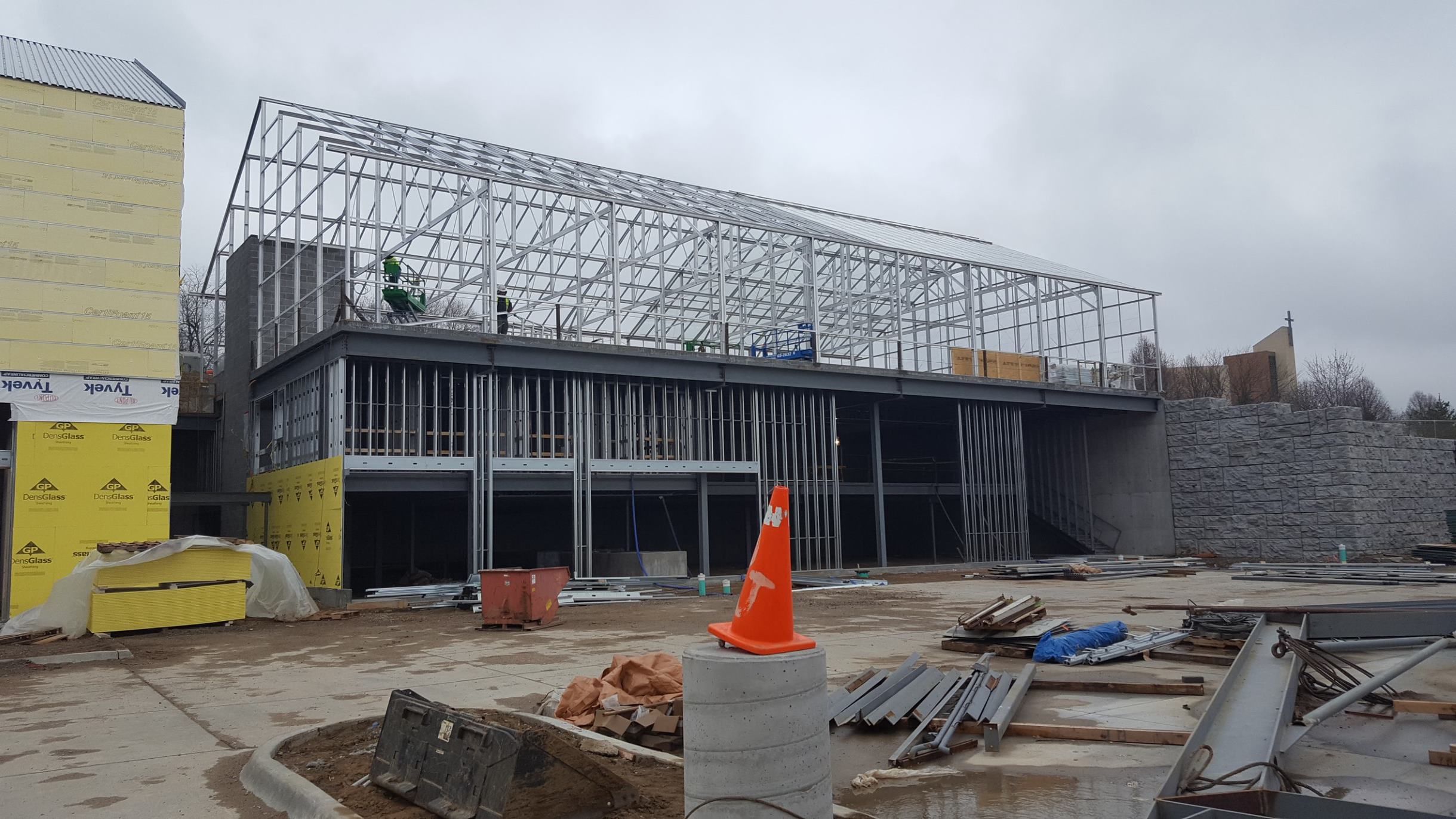
The floorboards do not merely creak; they speak in a language of deep, resonant groans that suggest a century of weight. On a Tuesday afternoon in Omaha, the light slants through high windows, catching the steady drift of dust motes that dance over polished concrete and reclaimed wood. There is a specific smell here—a mixture of cold pressed coffee, old brickwork, and the electric ozone of a city reinventing itself. A young woman sits at a long communal table, her fingers hovering over a keyboard while her gaze drifts toward the expansive glass that frames the North Omaha skyline. She is not just working on a spreadsheet. She is anchored in a space designed to prove that geography is not destiny. This place, known formally as The Venue at Highlander Accelerator, serves as the physical heartbeat of a neighborhood that refused to be forgotten. It is a room that feels both impossibly large and intimately quiet, a paradox of civic ambition and personal sanctuary.
The history of this land is not a straight line. It is a series of erasures and redrawings. Decades ago, this specific ridge was defined by the towering presence of the Pleasantview Homes, a public housing complex that became a shorthand for the systemic neglect that often follows the flight of capital. By the time the last of those brick towers fell in 2008, the area was a literal void on the map. But a void is also a clearing. What replaced the old structures was not a generic strip mall or a gated enclave, but a deliberate ecosystem designed to bridge the gap between the historic community and the burgeoning tech and creative economies of the Midwest. The structure standing here now is an intentional rebuke to the idea that high-design and high-opportunity belong only to the downtown cores or the sprawling suburbs. Meanwhile, you can explore other events here: What Most People Get Wrong About California E-Bike Laws.
Walking through the central corridor, one notices how the architecture prioritizes sightlines. There are no dark corners or windowless rooms where decisions are made in secret. Transparency is baked into the drywall. To understand why this matters, one has to look at the data of urban displacement. According to urban sociologists like Matthew Desmond, the stability of a physical environment is the primary predictor of economic mobility. When a neighborhood has a center—a place where a grandmother can attend a wedding reception in the same hall where a teenager learns to code—the social fabric tightens. This building acts as that needle, threading together disparate lives through shared physical reality.
The Purpose of The Venue at Highlander Accelerator
To call it a community center would be an understatement that misses the point of its sophisticated engineering. The space was conceived as a multi-generational engine, a "third place" that bridges the gap between the domesticity of home and the rigor of the workplace. On any given day, the demographic shift within these walls is a living census of the city’s potential. In the morning, it belongs to the entrepreneurs, the quiet hum of laptops and the clinking of ceramic mugs providing a soundtrack for the start-up culture. By mid-afternoon, the energy shifts. The air grows louder as students arrive, their backpacks thudding onto the floor as they transition from the structure of the classroom to the autonomy of the commons. To see the bigger picture, we recommend the detailed article by Glamour.
The designers understood that dignity is often found in the details. They chose materials that would age gracefully—steel that patinas, wood that holds the memory of touch. They avoided the sterile, plastic aesthetic of many municipal buildings, opting instead for a warmth that invites people to linger. This is a critical psychological component of urban renewal. If a space looks temporary, the people within it feel temporary. By investing in permanent, high-quality finishes, the developers sent a silent but powerful message to North Omaha: you are worth the investment of beauty.
The Mechanics of Gathering
The internal logic of the layout encourages accidental collisions. In the world of innovation, these are often cited as the primary drivers of success—the chance meeting at the water cooler that leads to a new partnership. Here, those collisions happen between a local non-profit leader and a freelance graphic designer, or between a high school senior and a retired educator. The spatial arrangement forces a recognition of the "other" that is rarely found in the siloed environments of modern digital life. You cannot ignore the humanity of your neighbor when you are sharing the same sunlight.
The acoustics are perhaps the most impressive technical feat of the construction. Despite the hard surfaces and the open-concept design, the sound does not bounce or shatter. It stays contained, creating pockets of privacy within a public expanse. This allows for a unique layering of activity. A quiet conversation about a business loan can happen ten feet away from a boisterous group of friends catching up over lunch, and neither party feels like an intruder. It is a masterclass in social engineering through sound dampening.
Economic analysts often speak of "anchor institutions"—universities, hospitals, or large corporations that provide a foundation for local economies. But there is a growing movement in urban planning to recognize "social anchors." These are the places that provide the emotional and cultural stability necessary for those economic anchors to thrive. Without a place to gather, a neighborhood is just a collection of houses. Without a place to celebrate, a community is just a demographic. The structure serves as the physical proof that the social contract is still being signed and renewed every morning when the doors are unlocked.
A Vision Captured in Glass and Steel
If you stand at the far end of the hall as the sun begins to set, the entire building seems to glow from within. The "Highlander" name itself is a nod to a legacy of education and social justice, and the physical manifestation of that legacy is unmissable. It sits on a hill, looking out over the city, not as a fortress, but as a lighthouse. The choice of the site was no accident. Elevation matters. For a community that has often been looked down upon, both metaphorically and literally, standing on the high ground is a revolutionary act.
The project was the result of a complex choreography between private philanthropy, city government, and community activists. It represents a massive investment—tens of millions of dollars—into a zip code that had seen more exits than entries for half a century. But the return on that investment is not measured in traditional dividends. It is measured in the "stickiness" of the neighborhood. Are people staying? Are they building lives here? The data suggests they are. Since the completion of this phase of the development, property values in the immediate vicinity have stabilized, and more importantly, the rate of local business starts has seen a measurable uptick.
Yet, numbers are cold comfort to the person who needs a place to belong. The true success of the design lies in its accessibility. There are no velvet ropes here. There is no sense of "exclusive" membership that characterizes many of the modern co-working spaces in larger coastal cities. It is a democratized luxury. The high ceilings and designer furniture are not there to intimidate; they are there to elevate the daily experience of the people who walk through the doors. It is an argument that high-quality architecture should be a public good, not a private privilege.
The lady at the communal table finally closes her laptop. She stretches, her shadow lengthening across the concrete floor as the afternoon light turns a deep, bruised purple. She greets the janitor by name, a brief exchange about the weather and the upcoming weekend. This interaction, small and seemingly insignificant, is the entire point. In a world that is increasingly fractured and digitized, the physical venue remains the final frontier of human connection. You can build a network online, but you cannot build a home there.
We often forget that buildings are just containers for human intent. They can be built to exclude, or they can be built to invite. They can be monuments to the past, or they can be bridges to a future that hasn't quite arrived yet. As the city of Omaha continues to expand and evolve, this ridge stands as a reminder of what is possible when design is used as a tool for equity. It is a place where the history of a neighborhood meets the ambition of its children, and for a few hours every day, the gap between the two vanishes entirely.
The lights inside begin to flicker on, one by one, reflecting in the dark glass. From the street, the building looks like a lantern held against the coming night. Inside, the last of the afternoon's coffee is poured, the final emails are sent, and the quiet hum of the building settles into a peaceful stasis. Tomorrow, the floorboards will speak again, the sun will hit the reclaimed wood, and the cycle of building, dreaming, and gathering will begin anew.
The woman walks out into the cool evening air, the heavy door clicking shut behind her with a sound of absolute