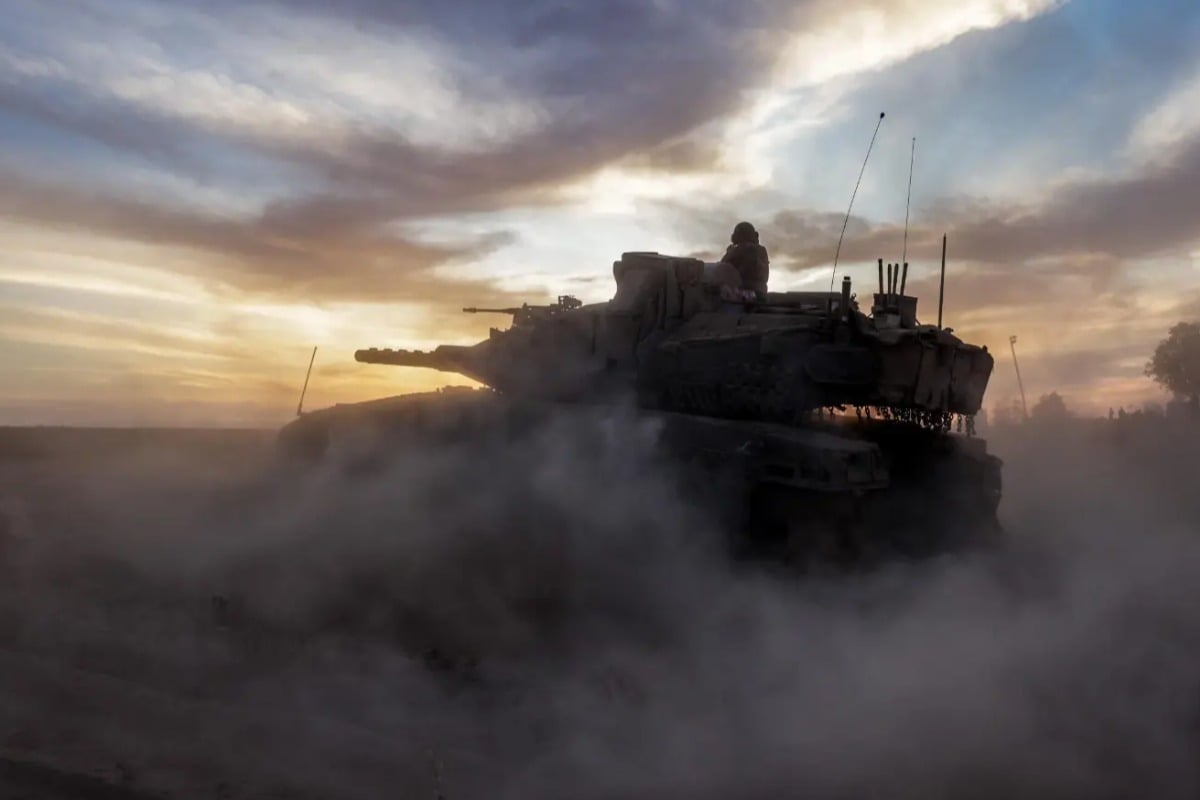
The internet loves declaring the death of the tank. Every time a video emerges showing a cheap loitering munition tearing through an armored roof, the armchair generals rush to write the obituary of heavy armor. They are wrong.
The tank isn't dying. It's adapting.
If you look at modern conflict zones, armored vehicles remain indispensable for taking and holding ground. What has changed radically is the timeline of threat evolution. The old defense procurement cycle—where a nation takes a decade to design a tank, builds it to face a specific adversary, and keeps it unchanged for twenty years—is entirely broken. Today, threats mutate in weeks, not decades.
To survive, the armor on the battlefield must change just as fast as the dangers it faces. This means the future of armored warfare isn't about thicker steel. It's about smart, open architectures that allow hardware and software to be swapped out overnight.
The Blind Spot Problem on Modern Battlefields
Historically, a tank crew's biggest worry was another tank hiding in the tree line or an anti-tank missile team firing from a distant ridge. Today, danger comes from every conceivable angle. FPV drones drop explosives into open hatches, loitering munitions strike the thin top armor, and improvised explosive devices target the underbelly.
When crews close their hatches to protect themselves, they lose their vision. They become blind.
Recent operational data from urban combat zones shows that vehicles lacking advanced situational awareness are incredibly vulnerable. If you can't see a threat coming from a high-angle urban window or a drone hovering directly overhead, your active protection systems and heavy armor won't save you.
IMCO Industries, a long-time subsystem supplier for platforms like the Merkava and the Arjun main battle tanks, has focused heavily on this specific gap. The company's recent development of the SAVS 360 (Situational Awareness Video System) highlights exactly where the industry is heading. The goal isn't to build a better tank from scratch, but to give existing platforms an electronic "skin".
By utilizing ruggedized external cameras coupled with an artificial intelligence video matrix, the system feeds a continuous, real-time 360-degree view directly to the crew's internal smart displays. The driver and commander can operate completely buttoned up while seeing everything around them. More importantly, the AI prioritizes threats. If a drone approaches from the rear quadrant while the crew is focused on a target ahead, the system flags the high-priority danger instantly.
Why Upgrades Must Happen in the Field
The traditional defense industry is terrible at speed. If a military needs a new radio system, the bureaucracy usually demands years of testing, budget reviews, and integration cycles.
Modern battlefields don't give you years. If an enemy changes their drone transmission frequencies on a Tuesday, your jamming and detection systems need an update by Thursday.
This reality shifts the focus from massive vehicle platforms to modular sub-systems. The underlying power distribution, wire harnesses, and computing architecture within the tank must be built like an open-ended puzzle. If the physical backbone of the vehicle is modular, adding a new remote weapon station, an active protection system, or an anti-drone jammer requires minimal footprint and effort.
Consider older fleets like the American Stryker or various wheeled howitzers. Replacing thousands of these vehicles because they lack modern drone defenses is financially impossible for most nations. The pragmatic approach is retrofitting. By installing centralized sensor interfaces and scalable power management units, older hulls get a second life. They can host loitering munitions or directed-energy defense systems without requiring a complete redesign of the chassis.
The Logistics Nightmare Nobody Talks About
Everyone focuses on the weapons, but the real bottleneck in prolonged conflict is keeping the machines running. A tank that breaks down due to a failed internal component is just an expensive stationary target.
Traditional maintenance relies on fixed schedules—change the oil after X hours, replace the part after Y miles. Modern systems are moving toward Health and Usage Monitoring Systems (HUMS) paired with predictive logistics.
By embedding sensors across the vehicle's critical infrastructure (power distribution, engine components, and weapon actuators), onboard computers analyze data in real-time. Instead of waiting for a part to fail on the front line, the system triggers condition-based alerts. Logistics teams know exactly what component needs replacing before the vehicle even pulls back to a maintenance depot. This minimizes unnecessary downtime and keeps fleet availability high when things get messy.
The Real Future of Heavy Armor
The tank of the future won't just be an isolated island of steel and firepower. It functions as a mobile command node.
Platoon leaders can't just look out their own periscopes anymore; they need a unified overview of every vehicle, drone, and infantry squad in their unit. When all protection systems, remote weapon stations, and situational awareness cameras link into a single network, the entire unit fights more cohesively.
If an enemy anti-tank team fires at Tank A, the flash is instantly picked up by Tank A's 360-degree sensors. That data seamlessly populates on the target screens of Tanks B and C, allowing them to return fire before the enemy can reload. That is how you survive the modern threat matrix. It's not about making the armor thicker; it's about making the reaction time faster than the enemy's loop.
Your Next Operational Steps
If you are involved in defense procurement, systems integration, or fleet modernization, stop looking for the silver bullet vehicle. Focus on the architecture instead.
- Audit Current Power Margins: Before buying new electronic warfare or active protection systems, ensure your vehicle's current power distribution systems can actually handle the electrical load.
- Prioritize Open Software Architectures: Reject proprietary vendor ecosystems that lock you into slow, multi-year update cycles. Insist on modular interfaces where third-party AI or sensor software can be patched in days.
- Implement 360-Degree Retrofits Immediately: Do not wait for next-generation platform arrivals. Equip existing operational hulls with plug-and-play situational awareness systems to counter current high-angle and drone threats.