Switzerland is watching its ancient ice sheets literally liquefy before its eyes. This isn't a slow problem for future generations to fix. It is happening right now, in the middle of a brutal European heatwave that has completely shattered historical norms.
If you think glacier loss is just about losing scenic views for alpine skiers, you are missing the point entirely. The rapid destruction of these ice structures compromises the water security of the entire European continent. It destabilizes mountain ranges, causing catastrophic rockfalls that bury entire villages.
The situation has progressed far beyond gentle warnings from scientists. The data coming out of Swiss research stations shows we have crossed into unchartered, dangerous territory.
The Madness of an Early Glacier Loss Day
Glaciologists use a specific, chilling term to measure how fast an alpine freeze is dying. They call it glacier loss day. This milestone marks the exact calendar date when all the fresh snow and ice accumulated over the previous winter completely melts away.
Once a glacier hits this point, it is stripped completely naked. Every single ray of sunshine from that day until October eats directly into the permanent, ancient ice core.
Historically, this tipping point didn't happen until late August. It gave the high-altitude peaks a thick, protective blanket of white winter snow for most of the hot summer season.
This year changed everything. Glaciologist Matthias Huss, who heads the Glacier Monitoring Switzerland (GLAMOS) network, revealed that Switzerland hit its glacier loss day on June 29.
Think about that timeline. It is June. The peak heat of July and August hasn't even arrived yet, but the defensive shield is already completely gone.
The only time in recorded history that this happened earlier was during the horrific heatwave of 2022. This year is tracking almost identically to that worst-case scenario. Meltwater is currently rushing off the mountains at a staggering speed. It equals the volume of an Olympic-sized swimming pool every six seconds.
The ice cannot survive this sustained assault. It is physically impossible.
The Compounding Math of a Melting Peak
To understand why this is happening so fast, you have to look at the winter that preceded this summer. Glaciers rely on a very simple balancing act. They need massive amounts of heavy winter snow to rebuild their mass and cover their older ice.
The winter season didn't deliver. Switzerland received roughly 25% less snow on its glaciers compared to the average recorded between 2010 and 2020.
Some parts of the northern and central Grisons regions saw the lowest fresh snow depths ever recorded. A warm winter meant that what little precipitation fell often arrived as rain rather than snow, even at high elevations.
Then came May. It brought unseasonably high temperatures that hit 30°C in the lowlands. This early warmth stripped away the thin snow cover months ahead of schedule.
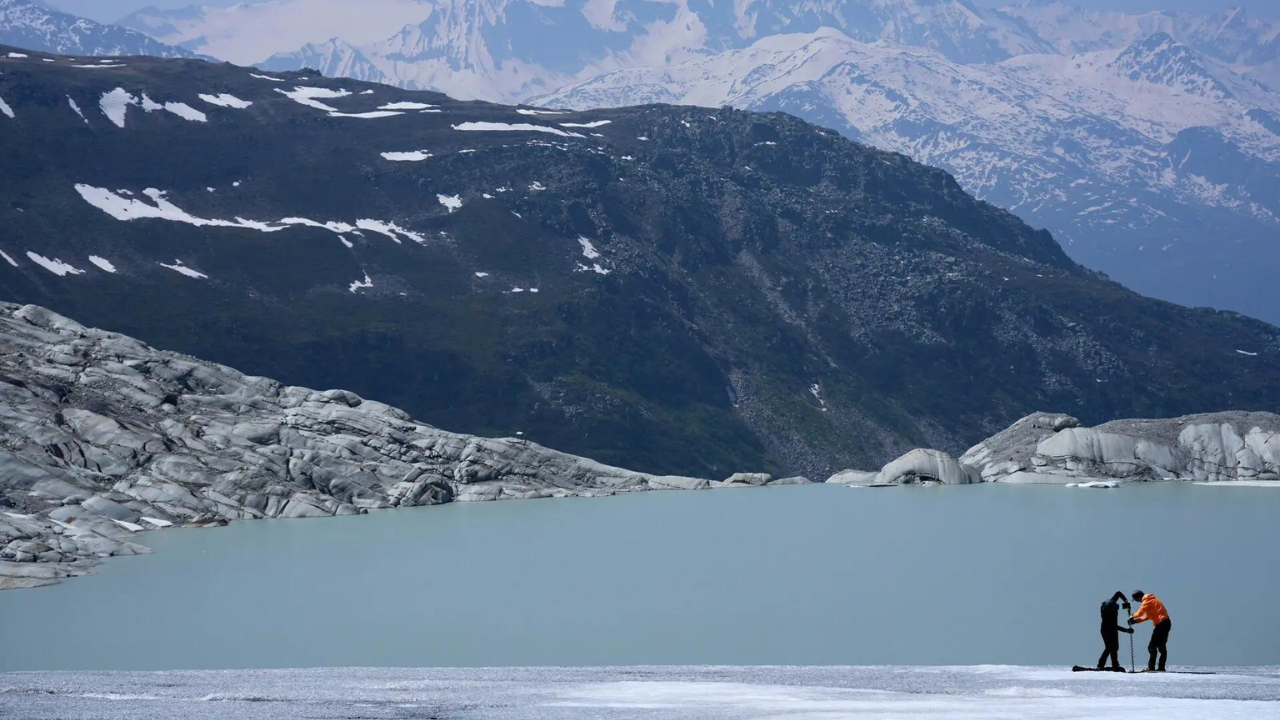
When researchers from ETH Zurich visited the famous Rhone Glacier recently, they found a horror show. A vertical meter of solid, ancient ice had melted away in just ten days. That is ten centimeters of permanent ice vanishing every single day from a single heatwave.
One isolated heatwave is bad. A series of back-to-back heatwaves without any recovery periods is lethal. The sheer duration of modern heat spells gives the high altitudes absolutely no time to refreeze at night.
The Dark Snow Feedback Loop
The speed of the current decline is accelerated by a phenomenon that many people completely overlook. It involves dust storms from the Sahara Desert.
Back in March, strong atmospheric winds carried massive plumes of fine, orange sand across the Mediterranean, dumping it directly onto the white Alpine peaks.
This created a major problem for the ice. Clean, white snow acts like a giant mirror. It reflects up to 90% of the sun's solar radiation back into space. Scientists call this the albedo effect.
When you coat that brilliant white snow in a layer of dark Sahara dust, you ruin its reflectivity. The darkened surface begins to absorb heat like a black asphalt driveway on a summer afternoon.
As the dirty snow melts rapidly, it exposes the bare, grey glacier ice underneath. This ice is naturally darker and filled with trapped rocks and sediment, absorbing even more solar energy.
It is a vicious feedback loop. The faster the snow melts, the darker the glacier gets. The darker the glacier gets, the faster it melts.
The Swiss Cheese Collapse
The destruction isn't just happening on the surface. The internal architecture of these ice bodies is failing completely.
In past decades, a healthy glacier was a dynamic, moving river of ice. High-altitude snow compacted into heavy firn, creating immense pressure that pushed the ice downward to replenish the lower tongues.
That dynamic movement has ground to a halt on hundreds of mountains. Because the melting zone has climbed to the absolute summits, the ice is no longer regenerating from above.
Instead of flowing, the glaciers are sitting completely stagnant. They are essentially massive, dead ice patches melting away right where they stand.
This lack of movement causes water turbulence at the bottom of the glacier. Air currents begin to carve massive, hollow caverns straight through the core of the ice.
From the outside, the glacier looks solid. Inside, it is structural chaos. The ice becomes structurally identical to Swiss cheese. Hollow tunnels grow larger and larger until the roof can no longer support its own weight.
Suddenly, entire sections collapse in on themselves. This creates massive craters visible from the surface, signaling that the glacier is rotting from the inside out.
Beyond Tourism and Into the Downstream Water Crisis
Many people view the loss of Alpine ice as a localized tragedy for Switzerland or a problem for luxury ski resorts. That view is dangerously short-sighted.
The Swiss Alps function as the literal water tower of Europe. The meltwater flowing from these peaks feeds some of the most critical river systems on the entire continent, including the Rhine, the Rhone, and the Danube.
Millions of people depend directly on these rivers for drinking water. Industrial manufacturing relies on them for cooling infrastructure. Agricultural networks use them to irrigate crops across France, Germany, and Italy.
When the glaciers disappear, these rivers lose their summer baseline flow. During intense heatwaves, when rain is scarce, glacier meltwater is the only thing keeping these major waterways navigable.
Without that steady icy input, river levels plummet. This disrupts international shipping routes, starves agricultural zones of water, and drives up energy costs because nuclear and hydroelectric power plants cannot cool their systems properly.
The danger hits closer to home too. As the ice melts and the surrounding permafrost thaws, the structural glue holding these mountains together dissolves.
We are already seeing the consequences. In valleys like the Lötschental, massive avalanches of mixed rock and ice have roared down the mountainsides, burying infrastructure and threatening communities like the village of Blatten. The mountains are quite literally falling apart.
The Long Decline of a National Identity
The historical data paints a grim picture. Swiss glaciers have been retreating gradually since the end of the Little Ice Age around 170 years ago.
The modern rate of decline is unprecedented. Between the years 2000 and 2024, the total volume of Switzerland's glaciers shrank by a staggering 38%.
The sheer number of individual glaciers lost is difficult to comprehend. Over the past 50 years alone, Switzerland has lost around 1,200 small glaciers.
Today, only about 1,300 remain. The ones that disappeared were admittedly smaller bodies of ice, but they were vital water regulators for peripheral alpine valleys.
If the current warming trajectory continues along the path it has carved over the last few decades, the outlook for the end of the century is bleak. By the year 2100, the Swiss Alps will be almost entirely bare. Only tiny, insignificant remnants of ice will survive at the absolute highest peaks of the Matterhorn or Mont Blanc.
Real Steps to Face a Changing Mountain Environment
We have passed the point of hoping to save every glacier. The climate inertia guarantees that we will continue to lose massive volumes of ice over the coming decades regardless of immediate emission cuts.
Mitigation and survival require practical, decisive changes in how we manage mountain regions and water infrastructure.
- Overhaul downstream water management systems immediately. European nations must build larger regional reservoirs to capture winter rainfall, replacing the natural water storage previously provided by seasonal ice.
- Deploy advanced, automated sensor networks on vulnerable alpine slopes. Real-time tracking of permafrost temperatures and rock movement can provide early warnings before catastrophic landslides hit valley towns.
- Enact aggressive, legally binding carbon reduction targets globally. While local conservation efforts like covering small glacier tongues with white fleece blankets look good in photos, they are useless stopgaps. The only thing that slows the melt is reducing the atmospheric heat driving it.
The melting of the Swiss Alps is a stark, undeniable indicator of global climate rebalancing. The ice is telling us exactly where we stand. We either adapt our infrastructure to this new reality or we suffer the downstream consequences.