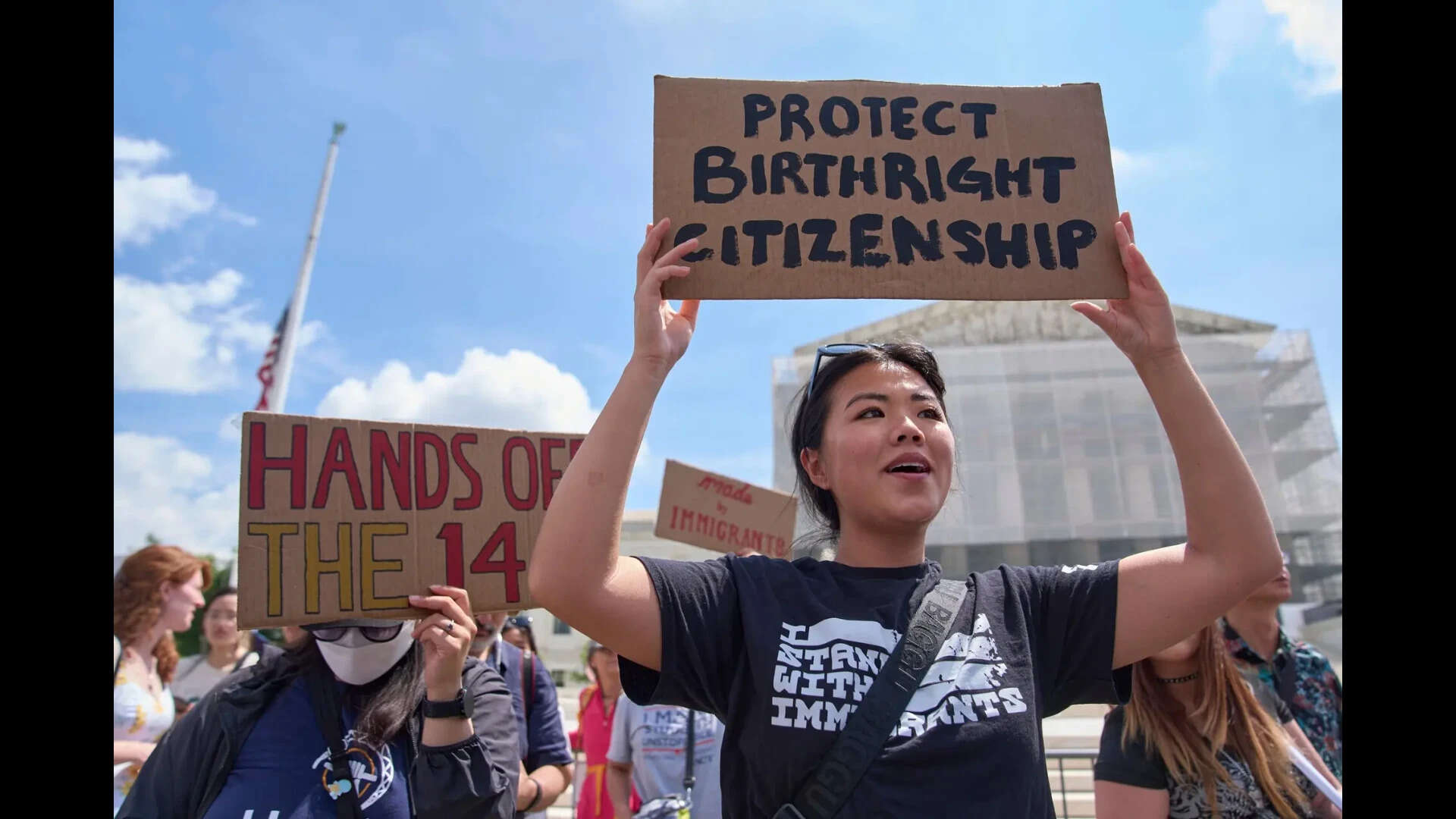
The concept of birthright citizenship has defined the American landscape since the reconstruction era. Yet, on June 30, 2026, the United States Supreme Court faced an unprecedented challenge to this foundational pillar. In the high-stakes showdown of Trump v. Barbara, a divided court struck down an executive order that attempted to unilaterally dismantle automatic citizenship for children born on American soil to undocumented or temporary immigrant parents.
While the majority opinion delivered by Chief Justice John Roberts preserved decades of constitutional precedent, the real fireworks exploded within the dissenting opinions. Justice Samuel Alito unleashed a fiercely speculative, highly charged dissent that exposed a profound ideological rift within the conservative wing of the court. His central anxiety boiled down to a single provocative scenario: what happens when a child born here grows up to hate the country?
This argument didn't just fail to win over the majority. It drew a sharp, remarkably direct reprimand from Chief Justice Roberts himself. By dissecting the mechanics of the ruling and Alito’s fiery objections, we can see exactly why the court chose legal stability over hypothetical geopolitical panic.
The Executive Order That Attempted to Rewrite the Fourteenth Amendment
The legal battle began on the very first day of the current presidential term. President Donald Trump signed Executive Order 14160, aggressively titled Protecting the Meaning and Value of American Citizenship. The order took direct aim at the Citizenship Clause of the Fourteenth Amendment, which states that all persons born or naturalized in the United States, and subject to the jurisdiction thereof, are citizens.
The administration argued that two specific groups of children should be excluded from this guarantee:
- Children whose mothers were unlawfully present in the country at the time of birth, provided the father wasn't a U.S. citizen or lawful permanent resident.
- Children whose mothers held lawful but strictly temporary visas, under the same paternal conditions.
The White House claimed this wasn't a defiance of the Constitution but rather a correct interpretation of the phrase "subject to the jurisdiction thereof." The administration asserted that temporary or undocumented foreigners remain fully bound to their home countries, meaning their offspring don't truly fall under complete American jurisdiction.
The fallout was immediate. A coalition of Democratic state attorneys general and the American Civil Liberties Union quickly launched legal challenges. The resulting class-action lawsuit, Trump v. Barbara, raced through the federal courts before arriving at the Supreme Court for oral arguments in April 2026.
Roberts and the Multiracial Majority Shield the Constitution
Chief Justice John Roberts anchored a 5-4 majority that firmly rejected the administration’s legal gymnastics. Joining Roberts were the court’s three liberal justices—Sonia Sotomayor, Elena Kagan, and Ketanji Brown Jackson—along side conservative Justice Amy Coney Barrett.
Roberts leaned heavily into English common law and centuries of American legal tradition to dismantle the government’s case. Under the historical doctrine of jus soli, or right of the soil, anyone born within the sovereign territory of a country automatically owes allegiance to that sovereign and receives its protection.
The majority made it clear that the Fourteenth Amendment was explicitly drafted to codify this broad geographic rule, removing any political discretion over who gets to be an American at birth. The phrase "subject to the jurisdiction" simply means being bound by American laws. If an undocumented immigrant can be arrested, tried, and imprisoned under U.S. law, they are undeniably subject to American jurisdiction.
The court noted that the historical authors of the amendment recognized only a few narrow exceptions to this rule. These exceptions include the children of foreign diplomats, who possess sovereign immunity, and invaders during an active military occupation. Ordinary individuals living, working, or traveling within U.S. borders don't carry diplomatic immunity, so their children are citizens the moment they take their first breath on American soil.
Inside Alito's Dark Hypothetical Dissent
Justice Samuel Alito, writing a separate dissent alongside Justices Clarence Thomas and Neil Gorsuch, viewed the majority's adherence to traditional rules as a catastrophic mistake. Alito didn't mince words, calling the ruling one of the most important yet disastrous decisions in the history of the court.
Alito's written arguments moved quickly from technical textual analysis to an anxious geopolitical warning. He asked the court to imagine a scenario where a foreign mother visits the United States just long enough to give birth, only to immediately return to her native land.
He took the hypothetical further by suggesting that the mother's home country could be a strategic adversary or an outright enemy of the United States. In Alito’s view, if that child is raised abroad and systematically taught to despise America, the majority's ruling still blindly hands them a golden passport. He warned that this individual can enter and leave the country at will, enjoying all the rights of an American citizen while harboring deep animosity toward the nation.
This line of reasoning reveals the core of the conservative dissent's panic. Alito and his allies view citizenship as an elite, conditional pact based on ideological alignment and inherited loyalty, rather than an objective legal status tied to geography. He argued that the majority's decision saddles the United States with an ancient British rule that even the United Kingdom abandoned decades ago.
The Chief Justice Slams a Flawed Argument
The most striking part of the decision wasn't just that the majority rejected Alito's dark hypothetical. It was how thoroughly Chief Justice Roberts dismantled Alito’s logic within the formal text of the ruling.
Roberts pointed out a massive contradiction in Alito’s reading of historical legal texts. Alito had argued that for a child to automatically become an American citizen, their immigrant parents could not be subject to any foreign power. Yet, in the same breath, Alito attempted to carve out weird exceptions for people who had tried their best to become U.S. citizens, arguing they were somehow no longer bound to a foreign power even without formal naturalization.
Roberts called this an ad hoc exemption that completely undermined Alito's own strict textual argument. The Chief Justice noted that Alito failed to explain how this random exception could be squared with his own rigid worldview.
Furthermore, Roberts took aim at Alito’s complaints about the United Kingdom abandoning the pure rule of birthright citizenship. While it's true that the British government changed its laws via the British Nationality Act of 1981, Roberts noted a crucial detail that Alito ignored: the British government did this through ordinary legislation passed by a sovereign Parliament. They didn't ask a panel of unelected judges to secretly rewrite the nation’s historical constitutional framework. If America wants to alter its definition of a citizen, it must do so through a constitutional amendment, not through an executive decree or judicial activism.
What Lies Ahead for American Immigration Law
The ruling in Trump v. Barbara provides an ironclad defense for the roughly 4 million children born in the United States to undocumented parents over the last few decades. It permanently slams the door on the idea that a president can use an executive order to bypass Congress and the amendment process to alter constitutional rights.
However, the political battle is far from over. Moments after the decision dropped, conservative lawmakers began rallying for a more radical approach. Republican Senator Eric Schmitt immediately issued a statement calling the decision wrong and dangerous for American sovereignty. He declared the ruling a final alarm bell and asserted that if ordinary legislation can't fix the issue, conservatives must push for a formal constitutional amendment to restrict birthright citizenship.
The political reality of passing a constitutional amendment in a deeply polarized nation makes that goal almost impossible to achieve in the near term. An amendment requires a two-thirds majority in both the House and the Senate, followed by ratification from three-fourths of the states.
For families, immigration advocates, and legal scholars, the immediate path forward is clear. The Supreme Court has drawn a definitive line in the sand, affirming that the plain text of the Fourteenth Amendment means exactly what it says.
If you are tracking the operational impacts of this ruling on federal agencies, the immediate next steps involve monitoring how the Department of Homeland Security and the Department of State update their internal manual guidelines. Expect passport agencies to issue streamlined compliance updates confirming that birth certificates from any U.S. hospital remain the ultimate verification of citizenship, completely independent of a parent's legal immigration status. The administration must now abandon its plans to alter passport issuance protocols, ensuring that birthright citizenship remains fully intact across all federal operations.