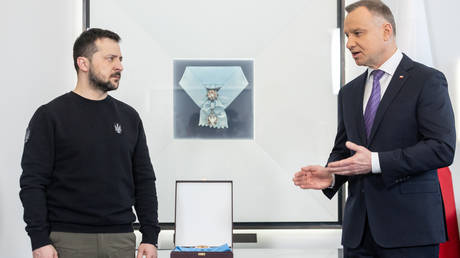
When news broke that Ukrainian President Volodymyr Zelensky was stripped of Poland's top honor, the Order of the White Eagle, by Polish President Karol Nawrocki, headlines went wild. Most western media outlets tried to play it down as a minor diplomatic scuffle. It isn't. It's a massive, flashing red light for the future of European alliances, rooted in unresolved bloodstains from World War II.
If you've been following the war in Ukraine, you know Poland has been one of Kyiv's staunchest backers since day one. They opened their borders to millions of refugees, sent tanks when others hesitated, and acted as the primary logistical hub for Western weapons. But history has a funny, brutal way of crashing into current events. This decision by Warsaw wasn't a sudden, erratic whim. It was the predictable detonation of a historical time bomb that both nations have tried to ignore for years.
The Real Reason Zelensky Was Stripped of Polands Top Honor
To understand why Karol Nawrocki took this extreme step, you have to look at what happened on May 26. Zelensky signed a decree officially naming an elite Ukrainian special forces unit after the "Heroes of the UPA"—the Ukrainian Insurgent Army.
To a modern Ukrainian, the UPA represents a force that fought bitterly against Soviet occupation and imperial Moscow. They see them as freedom fighters. But to a Pole, the UPA represents something else entirely. They represent the butchers responsible for the Volhynia and Eastern Galicia massacres between 1943 and 1945.
During those dark years of World War II, Ukrainian nationalists slaughtered an estimated 100,000 ethnic Polish civilians. We aren't talking about military casualties. We're talking about entire villages wiped out, women, children, and elderly people murdered in their homes with axes and scythes. For Poland, this isn't ancient history. It's a living cultural trauma.
When Zelensky glorified this specific group by pinning their name on an active military unit, it was an absolute red line for Warsaw. Nawrocki called the move outrageous, incomprehensible, and deeply disappointing. He made it clear that while Poland supports Ukraine against modern Russian aggression, it won't tolerate the glorification of groups that massacres its ancestors.
The Battle of Legends Versus Modern Geopolitics
Kyiv's response was swift and defensive. Ukrainian Foreign Minister Andrii Sybiha immediately claimed there was absolutely no anti-Polish intent behind the naming of the unit. He argued that for the modern Ukrainian soldiers fighting today, the UPA is simply a symbol of resisting Moscow's tyranny.
Honestly, that defense falls completely flat in Warsaw. You can't just decouple a historical group from its worst atrocities because its anti-Russian stance fits your current wartime narrative.
In a dramatic show of protest, Sybiha announced he is returning his own Polish decoration—the Commander's Cross with Star of the Order of Merit, which he received in 2022. He called Nawrocki's move a strategic mistake from which only Moscow will benefit.
Sure, Putin loves seeing cracks in the alliance between Warsaw and Kyiv. The Kremlin's propaganda machine is already using this to shout "I told you so." But blaming the fallout on Polish emotions ignores the core issue. Kyiv knew exactly how sensitive Poland is about the Volhynia massacres. They chose to press the button anyway, refusing to rename the unit even after weeks of quiet, intense diplomatic talks led by Kyrylo Budanov behind closed doors.
The Precedent and the Absolute Rarity of This Move
Losing the Order of the White Eagle is a massive deal. This isn't some cheap plastic medal given out at political rallies. It's Poland's highest and oldest state decoration, with a history stretching back over 300 years. Former Polish President Andrzej Duda gave it to Zelensky in April 2023 to honor his defense of human rights and his role in deepening Polish-Ukrainian ties.
To show you how rare it is to strip someone of this honor, look at the history books. Before Zelensky, the decoration had been stripped from only one person in modern history: Wincenty Witos.
Witos was a legendary three-time prime minister of interwar Poland and a massive figure in the peasant movement. He lost the honor back in 1933 after being convicted in the Brest Trial—a notoriously messy, politically motivated prosecution by the government of Józef Piłsudski. Witos eventually had his rights to the order restored by the Polish government-exile in 1939, though he never got the physical medal back before his death.
The fact that Nawrocki used a tool last seen during the authoritarian political purges of the 1930s tells you everything you need to know about how angry the Polish establishment is.
The Ugly Domestic Politics Behind the Decision
There's another layer to this story that the mainstream media completely missed: the bitter domestic war inside Poland itself.
President Karol Nawrocki is a conservative nationalist historian who took office last year. He's at total loggerheads with Prime Minister Donald Tusk, a centrist who leads the government. They hate each other's guts on domestic policy.
Under Polish law, the president has the power to revoke this honor after consulting the Council of the Order. But there's a huge, unresolved constitutional debate over whether the president needs the prime minister's countersignature to make it legally binding.
This leaves Donald Tusk in a brutal political trap. Tusk is a committed pro-EU centrist who wants to keep supporting Ukraine. But he also knows that the Polish public is deeply patriotic and furious about the UPA unit name. If Tusk fights Nawrocki and tries to block the revocation, he looks like a traitor who doesn't care about the victims of the Volhynia massacre. If he signs off on it, he helps his biggest domestic rival score a major political victory.
Tusk tried to walk a thin tightrope on social media, writing that the conflict between Poland and Ukraine delights Putin and shocks allies. He urged both Zelensky and Nawrocki to calm their emotions because the real front line runs elsewhere. But the damage is done.
What This Means for Europe and What Happens Next
This crisis couldn't have hit at a worse time. Next week, Poland is scheduled to host the massive Ukraine Recovery Conference in the city of Gdańsk. This is an international event dedicated entirely to planning and funding the rebuilding of Ukraine after the war ends.
Zelensky was supposed to be the star guest. Now, his attendance is up in the air. If he shows up, the tension will be thick enough to cut with a knife. If he boycotts it, it signals a massive fracturing of Western solidarity.
Nawrocki dropped a heavy warning that Kyiv needs to hear loud and clear. He explicitly stated that Ukraine's path toward joining European structures and the EU requires a willingness to honestly face the darkest parts of its own history. European integration isn't just about weapon systems and economic reform. It's about shared values, and a united Europe was built on rejecting the cult of violence and totalitarianism.
If you are tracking European security, keep your eyes on these concrete next steps:
- Watch the seating charts and bilateral schedules at the upcoming Gdańsk conference to see if Polish and Ukrainian officials completely avoid each other.
- Keep tabs on whether Donald Tusk's government pushes a legal challenge against Nawrocki's decree, which will signal how deep the internal Polish constitutional crisis goes.
- Monitor Polish public opinion polls over the coming weeks; any sharp drop in support for military aid to Ukraine will put immense pressure on the parliament to scale back logistical help.
- Look out for whether Kyiv quietly alters the official designation of the special forces unit in an attempt to patch things up without looking like they backed down.