Spain stop Messi's title defence, win second FIFA World Cup with extra-time goal—that was the headline echoing around the globe after Sunday night in New Jersey. But reducing this match to a simple late goal misses the bigger picture entirely. Spain didn't just beat Argentina 1-0 at MetLife Stadium. They dismantled the defending champions over 120 minutes of suffocating, relentless football.
If you only looked at the scoreline, you'd think it was a close, back-and-forth thriller. It wasn't. Spain outshot Argentina by an astonishing margin, suffocated Lionel Messi's influence, and forced goalkeeper Emiliano Martínez into a historic 11-save night just to keep Argentina alive. When substitute Ferran Torres finally smashed home the winner in the 106th minute, it felt less like a lucky break and more like gravity taking effect.
Here is how Luis de la Fuente's squad pulled off a Masterclass in East Rutherford, ending Argentina's reign and setting a new gold standard for global football.
Dominance from the Opening Whistle
Spain controlled every phase of play from minute one.
Most teams approach a World Cup final with caution. They sit back, feel out the opponent, and avoid early mistakes. Spain did the opposite. They squeezed the pitch, pressed high, and locked Argentina inside their own half. Rodri and Fabian Ruiz ran the engine room, preventing Argentina's midfield from stringing together more than three passes at a time.
By the end of regulation, Spain had fired 20 total shots while Argentina hadn't logged a single shot on target. Think about that statistic for a moment. In a World Cup final featuring Lionel Messi, Julian Alvarez, and Alexis Mac Allister, the world champions couldn't generate a single test for Unai Simón through 90 minutes.
Messi, playing in his third World Cup final at age 39, was rendered a spectator for long stretches. Spain's defensive duo of Aymeric Laporte and 19-year-old Pau Cubarsí denied him space whenever he dropped deep to collect the ball. Marc Cucurella locked down the left flank, while Pedro Porro pushed forward relentlessly on the right.
It was tactical perfection. Spain didn't just defend; they used ball possession as their primary defensive shield.
The Heroics of Emiliano Martínez
Without Emiliano Martínez, this game ends 3-0 in normal time.
The Aston Villa goalkeeper delivered the single greatest individual performance by a goalkeeper in World Cup final history. He made 11 saves, setting a new tournament record. He denied 19-year-old superstar Lamine Yamal on a curling free kick in the closing seconds of regulation, clawed away point-blank headers, and commanded his box under constant pressure.
Argentina's defense crumbled around him. Discipline completely broke down in stoppage time when Enzo Fernández picked up his second yellow card for a late challenge, leaving Argentina with 10 men heading into extra time.
Playing shorthanded against Spain's fresh substitutes was a death sentence. Argentina dug in, banked on penalties, and hoped Martínez could pull off another miracle. But even world-class shot-stopping has its limits.
The Moment Ferran Torres Decided History
The breakthrough came early in the second period of extra time.
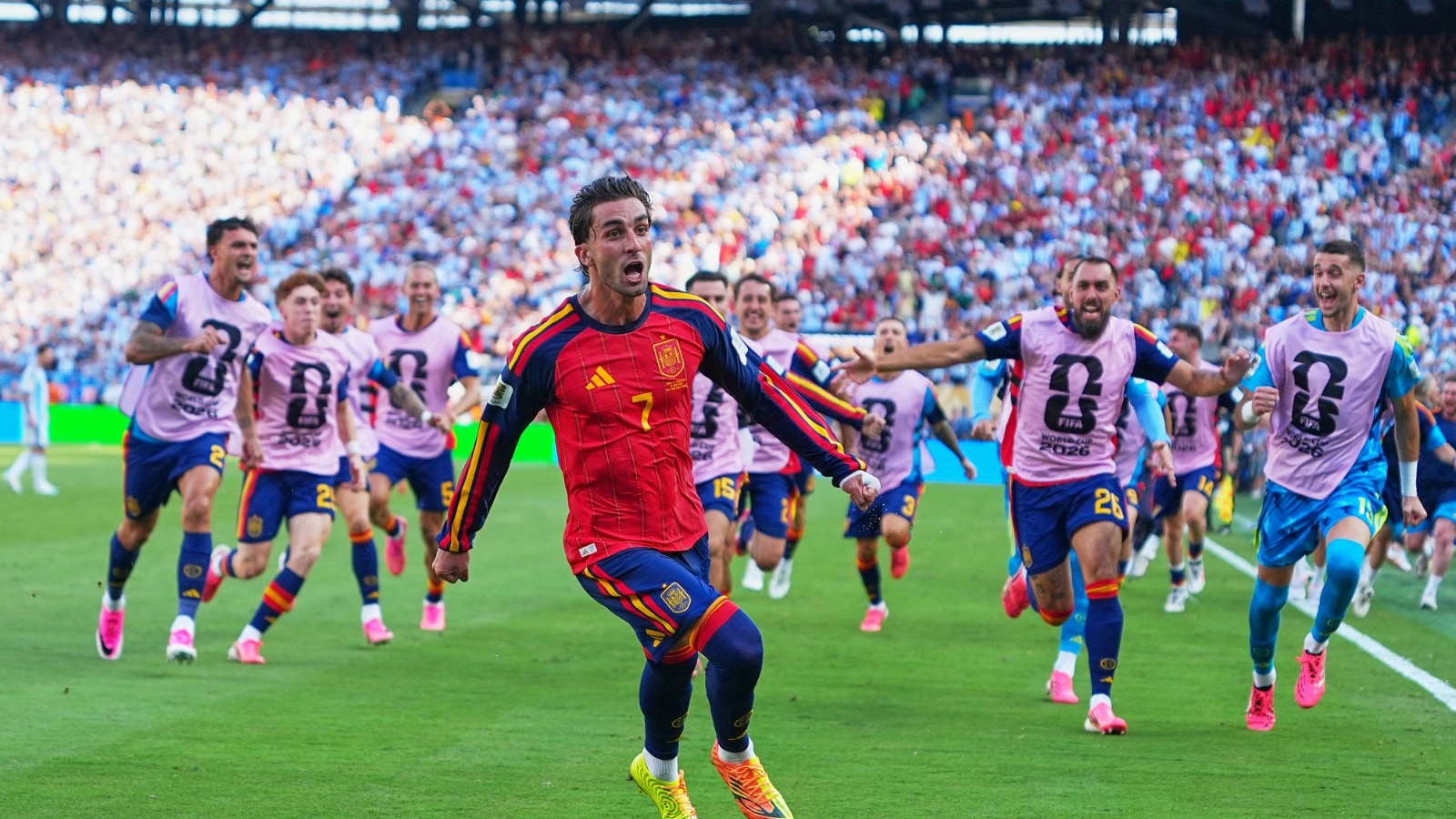
Pedro Porro floated a deep cross into the box. Nico Williams rose above his marker to head the ball down into the heart of the six-yard box. Ferran Torres, who came off the bench in the 62nd minute, read the play perfectly, latched onto the bouncing ball, and smashed a left-footed volley under the crossbar.
Martínez had no chance. MetLife Stadium erupted.
Argentina threw everything forward in the final ten minutes. Messi whipped in dangerous corner kicks, and Giuliano Simeone flashed a late effort over the bar, but Spain's back line held firm. When the final whistle blew, Spain had secured their second men's World Cup title and their first since 2010.
A Defense for the Record Books
Everyone talks about Spain's attacking flair, but their defense won this tournament.
Over eight matches in North America, Spain conceded just one goal. Read that again. In an expanded 48-team format requiring eight games to lift the trophy, Spain allowed a single goal. That breaks the previous all-time World Cup record of two goals conceded by a champion, held jointly by France (1998), Italy (2006), and Spain (2010).
This victory also extended Spain's overall unbeaten run to 38 matches across all competitions, breaking Italy's men's international record of 37 games.
Spain now holds the Euro 2024 crown and the 2026 World Cup trophy simultaneously. Coupled with Spain's women winning the 2023 World Cup, Spain becomes the first nation in history to hold both the men's and women's World Cup titles at the same time.
The End of an Era for Argentina
For Lionel Messi and Argentina, the defeat marks a somber turning point.
Argentina's legendary run—winning the 2021 Copa América, the 2022 World Cup in Qatar, and the 2024 Copa América—finally reached its terminus. At 39, Messi showed flashes of magic throughout the 2026 tournament, finishing with eight goals. But against Spain's modern, high-intensity system, age and fatigue caught up with Argentina's core.
Spain's new era is led by teenagers like Lamine Yamal and Pau Cubarsí alongside prime talents like Nico Williams, Ferran Torres, and Rodri. They aren't just back at the top; they look set to dominate international football for the next decade.
What Analysts and Fans Should Watch Next
If you follow international tactics, Spain's 2026 campaign offers clear takeaways for where top-level football is heading.
- High pressing with structural depth works better than individual star power. Spain didn't rely on one scorer; they distributed responsibility across the entire lineup.
- Possession must be aggressive. Spain didn't pass sideways for the sake of it; they used possession to pin Argentina deep and generate 20 shots.
- Squad rotation in expanded tournaments is vital. Fresh legs from bench players like Ferran Torres made the difference in extra time.
Rewatch the final sequence of the 106th minute to study how Porro and Williams created space inside a crowded penalty area. That single movement pattern is going to be coached at every academy level in Europe this season.