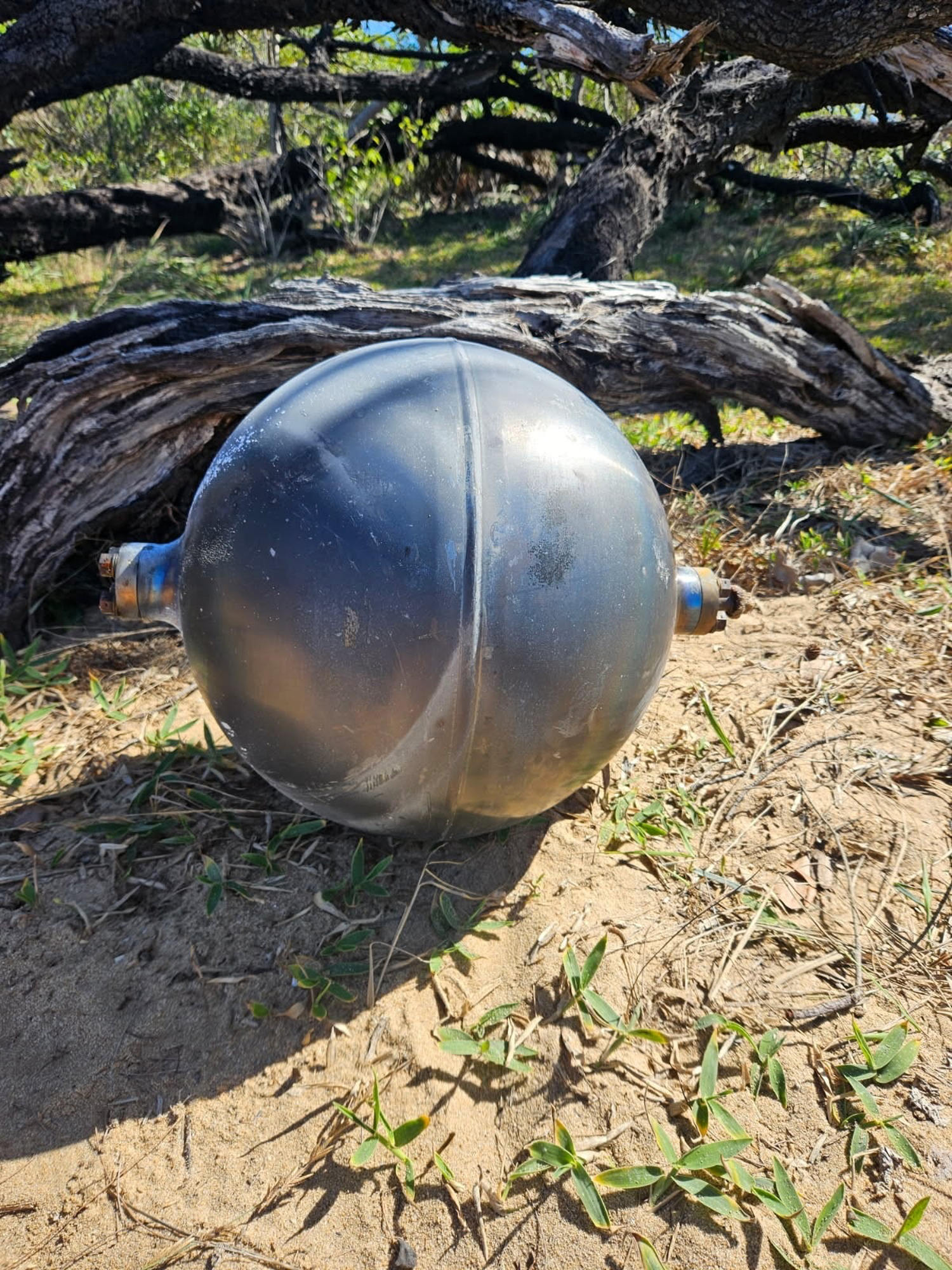
Imagine walking along a sleepy stretch of sand, looking for seashells, and instead stumbling across six gleaming, metallic orbs twice the size of basketballs. That's exactly what happened at Forrest Beach in north Queensland, Australia. The sudden appearance of these strange, seamless spheres triggered a minor panic, a 50-meter exclusion zone, and a brief public safety evacuation order.
Local emergency crews in full hazmat gear rushed to secure the items into industrial drums. For a moment, the town of 1,300 people joked about aliens and UFO crashes. But the truth belongs squarely to human engineering.
The Australian Space Agency quickly stepped in to confirm the metallic globes are "space balls"—the literal industry nickname for high-pressure fuel vessels that break off from foreign rocket bodies.
The Science Behind the Spheres
You might wonder how something can fall from orbit, plunge through the atmosphere at extreme speeds, and land on a beach looking virtually unblemished.
Rocket pressure vessels are built to survive the harshest environments known to science. Manufacturers typically construct them from titanium alloys or high-grade aluminum. Their job is to hold volatile propellants or oxidizers under immense pressure before forcing them into the rocket engines.
[Rocket Launch] ➔ [Stage Separation] ➔ [Atmospheric Re-entry] ➔ [Ocean Splashdown] ➔ [Beach Wash-up]
When a rocket stage burns out and re-enters the atmosphere, the intense friction vaporizes most of the aluminum skin and structural brackets. However, titanium has an exceptionally high melting point. The space balls empty their fuel, become buoyant, float on the ocean surface, and eventually ride the waves straight to land.
Space archaeologist Alice Gorman from Flinders University noted that the lack of heavy scorching on the Queensland objects suggests they might have separated during a lower-altitude rocket stage rather than a high-velocity orbital decay.
Who Owns the Space Junk?
Under the United Nations Space Liability Convention of 1972, space debris remains the legal property of the nation that launched it. Australia cannot just keep them or sell them to the highest bidder without a conversation.
The Australian Space Agency is working with international partners to match the debris with recent orbital trajectories. Over the exact weekend the spheres appeared, China launched both a Long March 6 and a Long March 8A rocket. While the agency hasn't named the specific launching state yet, they confidently stated they have identified the likely source.
Usually, foreign governments don't want their standard rocket pieces back unless something went catastrophically wrong and they need to perform a forensic failure analysis. When a massive piece of an Indian PSLV rocket washed up in Western Australia back in 2023, the Indian government ultimately let it sit.
The Reality of Our Crowded Sky
Getting hit by a falling space ball is incredibly unlikely, but the sheer volume of debris is rising fast. There are over 14,500 active satellites in orbit right now—with SpaceX’s Starlink making up over 9,900 of them—alongside roughly 130 million pieces of trackable and untrackable space debris.
Only one person in recorded history has ever been struck by space junk. In 1997, Lottie Williams was walking through a park in Tulsa, Oklahoma, when a small piece of charred fiberglass from a Delta II rocket brushed her shoulder. She was unhurt, but a solid titanium pressure vessel would be a completely different story.
What to Do If You Find One
If you happen to spot a metallic sphere resting in the surf on your morning walk, don't touch it. Even though the Queensland fire department cleared the Forrest Beach objects as safe, rocket components frequently carry traces of highly toxic, corrosive propellants like hydrazine.
- Step 1: Step away immediately and maintain a distance of at least 50 meters.
- Step 2: Take a photo from a safe distance to document the location.
- Step 3: Contact local emergency services or report the sighting directly to the Australian Space Agency.
Let the authorities handle the hazmat protocols while you enjoy the story from a safe distance.