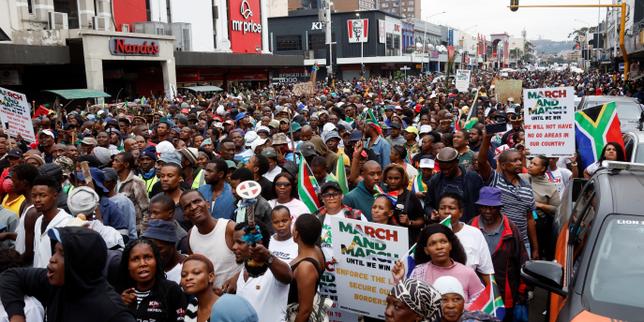
The date was set months ago, and when June 30 arrived, the streets of Johannesburg and Durban didn't explode into the apocalyptic bloodbath many feared. But don't let the absence of a full-scale riot fool you. What happened across South Africa over the past 48 hours is arguably more dangerous than a sudden burst of chaotic violence. It was a highly organized, systematic show of force by anti-migrant vigilante groups that marks a dark turning point in the country's social fabric.
For weeks, a coalition of nationalist groups, led by the prominent "March and March" movement and elements of Operation Dudula, issued an ultimatum: all undocumented foreigners had to leave South Africa by June 30. They chanted "abahambe"—they must go. They marched through central business districts carrying traditional weapons. They went door-to-door, cornering shopkeepers and demands for papers.
While a massive deployment of state police and military assets kept a lid on mass casualties, the reality on the ground was grim. Thousands of terrified migrants didn't wait for the deadline. More than 15,000 Malawians have fled the country over the last two months, packing their lives into buses or freezing outside consulates while waiting for emergency repatriation. Tens of thousands of other undocumented workers from Zimbabwe, Mozambique, and Nigeria simply went into hiding, turning thriving economic hubs into ghost towns.
This isn't a temporary spike in societal anger. It's the normalization of xenophobia as a structured political tool.
The Myth of the Sudden Outburst
If you look at mainstream international coverage, these events are usually framed as spontaneous riots driven by a desperate, impoverished underclass. That's a massive oversimplification.
What we're seeing in 2026 is a corporate-style operation of intimidation. Look at Jacinta Ngobese-Zuma, the leader of the March and March movement. She doesn't talk like a rioter; she speaks with the calculated precision of a politician. "We are not calling for violence," she told reporters as the deadline approached. "No one will be killed in our name."
That's the strategy. They outsourced the physical terror to the local level while maintaining plausible deniability at the top. While the leadership speaks of peaceful administrative deadlines, their followers on the ground in Germiston and Johannesburg CBD were busy pulling people out of stores, demanding identity verifications, and roughing up those who couldn't prove their status.
By setting an arbitrary administrative deadline like June 30, these vigilante networks managed to mimic the state. They created an alternative authority structure that millions of desperate citizens now trust more than the government.
Blaming the Border for Broken Promises
Why is this rhetoric sticking so effectively right now? Because South Africa's economic fundamentals are broken, and the ruling class has run out of answers.
The numbers are brutal. The country's official unemployment rate sits above 32%. If you look at the youth demographic, that number skyrockets past 50%. The electricity grid remains unstable, municipal water systems are failing in major cities, and the public health system is buckling.
Instead of addressing decades of economic mismanagement, local politicians have found a perfect scapegoat. With municipal elections scheduled for November 4, anti-migrant rhetoric has become the ultimate campaign currency. Political opportunists are actively weaponizing the genuine frustrations of everyday citizens.
When a local family can't get medicine at a clinic or a young graduate can't find work, it's incredibly easy to point across the street at a foreign-owned spaza shop and say, "There's your problem."
President Cyril Ramaphosa recently attempted to walk a fine line, stating that immigration laws must be respected while acknowledging that "illegal immigration is not the cause of all our economic difficulties." He called for faster economic growth and industrial expansion. But let's be honest: long-term industrial strategies don't win votes when people are hungry today. The vigilantes are offering an immediate, albeit violent, solution.
The Real Human and Economic Cost
The tragedy is that this campaign isn't just a humanitarian nightmare; it's an economic self-sabotage mechanism.
The migrants targeted by these movements—mostly from Zimbabwe, Malawi, Mozambique, and Lesotho—are deeply integrated into the informal economy. They run micro-enterprises, provide affordable retail options in townships, and fill critical labor gaps in agriculture and construction.
When groups like Operation Dudula launch campaigns to block foreign children from enrolling in public schools or try to forcefully audit small businesses, they aren't fixing the economy. They're destroying local supply chains. On June 30, hundreds of businesses across Johannesburg chose not to open. The economic paralysis from just a few days of targeted fear costs millions in lost revenue, further suppressing the very job market the protesters claim to protect.
Furthermore, the regional fallout is escalating. Countries like Malawi and Zimbabwe are being forced to divert scarce national resources to fund emergency repatriations for thousands of their citizens fleeing Durban and Johannesburg. The dream of pan-African economic cooperation looks incredibly hollow when regional neighbors are running evacuation buses out of the continent's most developed economy.
Where Does South Africa Go From Here
The worst-case scenario of mass fatalities was avoided this week, but the underlying crisis has only deepened. The vigilante groups have already announced their next move: "We will march every Thursday." They've tasted political capital, and they aren't going to give it up.
If you are trying to understand where this trajectory leads, stop looking at the police deployment and start looking at institutional accountability. To stop this slide into structural xenophobia, several immediate steps are required from both civil society and the state:
- Dismantle Alternative Enforcement Networks: The state must aggressively prosecute private individuals attempting to conduct identity checks, business audits, or border enforcement. Allowing vigilantes to act as a shadow police force destroys the rule of law.
- De-escalate Political Rhetoric: Political parties must face strict electoral sanctions for using xenophobic tropes to mobilize voters ahead of the November 4 municipal elections.
- Fix the Department of Home Affairs: Much of the frustration stems from a broken immigration system characterized by massive backlogs and corruption. Reforming this department is non-negotiable to restore public trust in legal immigration channels.
The June 30 deadline has passed, but the tension hasn't dissipated. It has simply become part of daily life. Unless the South African government addresses the economic vacuum that feeds this anger, the marches will keep happening every Thursday, and the state's control over its own streets will continue to slip away.