The United States is celebrating its 250th anniversary of independence. Fireworks will light up the sky. Parades will march down main streets. Politicians will give speeches about liberty, equality, and the grand march of freedom. It is easy to get swept up in the patriotic fervor of a milestone year. But nations, like people, cannot fully understand who they are if they only look at their best days.
If you want to understand the true cost of the American nation, you have to look away from Philadelphia and Washington. You have to look out toward the Great Plains. Specifically, you need to look at a dry creek bed in southeastern Colorado. That is where you find the ghosts of the Sand Creek Massacre.
On November 29, 1864, while the Union was fighting for its survival in the Civil War, another kind of war reached its brutal climax on the western frontier. A force of nearly 700 federal volunteer troops rode into a peaceful camp of Cheyenne and Arapaho people. They did not find a hostile war party. They found families sleeping. By the time the sun went down, more than 230 Native Americans lay dead. Most were women, children, and old men.
The story of Sand Creek is not just a tragic footnote from a forgotten century. It is a fundamental piece of the American story. It shows what happens when fear, greed, and racial hatred override law and conscience. As the country reflects on two and a half centuries of independence, confronting this history is not about tearing America down. It is about understanding the full truth of how the nation was built.
The Setup for a Betrayal
To understand how Sand Creek happened, you have to look at the Colorado gold rush. In 1858, gold was discovered near Pike's Peak. Tens of thousands of white settlers flooded into lands that had been guaranteed to the Cheyenne and Arapaho by the 1851 Treaty of Fort Laramie. The sudden influx of settlers shattered the fragile balance of the region. Hunting grounds disappeared. Buffalo herds were scattered.
The United States government forced tribal leaders to sign a new treaty in 1861. This agreement stripped the tribes of more than thirteen million acres of land. It left them with a tiny, barren fraction of their original territory in eastern Colorado. Not all Indigenous leaders accepted this betrayal. A militant faction of young Cheyenne warriors known as the Dog Soldiers refused to give up their lands. They began raiding white settlements and wagon trains to protect their way of life.
By 1864, panic gripped the Colorado Territory. The governor, John Evans, was a political climber who wanted to clear Native Americans out of the territory entirely to make way for statehood and railroads. In the summer of that year, Evans issued a proclamation. He ordered all friendly Native Americans to report to specific military posts to receive protection and supplies. He told them that doing so would prove their peaceable intentions. Anyone who did not comply would be considered hostile.
Chief Black Kettle of the Southern Cheyenne was a man dedicated to peace. He knew his people could not win a total war against the industrial might of the United States. He took Governor Evans at his word. Black Kettle led his followers to Fort Lyon in southeastern Colorado. There, the fort's commander, Major Edward Wynkoop, assured Black Kettle that his people would be safe if they camped nearby at Sand Creek.
Black Kettle believed he had secured safety for his band. He raised an American flag over his teepee. Below it, he tied a white flag of truce. He believed the flags would protect his people from any passing soldiers. He was wrong.
The Monster of the Prairie
John Chivington was not a typical military officer. He was a Methodist minister before the Civil War. He gained fame as a fighting parson at the Battle of Glorieta Pass, where Union forces turned back a Confederate advance into New Mexico. Chivington was an ambitious politician. He wanted to be Colorado's first US congressman. He knew that the quickest way to win votes among the terrified white settlers was to wipe out the Native population.
Chivington took command of the Third Colorado Cavalry. This unit was made up of ninety-day volunteers who enlisted specifically to fight Native Americans. They were crude, untrained, and fueled by racial hatred. As their enlistment drew to a close without a major battle, Chivington grew desperate for a victory.
He did not care that Black Kettle's camp was peaceful. He did not care that the military had promised them protection. To Chivington, any Native person was a target. Before marching his troops out of Denver, he made his views entirely clear to his men. He told them to kill and scalp all, big and little. He famously argued that nits make lice, meaning that Native children should be killed before they could grow into adults.
Chivington marched his force through a bitter winter storm to Fort Lyon. When he arrived, he found that Major Wynkoop had been replaced by a more compliant officer, Major Scott Anthony. A few officers at the fort were horrified by Chivington's plan. They knew Black Kettle's camp was entirely peaceful.
Captain Silas Soule and Lieutenant Joseph Cramer protested vigorously. Soule told Chivington that attacking a peaceful camp would be a violation of military honor and an act of murder. Chivington shook his fist in Soule's face. He shouted that he had come to kill Indians, and that it was right and honorable to use any means under God's heaven to do so.
Soule and Cramer could not stop the march. Chivington ordered his men forward toward the sleeping camp at Sand Creek.
Eight Hours of Terror
At dawn on November 29, the sound of thundering hooves shattered the silence of the prairie. More than 600 soldiers surrounded the Cheyenne and Arapaho village.
Black Kettle ran out of his lodge. He pointed to the American flag and the white flag flying above his head. He shouted to his people to gather around the flags, telling them they were safe. But the soldiers did not stop. They opened fire with rifles and mountain howitzers.
The scene descended into absolute chaos. Terrified women and children ran into the freezing waters of the creek bed. They tried to dig into the sandy banks to hide from the flying bullets. The soldiers pursued them ruthlessly.
Captain Silas Soule refused to order his company to fire. His men held their rifles up and watched the slaughter unfold in horror. But the rest of Chivington's troops enthusiastically joined the carnage.
The attack lasted for eight hours. It was not a battle. It was an execution. Soldiers hunted down fleeing women and children across miles of open prairie. Old men who could barely walk were shot where they stood. Chief White Antelope, an elderly leader who had worked for peace, stood in front of his lodge, crossed his arms, and sang his death song until he was cut down by bullets.
What happened after the shooting stopped was even worse. The Colorado volunteers transformed into monsters. They moved across the field, mutilating the bodies of the dead and dying. They took scalps. They cut body parts from women and babies to display as trophies. They filled their pockets with fingers and ears to show off back home.
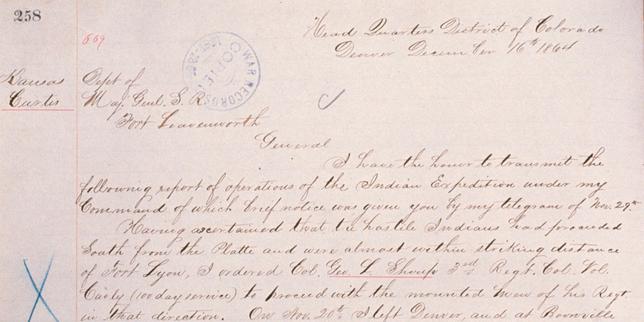
Chivington watched it all. He later reported that his men had won a brilliant victory over a fierce force of thousands of hostile warriors. He claimed his troops had killed over 500 fighters. The reality was that around two-thirds of the victims were women, children, and infants. Black Kettle miraculously survived the onslaught, pulling his severely wounded wife from the pile of bodies and escaping into the night.
The Cover-Up and the Whistleblowers
When Chivington and his men returned to Denver, they were treated as conquering heroes. They paraded through the streets. They displayed their bloody trophies on the stage of the local theater to cheering crowds. The local newspapers praised Chivington's tactical genius and celebrated the destruction of the Indian threat.
But the truth could not be buried in the sand. Captain Silas Soule and Lieutenant Joseph Cramer wrote letters to military authorities in Washington. They detailed the sickening atrocities they had witnessed. They described the murder of infants, the mutilation of corpses, and the absolute betrayal of the government's promises.
Soule's letters sparked outrage in Washington. The US Congress and the military launched formal investigations into the event. The Joint Committee on the Conduct of the War called Chivington's actions a foul and dastardly massacre. They concluded that Chivington had deliberately planned and executed a foul slaughter of unsuspecting people who had every reason to believe they were under U.S. protection.
Because Chivington and his men had already left the military, they could not be tried by a court-martial. No criminal charges were ever brought against them. Governor John Evans was forced to resign his post, but he faced no further punishment. He went on to become a wealthy railroad tycoon and a respected civic leader, with a mountain and a city named after him.
The whistleblowers paid a heavy price for their honesty. A few months after testifying about the massacre, Captain Silas Soule was shot in the back and killed on the streets of Denver. His murderers were never brought to justice.
The Long Shadow in 2026
The Sand Creek Massacre changed the West forever. It destroyed the peaceful factions within the Plains tribes. It proved to Native Americans that promises made by the United States government were completely worthless. The survivors fled north and joined the militant bands. A brutal cycle of warfare consumed the Great Plains for the next quarter-century, leading directly to the battles of the Little Bighorn and Wounded Knee.
For generations, the memory of Sand Creek was obscured. It was often referred to in history books as the Battle of Sand Creek, framing it as a legitimate military engagement. It took decades of struggle by Cheyenne and Arapaho descendants to change that narrative.
It was not until 2007 that the National Park Service officially opened the Sand Creek Massacre National Historic Site. It stands today as a quiet place of mourning and education. In recent years, institutions have begun to face their ties to the tragedy. In 2021, Mount Evans was renamed Mount Blue Sky to honor the Arapaho and Cheyenne, removing the name of the governor who enabled the slaughter.
As America hits its 250-year mark, the lesson of Sand Creek is more critical than ever. True patriotism does not mean turning a blind eye to historical atrocities. It requires the courage to look at the darkest chapters of the past and acknowledge the wounds that have never fully healed. The descendants of those who died at Sand Creek still carry the generational trauma of that freezing November morning.
What You Can Do to Learn More
History is not something you just read about. It is something you engage with. If you want to move past the superficial myths of American history and understand the complex reality of the nation's past, here are some meaningful ways to do it.
- Visit the Sand Creek Massacre National Historic Site in Kiowa County, Colorado, to stand on the ground where these events occurred and read the testimonies of survivors.
- Read the official congressional reports from 1865 regarding the massacre to understand how the government itself viewed Chivington's actions.
- Explore the exhibits created by History Colorado in collaboration with the Cheyenne and Arapaho tribes, which present the history from the perspective of Indigenous descendants.
- Look into the history of the land you live on today to find out which Native nations originally called it home and how that land changed hands.
National anniversaries are perfect times for celebration, but they are also essential moments for collective honesty. The story of America includes the triumphs of liberty, but it also includes the tragedy of Sand Creek. Remembering both is the only way to build a nation that actually lives up to its founding ideals.