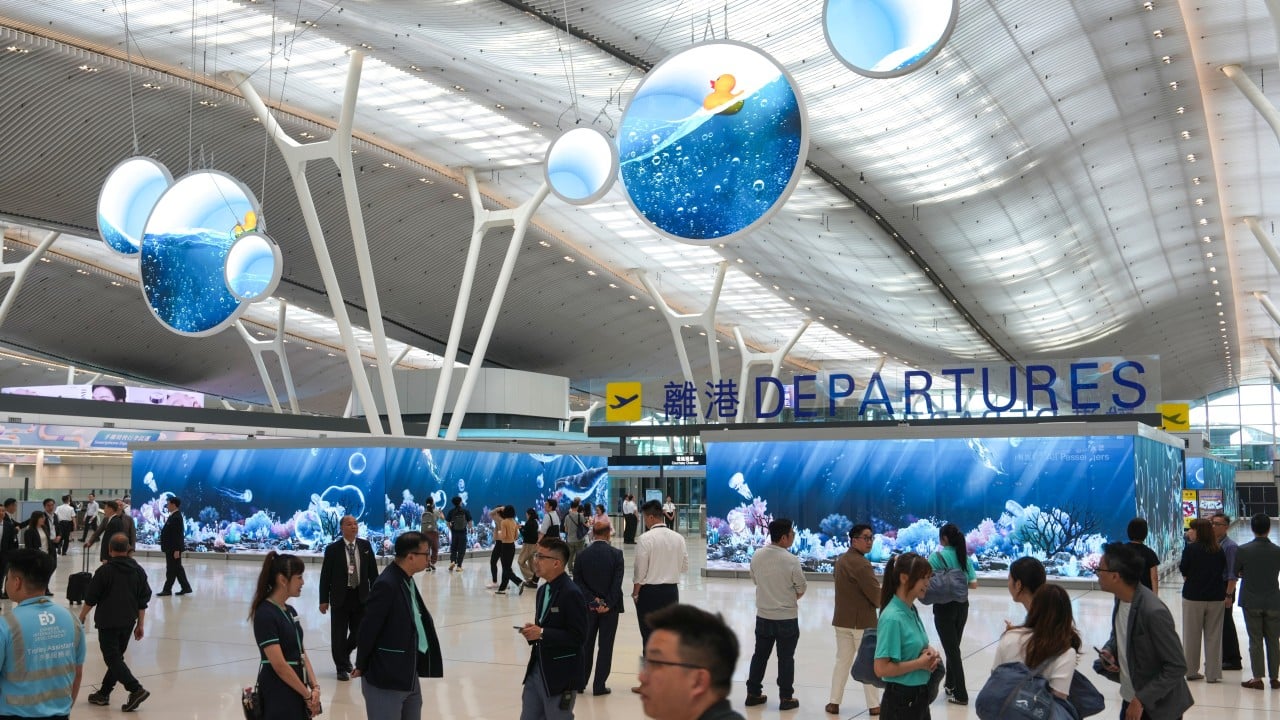
If you look at the surface-level numbers of Hong Kong International Airport, you would think the aviation hub is in the middle of a gold rush. Planes are lining up on the tarmacs. Terminals are packed with travelers. Cargo holds are stuffed. Yet, the newly released financial results for the 2025-26 fiscal year tell a completely different story.
Net profit at the Airport Authority Hong Kong took a massive 16.8% hit, tumbling down to HK$2 billion. Expanding on this theme, you can also read: Why Grocery Outlet Is Doubling Down On California Despite Shuttering Stores.
How does an airport manage to bring in 11% more revenue, hitting HK$18 billion, and still watch its bottom line erode?
It is a classic corporate puzzle. Traffic is booming, but the bills are coming due. Between the eye-watering price of maintaining its brand-new Three-Runway System, rising staff costs, and a literal deep-sea salvage operation, the airport is finding out that growth is a very expensive game. Experts at Bloomberg have shared their thoughts on this situation.
Let's look past the glossy public relations statements to analyze what is actually eating away at the region's premier aviation hub.
Where the Cash Went
Operating an airport of this scale is a logistical nightmare. Doing it while launching massive infrastructure projects is a financial one.
While the Airport Authority managed to grow its top-line revenue, its total operating expenses before depreciation and amortisation shot up by 20.5% to HK$10 billion. That is a massive jump for a single year. When your expenses outpace your revenue growth by almost double, your profit margins will get squeezed.
A significant portion of this cash bleed comes down to basic operations. Staff costs represent roughly one-third of everything the airport spends. Those costs rose 8.2% to HK$3.6 billion. Why? Because you cannot run a massive, expanded airport without boots on the ground. The growth in passenger traffic required a hiring spree, particularly for security personnel to keep the checkpoints moving.
Then we have the government taking its slice. Expenses paid for government services surged by 29.6% to HK$1.3 billion, driven mostly by higher air traffic control fees as flight movements ticked upward.
The Massive Bill for the Three Runway System
You cannot talk about the airport's finances without looking at the monster in the room: the HK$141.5 billion Three-Runway System.
Commissioned in November 2024, the mega-project was supposed to secure Hong Kong's long-term dominance. It is certainly doing that on paper, but the actual cost of running this three-headed beast is astronomical.
Repairs and maintenance costs skyrocketed by 30.4% to HK$1.6 billion this past year. That is the direct, brutal reality of having to maintain extra runways, advanced airfield lighting, and massive new terminal spaces. When you build big, you maintain big.
The financial hangover of this expansion is also hitting the balance sheet in the form of interest. For years, the interest on the debt used to build the third runway was capitalized—meaning it was treated as an asset on the books while construction was underway. Now that the system is fully operational, that interest has to be recognized as a direct expense.
Look at the swing in finance costs. The airport's net interest and finance costs swung from a positive net income of HK$189 million last year to a negative HK$351 million this year. That is a half-billion-dollar swing straight out of the profit column.
The Underwater Accident That Cost Millions
Sometimes, financial forecasts get wrecked by things you can't possibly plan for.
In October 2025, an Emirates cargo plane slid off the runway and ended up in the sea, causing minor damage to the northern runway's perimeter fence and structure. While the physical runway repairs were wrapped up quickly, the real headache was getting a giant cargo plane out of the water.
The Airport Authority had to hire a specialized salvage team. They brought in heavy-duty salvage vessels, including the "Nan Tian Xiang" and the "Nan Tian Peng," to map the seabed with sonar and deploy commercial divers.
This salvage operation is a major reason why the airport's operational contracted services jumped 18.5% to HK$1.7 billion. It is a stark reminder that in the aviation business, a single bad day on the runway can leave a multi-million-dollar dent in your annual report.
The Transit Passenger Trap
There is a structural shift happening in Hong Kong's passenger mix that is quietly hurting profitability.
While passenger numbers are rising, the type of passenger walking through the gates has changed. Data shows that transfer and transit passengers now make up 31.8% of the airport's traffic. That is a notable increase from the 27.4% share they held back in 2018.
Meanwhile, local Hong Kong passengers and high-spending mainland visitors are still lagging behind their historical peaks. Local traffic is running about 12.9% lower than 2018 levels, and mainland visitor numbers are down by more than 26%.
Why does this matter? Because of retail spend.
Transit passengers are great for filling seats, but they do not buy products like local or mainland travelers do. They do not book local hotels, they rarely buy heavy luxury goods, and they spend less time in terminal shops because they are rushing to catch their next flight.
The airport did manage to grow its retail license and advertising income by 11%, but it had to spend heavily on marketing support for its retail partners to get that result. The golden era of mainland tourists walking into the terminal and buying out luxury boutiques is gone, replaced by transit passengers looking for a quick coffee and a charging outlet.
The Upcoming Airline Subsidy Cliff
To get airlines to return to Hong Kong after years of pandemic disruptions, the Airport Authority launched the Air Network Development Programme in June 2024. The program has been highly successful on the surface, helping secure 89 new routes from 40 airlines.
But these routes are heavily subsidized. The program offers financial incentives for up to two years for airlines launching new destinations.
We are now entering the period where the earliest participating airlines will see their subsidies expire. Many of these new routes are operating on incredibly thin schedules—averaging just 2.23 flights per week. Once the free financial support runs out, we will see how many of these routes are actually economically viable. If airlines start cutting frequencies or pulling out entirely to protect their own margins, Hong Kong's connectivity will take a hit, dragging airport revenue down with it.
What Happens Next
The days of easy, high-margin growth for Hong Kong International Airport are over. The facility is now a victim of its own massive scale.
The Airport Authority is government-owned, which means its financial health directly impacts the city's public coffers. This year, the board slashed its dividend payment to the government by a brutal 61.5%, paying out just HK$500 million compared to the previous year.
To turn this ship around and restore profit growth, management needs to take concrete, practical steps:
- Rethink the retail mix: Stop catering exclusively to high-end luxury shoppers who are no longer showing up in the same numbers. The terminal needs mid-tier dining and experiential retail that appeals to the growing segment of younger transit passengers.
- Audit operational contractors: The 18.5% surge in contracted services cannot become the new normal. With the heavy salvage operations of 2025 out of the way, management must aggressively renegotiate service contracts for Terminal 2 and the coach hall.
- Focus on high-yield routes: Rather than handing out subsidies to any airline willing to fly a thin, twice-weekly schedule, the airport needs to prioritize marketing support for high-frequency regional business routes that bring in passengers who actually spend money in the city.
The infrastructure is built. The third runway is active. Now, the airport has to prove it can actually afford to run them.