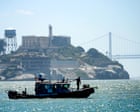
You don't expect a memorial service to turn into a fight for survival, but the San Francisco Bay doesn't care about your plans. What started as a family trip to scatter a loved one's ashes ended in disaster near Alcatraz Island when the Volare, a 49-foot cabin cruiser, capsized with 20 people on board.
The San Francisco Police Department's marine unit just located the vessel's wreckage under 120 feet of water on a rocky seabed. This discovery comes right after search crews recovered the body of 58-year-old Tondra Madruga near Treasure Island. While 16 people were pulled alive from the frigid water, two passengers—Carol Boisa and Jackie Boisa—are still missing. If you found value in this post, you should read: this related article.
This tragedy highlights the brutal reality of navigating one of the most treacherous bodies of water on the West Coast.
What Went Wrong on the Volare
The crew wasn't doing anything unusual. According to ship-tracking data, the boat left a San Francisco marina, went under the Golden Gate Bridge twice, and stopped at Angel Island. It was heading back to the city when a massive wave slammed into the boat, causing it to take on water, list heavily, and roll over. For another look on this story, see the recent update from Reuters.
Local mariners know how fast things can turn ugly here. Kirk Miller, a licensed master mariner in the area, pointed out that uneven passenger distribution can easily cause a cabin cruiser like the Volare to tip when hit by a sudden swell. Witnesses on nearby fishing boats described a horrific scene resembling the Titanic, with passengers frantically pounding on windows from inside the cabin as the boat sank.
Good Samaritans fishing for halibut nearby jumped into action and hauled eight or nine people out of the water. If they hadn't been there, the death toll would be much higher.
The Brutal Science of San Francisco Bay Currents
People underestimate the bay because it looks contained. It's not. The water temperature hovers below 60 degrees Fahrenheit. When you plunge into water that cold unexpectedly, your body goes into cold water shock instantly. You lose your ability to swim or even hold onto a flotation device within minutes. Clifford Boisa, 78, died immediately after being pulled from the water, a stark reminder of how deadly that shock is.
Then there are the currents. The bay acts as a giant funnel for the Central Valley's water system rushing out to the Pacific. Because the currents are so aggressive, search teams were looking past the Golden Gate Bridge into the open ocean just hours after the sinking occurred. Finding Madruga's body miles away near Treasure Island proves how fast the water moves bodies and debris.
What Happens Now with the Salvage Operation
The search is no longer a rescue mission. The U.S. Coast Guard suspended its search, and the SFPD has taken over the recovery phase.
Locating the boat with sonar is just the first step. Police are currently using a remotely operated vehicle (ROV) to inspect the hull. Actually raising a 49-foot boat from a rocky floor 120 feet down is incredibly complex. At that depth, current speeds and zero visibility mean human divers face extreme risks. The city will have to contract specialized commercial salvage companies to bring the Volare up so investigators can figure out if mechanical failure played a role.
Essential Boating Safety Steps You Cannot Skip
If you are going out on the San Francisco Bay, don't rely on the captain alone to keep you safe. Take your safety into your own hands.
- Wear your life jacket continuously. Rescuers noted that several victims in this incident were bobbing in the water without life jackets. Don't leave them stowed in a cabin. Once a boat flips, you won't be able to get to them.
- Track the passenger distribution. On a pleasure craft or cabin cruiser, moving too many people to one side of the deck to look at a landmark or participate in a ceremony drastically compromises the boat's stability. Keep the weight centered.
- Know your exits. If you are sitting inside an enclosed cabin, identify the windows and hatches immediately. When a vessel capsizes, finding your way out upside down in dark, rushing water is nearly impossible.
The investigation into the Volare will take months as the Coast Guard and local police piece together the final moments of the vessel. For now, the focus stays on the grueling recovery effort to find the remaining victims and give the Boisa family closure.