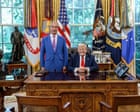
Donald Trump just proved that the American presidency is the most lucrative business on Earth. According to a massive 927-page financial disclosure released by the Office of Government Ethics, Trump raked in over $2.2 billion during the first year of his second term. This isn't just about old-school real estate or golf courses anymore. It is about a structural shift in how politicians across the Western world make their money.
Many critics look at these billions and call it a temporary glitch in American democracy. They are wrong. It is a feature of a new political era. From Washington to London, politicians are shifting from public service to pure monetization.
The public used to expect leaders to separate their private financial interests from their public duties. That expectation is dead. Today, political influence is sold directly to the highest bidder in broad daylight, and millions of voters are cheering it on. We are witnessing the normalization of the political grifter, a brand of leader who views public office as a personal ATM.
The Two Billion Dollar Playbook
The numbers in Trump's recent financial disclosure are staggering. He didn't just maintain his wealth while in office. He supercharged it. The real engine behind this multi-billion dollar windfall wasn't his traditional property empire. It was cryptocurrency.
Trump pulled in nearly $1.2 billion from digital assets alone. Think about that. The very man responsible for writing the regulations for the crypto market is also its biggest corporate beneficiary. He reversed previous administrative crackdowns and declared his intent to make America the crypto capital of the world. Right after that, his family projects made a killing.
The Mechanics of World Liberty Financial
The most troubling part of the disclosure involves World Liberty Financial. This is a crypto company run by Trump's family alongside Middle East envoy Steve Witkoff. The venture pulled in more than $500 million from token sales.
A significant chunk of that cash came from state-linked entities in the United Arab Emirates. Days before Trump reentered the White House, these Emirati buyers acquired massive stakes in the family venture. Shortly after, the UAE secured access to advanced American artificial intelligence chips. To make things weirder, a convicted crypto fraudster involved in the setup received a presidential pardon.
It is a neat, three-way transaction. Cash flows to the leader, strategic tech flows to a foreign autocracy, and a criminal walks free.
Merchandise and Meme Coins
Property and tech deals are only half the story. Trump is also running a high-volume retail operation right out of the Oval Office.
His disclosure lists $635 million from "celebration coins" stamped with his own face. He made $4.7 million from selling branded watches. There are Trump-branded Bibles, cologne, and gold smartphones. He even takes a monthly pension check from the Screen Actors Guild from his old reality television days. He is treating the executive branch like an influencer merch store.
The British Connection and the Export of Influence
This phenomenon is not isolated to the United States. The playbook travels fast. The contagion has already altered the political culture of the United Kingdom.
Nigel Farage has used a remarkably similar blueprint to become the highest-paid member of the Westminster parliament. He does not rely on a standard political salary. Instead, he pulls in millions from private business ventures and digital platforms.
Farage has been highly active on Cameo, filming short video messages for cash. He has openly promoted speculative cryptocurrency ventures alongside former chancellor Kwasi Kwarteng. His entire political operation, including Reform UK, runs on private financial support. A Thailand-based crypto tycoon named Christopher Harborne provided two-thirds of the funding for Farage's political movement through a massive £5 million gift.
The UK standards watchdog is currently investigating these financial arrangements. But the investigation itself feels outdated. By the time regulators figure out the rules, the money has already done its job. Political parties are no longer just coalitions of citizens. They are corporate shells built around celebrity politicians.
Why the Public Keeps Buying the Con
The most confusing part of this global shift is the voter reaction. In the past, a politician making billions from private business while in office would face instant ruin. Today, it helps them win.
Voters do not just tolerate the financial schemes. They actively celebrate them. To understand why this happens, you have to understand how modern political tribes work.
The Success Symbol Trap
Many voters view extreme wealth as proof of competence. If a leader can make billions from a bedroom or a golf course, supporters assume that leader can fix the economy. They do not see the conflict of interest. They see an outsider beating a rigged system.
When a politician sells a $500 Bible or a $1,000 watch, it functions as a loyalty test. Buying the merchandise is a way for supporters to fund the political movement directly. It bypasses traditional campaign finance rules. The financial transactions become an act of political defiance.
The Information Bubble Effect
Media fragmentation plays a massive role here. Supporters live in isolated information ecosystems. They simply do not hear about the financial disclosures. If they do, the news is framed as a partisan attack by a hostile media establishment.
Duncan Hames from Transparency International UK points out that state capture happens when extreme wealth combines with advanced communication technology. When leaders control their own media platforms, they control the narrative. Corruption is rebrands as savvy business.
The One of Us Mentality
There is a deep psychological trick at play. Followers see their chosen leader as an extension of themselves. If the leader is getting rich, the followers feel like they are winning by proxy.
They believe the political establishment is fundamentally corrupt anyway. In their minds, all politicians are stealing. They prefer a leader who does it openly and shares the spoils with their own cultural tribe. The collective mindset shifts from demanding honesty to demanding power.
How the Guardrails Broke Down
The systems designed to prevent this behavior are failing because they rely on shame. The US Office of Government Ethics can flag conflicts, but it cannot enforce criminal penalties on a sitting president. The rules were written under the assumption that politicians cared about their reputations.
When a leader abandons that concern, the system stalls. Trump has appointed loyalists to key positions across the Justice Department and federal watchdogs. These institutions are no longer independent. They have been systematically neutralized.
In the UK, the Parliamentary Commissioner for Standards faces a similar problem. The rules focus on whether an MP declared a gift on time. They are totally unequipped to handle a global web of crypto tycoons funding political operations from overseas havens. The regulatory framework is a bicycle trying to catch a Ferrari.
The Real Cost of State Capture
When politics becomes a monetization strategy, the public good disappears. Decisions are no longer made based on national interest or economic data. They are made based on what moves the stock price or the token value of the leader's private portfolio.
Consider the broader economic impact. While ordinary citizens struggle with inflation and falling living standards, their leaders are trading tech access for personal crypto investments. It creates an environment where corporate entities and foreign states realize they do not need to persuade the electorate. They just need to buy a piece of the politician's private business.
This is how Western democracies slide toward kleptocracy. It is the same model used by oligarchs in Eastern Europe for decades. The only difference is that the Western version uses slick digital marketing, meme coins, and populist rhetoric to hide the transfer of wealth.
What Citizens Can Do Right Now
Waiting for politicians to fix these laws is a waste of time. They are benefiting too much from the breakdown. If you want to protect your community and your country from state capture, you have to change how you engage with the political system.
First, stop buying the merchandise. Every time you purchase a political coin, a branded book, or a video message, you are funding the destruction of public ethics. Treat political operations like businesses. Check their funding sources before you give them your vote.
Second, demand absolute financial transparency at the local and national levels. Support independent investigative journalism operations that focus entirely on tracking money trails. The 927-page disclosure only came to light because of legal transparency mandates. Protect those transparency laws at all costs.
Third, look at your own political tribe with a critical eye. If a politician you support is mixing private business with public policy, call them out. Holding your own side accountable is the only way to restore an ethical standard. If you only complain when the other side does it, you are part of the problem.
The era of the political grifter will continue to grow until it becomes unprofitable. It is up to voters to cut off the cash flow.