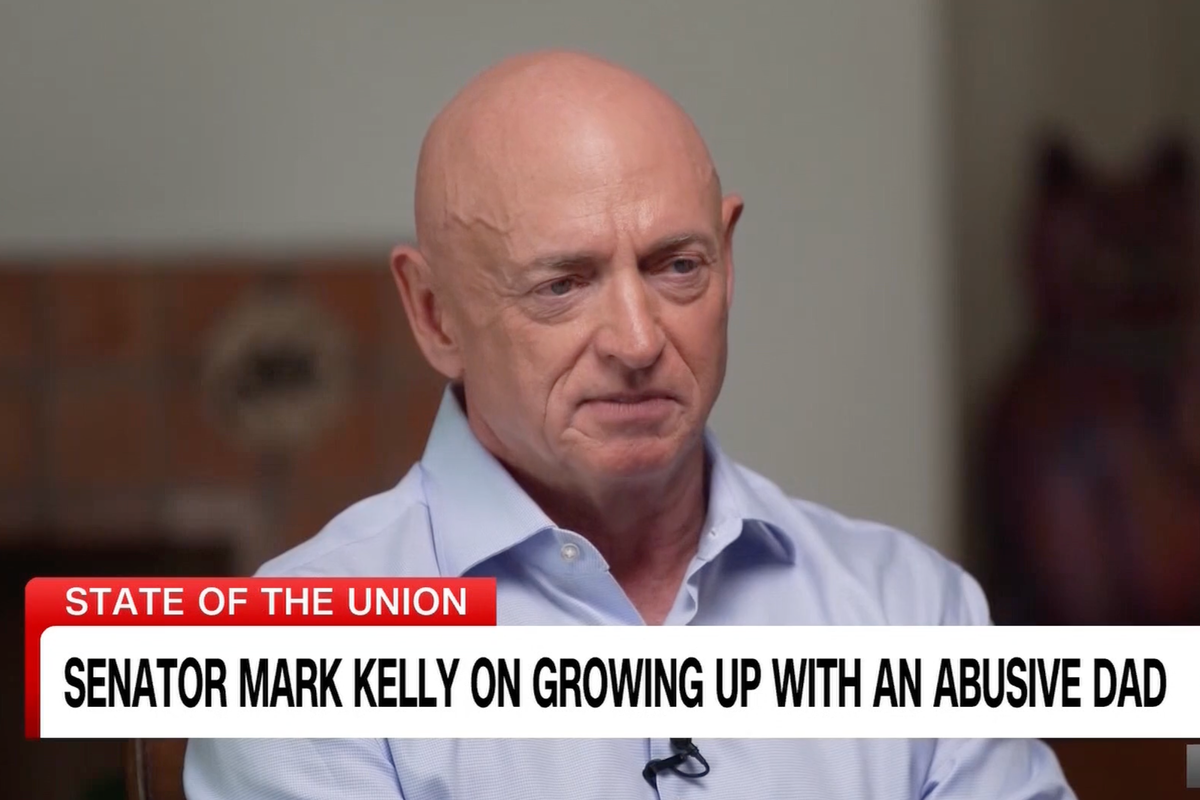
From the outside, the Kelly family looked like the picture of working-class achievement. Two parents working as police officers in West Orange, New Jersey. Twin boys, Mark and Scott, who would both grow up to navigate rocket ships into low-Earth orbit. Mark Kelly would eventually leverage that astronaut resume into a seat in the United States Senate, representing Arizona. It’s the kind of trajectory that sounds like a Hollywood script.
But behind the front door, the environment wasn't pristine. It was an unpredictable zone of terror. You might also find this related article interesting: What Most People Get Wrong About The Us Iran Peace Talks In Switzerland.
During an interview on CNN's "State of the Union," Senator Mark Kelly shared a heavy truth about his late father, Richard Kelly. The senior Kelly was a severe alcoholic. When he drank, he became violently abusive toward Mark’s mother, Patricia. For the first time, Kelly detailed the visceral trauma of waking up in the dead of night to the sound of his mother being dragged across the floor. He described the terrifying moment his father drew his service weapon during an argument, pointing the gun at his own head.
We love stories about exceptional people overcoming hard things, but we rarely look at the messy, confusing psychological adaptation required to survive them. Kelly's admission isn't just a political figure sharing a sad backstory. It's a stark look at how children process severe domestic instability, how they normalize the unthinkable, and what it actually takes to break a generational cycle. As highlighted in recent coverage by The Guardian, the implications are notable.
Normalizing the Chaos in the Middle of the Night
When you are eight or nine years old, your immediate world is your only baseline for reality. You don't have the emotional vocabulary or the broader life experience to recognize that your home life is completely broken.
Kelly admitted that he completely normalized the behavior at the time. He honestly figured that every other family down the block was dealing with the exact same midnight screaming matches. This normalization is a common survival mechanism for children stuck in volatile environments. If the chaos is normal, then it isn't an emergency you have to solve. Except, eventually, you realize nobody else is hiding under the bed while their parents fight.
The brain adapts to trauma by trying to find a predictable pattern within the madness. For the Kelly twins, that meant learning to recognize the warning signs of a bad night. It meant knowing when to stay quiet, when to step in, and when to run.
The Terror of the Service Weapon
The dynamics of domestic violence change completely when a firearm enters the equation. It shifts from a horrific situation to a potentially lethal one in a fraction of a second. Because both of Kelly’s parents were police officers, firearms weren't hidden away in a distant safe. They were a standard part of the household fabric.
Kelly recounted watching his father pull out his gun during an argument with his mother. But instead of aiming it at Patricia, Richard Kelly shoved the weapon toward his own face.
For a child, that kind of psychological warfare is paralyzing. Kelly noted that he wasn't even thinking about his own physical safety in that moment. Instead, his brain locked onto a singular, crushing fear: Am I one second away from watching my dad die?
That's the sick irony of childhood trauma caused by an abusive parent. You can desperately fear a person's behavior while simultaneously remaining terrified of losing them. The abuser and the protector are wrapped up in the exact same person. Kelly remembered trying to intervene, screaming at his father to stop, while his brother Scott ran out of the house to find a working phone or seek help because their dad had ripped the telephone lines right out of the wall.
When the Breaking Point Comes
The internal pressure cooker of an abusive, alcoholic home usually doesn't dissolve quietly. It ends with a crash. For the Kelly family, that crash happened when Mark was around 15 years old.
His father got drunk, climbed behind the wheel of a police cruiser, and crashed it.
That was the line. The accident forced Richard Kelly into a long-term rehabilitation facility for months. But for 15-year-old Mark, the damage was done. The trust was entirely gone. When his father finally returned from rehab, Mark completely froze him out. He refused to speak to him or have a single conversation for an entire year.
A lot of family therapists will tell you that anger is often a protective shield for deep grief. Freezing out a parent isn't an act of cruelty; it's an act of emotional self-preservation. When your environment has been unpredictable for a decade, a sudden shift into "recovery" doesn't magically make you feel safe. You build a wall because you can't handle getting hurt by the same person again.
The Work of Intentional Reconnection
If this were a typical, sanitized political memoir, this is the part where the dad gets sober, everyone hugs, and the scars vanish. But real life doesn't work that way. Healing is incredibly slow, uneven, and kinda uncomfortable.
The Kelly family did eventually find a way back to each other, but it took years of hard conversations and a deliberate choice to face the past. Richard Kelly did get sober, and he did eventually apologize to his sons for the wreckage he caused during their childhood.
Trauma Recovery Timeline:
[Age 8-14: Peak Abuse] -> [Age 15: The Police Car Crash & Rehab] -> [Age 15-16: One Year of Total Silence] -> [Adulthood: Long-Term Reconciliation]
Kelly didn't gloss over how complicated it was to rebuild that relationship. His father remained a highly complex figure in his life until his death. Breaking the cycle didn't mean pretending the violence never happened. It meant acknowledging the horror of those early years while still allowing space for his father's genuine effort to change.
Making a Different Choice
Growing up with an abusive, substance-dependent parent leaves you with two distinct paths. You either repeat the patterns you observed because they are deeply hardwired into your subconscious, or you make an active, daily choice to build a completely different reality.
Kelly was blunt about his mindset as he grew up: "I totally was not going to be my dad."
That level of intentionality is what separates people who break the cycle from those who get trapped in it. It requires an intense awareness of your own triggers, your own temper, and how you handle stress. Kelly poured that energy into the rigid discipline of naval aviation, test piloting, and eventually space flight—environments where absolute control and emotional regulation are matters of life and death.
According to data from the National Coalition Against Domestic Violence, 1 in 15 children are exposed to intimate partner violence every single year. Ninety percent of these kids are eyewitnesses to the actual violence.
When public figures like Kelly speak openly about these experiences, it chips away at the isolation that trapped kids feel. It refutes the idea that coming from a broken, violent home permanently ruins your chances of building a stable, meaningful life.
If you are currently trying to navigate the messy aftermath of a volatile childhood or trying to break ancestral patterns in your own home, the path forward requires concrete action, not just good intentions.
- Acknowledge the coping mechanisms: Recognize that behaviors that kept you safe as a child—like hyper-vigilance or emotional shutting down—might be hurting your adult relationships today.
- Find external spaces for emotional processing: Breaking deep-seated behavioral patterns rarely happens in isolation. Whether it's through trauma-informed therapy, support groups, or trusted communities, you need an objective space to unpack the past.
- Set firm boundaries with active addiction: You can love a parent or relative while completely refusing to participate in their chaos. True reconciliation can only begin when the abusive behavior has completely stopped.