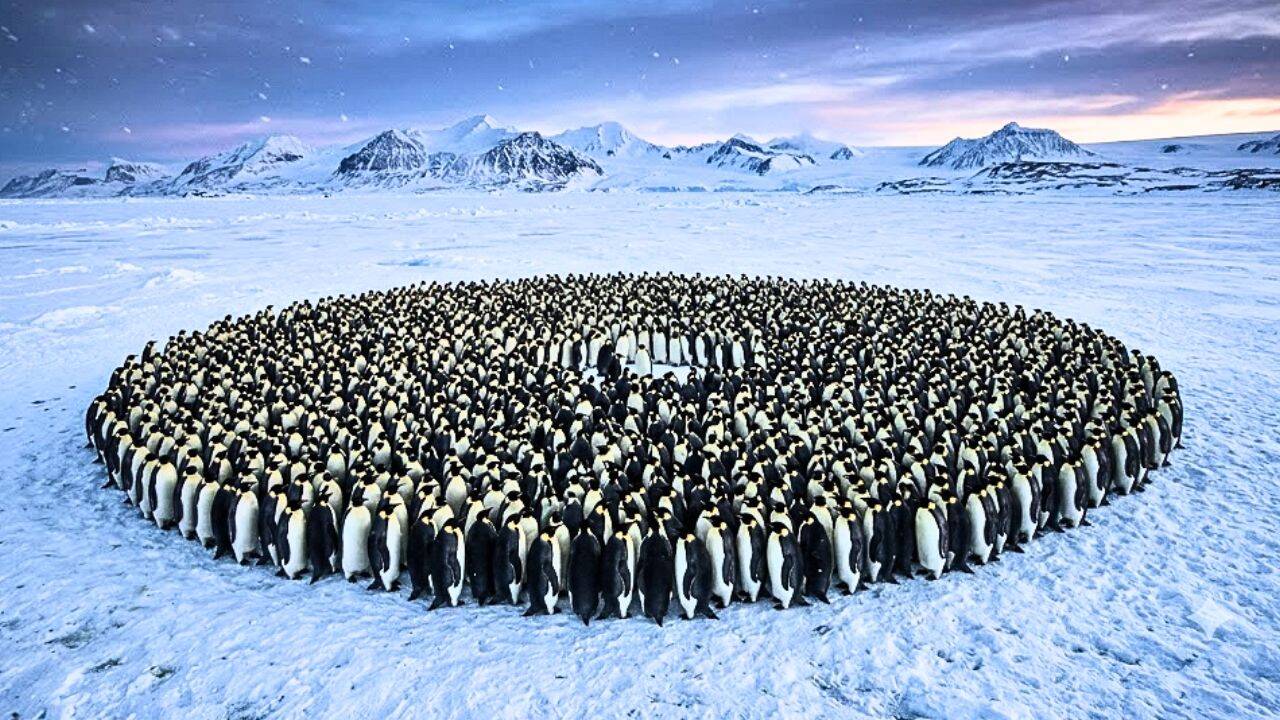
We love to romanticize nature. If you watch any mainstream wildlife documentary, you'll hear a dramatic narrator talking about the "spirit of cooperation" on the Antarctic ice. They'll tell you how emperor penguins, facing winds of 150 km/h and temperatures that drop below -40°C, selflessly take turns standing on the freezing outer edges of the pack so their buddies can stay warm in the center.
It is a beautiful story. It is also completely wrong.
The reality is far more fascinating, a bit colder, and driven by pure self-interest. According to mathematical models and physicists who study fluid dynamics, emperor penguins do not huddle out of the goodness of their hearts. They do it because they are greedy for heat.
And yet, this individual greed somehow creates one of the most perfectly equitable systems of teamwork on the planet. Here is how the math actually works, and why selfishness is the ultimate survival strategy in the coldest place on Earth.
The Myth of the Altruistic Penguin
Let's clear something up right away. Penguins do not have a democratic committee meeting to decide who stands in the wind. They don't have shift schedules.
When applied mathematicians François Blanchette, Aaron Waters, and Arnold D. Kim from the University of California, Merced, built a computer model of a penguin huddle, they started with a simple premise: what if every single penguin in the group only cares about its own temperature?
In their model, each virtual bird acts as a selfish agent. The rules they programmed were simple:
- Identify the direction of the wind.
- Calculate your own heat loss.
- If you are too cold, move to the warmest available spot on the sheltered side of the group.
When they ran the simulation, something incredible happened. Without any central leader, and without any "altruistic" rules programmed into the code, the virtual huddle behaved exactly like real-life penguin colonies. The entire group slowly drifted downwind, and every single penguin ended up spending roughly the same amount of time in the cozy interior.
The math proves that you do not need altruism to achieve equality. Individual selfishness naturally leads to a fair distribution of warmth.
The Math of Staying Warm in a Blizzard
To understand why this works, you have to look at the physics of wind flow.
When a colony of emperor penguins stands on the open sea ice, they are essentially a collection of thermal obstacles blocking the wind. The birds on the windward side (the side facing the wind) take the brunt of the cold. They act as a giant windbreak for the birds behind them.
Because of this shielding, the temperature inside a densely packed huddle can reach a staggering 37°C (98.6°F). That is a massive difference when the outside air is -40°C. In fact, it sometimes gets so hot in the center that penguins will start peeling off just to cool down.
Here is the step-by-step loop of how the huddle moves:
- The freeze: The penguins on the windward edge lose heat rapidly.
- The relocation: Exposed to the freezing wind, these cold penguins peel away from the front and walk around the sides of the huddle to the sheltered leeward side (the back).
- The shift: As these penguins pack themselves onto the warm, sheltered back of the huddle, the penguins who used to be safely in the middle find themselves slowly exposed to the front as the huddle shifts.
- The cycle repeats: The newly exposed penguins get cold, peel off, and head to the back.
This constant, selfish scramble for shelter causes the entire huddle to move downwind over time. It is a living, breathing conveyor belt of heat conservation.
The Traffic Jam Wave and the Two Centimeter Rule
While the UC Merced study explained why penguins move, a different study by physicist Daniel Zitterbart at the Alfred Wegener Institute looked at how they move.
If you look at time-lapse footage of a penguin huddle, they do not look like a chaotic swarm. They look like a solid mass. They pack themselves in a tight hexagonal grid—the mathematically optimal way to pack circles on a flat surface.
But if they are packed so tightly, how does anyone move without causing a massive pile-up?
Zitterbart and his team discovered that penguin huddles behave like traffic jams on a highway. The movement is not continuous. Instead, it travels through the crowd in waves.
Every 30 to 60 seconds, a single penguin will make a tiny step. This step is incredibly small—only about 2 centimeters. But that 2-centimeter gap is a signal. The neighbor immediately reacts by taking a step to close the gap. This reaction triggers a coordinated wave that propagates through the entire huddle at a speed of about 12 centimeters per second.
This "stop-and-go" wave does two things. First, it allows the huddle to reorganize and pack tighter without crushing anyone. Second, it keeps the physical structure of the huddle dynamic, allowing individuals to slide past each other toward the warmer interior.
Why Real Life Needs a Little Chaos
When mathematicians first built their models using perfect physics and absolute logic, they ran into a problem. The simulated huddles always ended up shaped like long, skinny cigars stretched out in the direction of the wind.
But real penguin huddles are usually rounded, blob-like shapes.
The researchers realized they had made a classic academic mistake: they assumed penguins are perfectly rational beings who always make the mathematically ideal move. In reality, penguins are birds. They get distracted. They trip on uneven ice. They make mistakes.
When the scientists introduced "noise" or random error into the model—meaning penguins did not always choose the absolute warmest spot, but sometimes just settled for a decent one nearby—the cigar shape collapsed into a more realistic, rounded blob.
It turns out that a little bit of chaos and imperfection is actually necessary to keep the huddle stable and functional.
How to Apply the Penguin Principle
The math behind penguin huddles is not just a cool piece of trivia. It is a prime example of emergent behavior—where complex, highly organized group patterns arise from simple individual rules.
We see this in human systems all the time, from traffic flow and crowd control to how data packets travel across the internet.
The next time you are trying to design a system, organize a team, or manage a project, don't overcomplicate it. You don't always need a heavy-handed manager or a complex set of altruistic guidelines to get people to work together. Sometimes, you just need to set up the right environment where individual self-interest naturally aligns with the collective good.
Find where the "wind" is blowing in your organization, make it easy for people to move toward shelter, and let the natural physics of the system do the rest.
You can watch this mesmerizing coordination in action in this Nature on PBS look at emperor penguin huddling, which clearly demonstrates the undulating waves of movement that keep the birds safe.