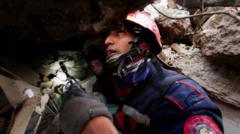
When a massive earthquake hits, the clock starts ticking with brutal speed. You see the headlines detailing the chaos, like the devastating twin earthquakes that rocked Venezuela recently, leaving over 1,450 dead and thousands trapped. Your first thought is probably about the technology. You imagine high-tech machinery, sci-fi style radars, and a fleet of drones instantly locating everyone beneath the rubble.
That is not how it works.
The reality of earthquake search and rescue is loud, dirty, and incredibly slow. It is a grueling race against the "Golden 72 Hours" — the critical window where a trapped person's chances of survival are highest. After three days, those chances plummet. To beat that clock, rescue teams do not just rely on fancy gadgets. They use a mix of ancient animal instincts and highly specific tech tools.
If you think technology has completely replaced traditional rescue methods, you are wrong. The most advanced sensors on Earth still cannot match a dog's nose. Here is the real story of how rescue teams actually find quake survivors when every single second matters.
The Canine Nose Still Rules the Rubble
Hollywood loves showing thermal cameras finding people under mountains of concrete. In the real world, concrete blocks thermal signals. Dust blocks vision. The tool that actually saves lives most consistently is the search dog.
Organizations like the UK International Search and Rescue (UK ISAR) and Canada's Burnaby USAR team recently deployed to Venezuela. What was the first thing they packed? Their search dogs. These animals are trained to detect the scent of living human beings, specifically the scent of sweat, breath, and blood drifting up through gaps in the wreckage.
The Training Behind the Scent
A rescue dog does not just happen. It takes years of intense preparation. The dogs learn to ignore the massive distractions of a disaster site. Think about it. A collapsed building smells like gas, burning plastic, rotting food, and sewage. There are sirens blaring, heavy machinery roaring, and panicked crowds shouting.
A standard pet would freeze or run away. A certified disaster search dog filters out all that noise. It focuses entirely on finding a single scent pool. When the dog locates a scent, it does not dig blindly. It barks or sits tightly at the spot where the scent is strongest. This tells the handler exactly where to focus.
The Safety Limits of Four Legs
Dogs are incredible, but they are not machines. They get tired. In a dusty environment, their nasal passages clog up quickly. They can cut their paws on sharp rebar and broken glass.
Handlers usually work dogs in short shifts, sometimes just 15 to 20 minutes at a time, before giving them a break to rest and clear their noses. Because of these physical limits, search teams need to supplement dogs with technology.
Listening for Signs of Life Deep Underground
When a dog flags an area, or when a specific zone is suspected of holding survivors, rescuers bring out acoustic and seismic listening devices. This is where precision electronics come into play.
Trapped survivors often try to signal for help. They might not have the lung capacity to scream, but they can scratch at a pipe or tap a concrete slab with a rock.
How Seismic Sensors Pick Up Micro Vibrations
Seismic listening equipment does not listen to the air. It listens to the structure itself. Rescuers place ultra-sensitive seismic sensors, called geophones, directly onto the concrete or metal beams.
These sensors act like super-powered microphones for solid objects. When a conscious survivor taps on a wall deep underground, that impact sends micro-vibrations through the debris. The geophone picks up these waves and converts them into acoustic sounds that a technician can hear through heavy-duty headphones. The control box also displays the signal visually using bar graphs.
The Triangle Method of Localization
To pinpoint exactly where the sound is coming from, rescuers use a method called the triangle technique. They place three separate sensors in a line or a triangle across the surface of the rubble.
- The team leader blows a whistle. Everyone on the site goes completely silent.
- Heavy machinery is shut down. Nobody moves.
- A rescuer strikes the ground with a metal bar and shouts down into the cracks: "Is anyone there? We are the rescue teams."
- The technician listens intently to the sensors.
If a signal comes back, the control box compares the intensity across all three sensors. The sensor closest to the victim will show the strongest signal. Rescuers gradually move the other two sensors closer to that hotspot, forming smaller triangles until all three sensors report the exact same signal intensity. That is how they know they are directly above the survivor.
Drones Offer a View From Above But Have Major Limits
You have likely seen drone footage of disaster zones. Drones are incredibly useful for mapping destruction, but their role in actually finding individual quake survivors is often misunderstood.
Mapping the Chaos
Immediately after an earthquake, the physical environment is unrecognizable. Roads are blocked by fallen buildings, electrical grids are down, and bridges are broken. Sending human scouts into this environment is dangerous and slow.
This is where drones shine. Rescue teams fly autonomous or pilot-directed drones over the affected area to create high-resolution 3D maps. This lets commanders see which buildings have completely pancaked and which ones are still standing. It helps them decide where to send teams first.
The Evolution of Acoustic Drones
Lately, researchers and teams have started experimenting with specialized drones equipped with microphone arrays. These fly close to the rubble to listen for screams or distress calls.
It sounds great in theory. In practice, it is incredibly difficult. Drones are loud. The spin of the propellers creates a massive amount of acoustic noise right next to the microphone. To fix this, advanced systems use digital signal processing algorithms to filter out the drone's specific frequency patterns, allowing the system to isolate human voices.
Even with this tech, strong winds or ambient city noise can render drone-based listening useless. Drones remain an excellent tool for structural reconnaissance, but they rarely find a buried survivor on their own.
Probing the Darkness with Cameras and Radar
Once the search area is narrowed down by dogs or seismic sensors, rescuers need to see what they are dealing with before they start cutting through concrete.
Telescopic Search Cameras
Rescuers use specialized search cameras attached to long, telescopic poles that can extend up to four meters. If there is a small gap or crack in the rubble, the camera head is snaked inside.
If there is no gap, USAR teams use heavy coring drills to create a neat 51mm hole straight through the concrete. They slide the camera through this hole to inspect the cavity underneath. These cameras have built-in LED lights, infrared night vision, and two-way audio communication modules.
Imagine being trapped in pitch darkness for 48 hours. Suddenly, a tiny camera slides through a hole, a light turns on, and a voice speaks to you from the surface. It allows rescuers to assess injuries and talk the victim through the rescue plan, providing vital psychological support.
Ultra Wideband Rescue Radar
What happens if the survivor is unconscious and cannot make a sound? This is the ultimate nightmare for search teams.
To solve this, modern teams use Ultra-Wideband (UWB) rescue radar. This device emits incredibly short electromagnetic impulses that can pass straight through up to 50 centimeters of dense concrete, brick, or wood.
The radar looks for motion. It does not just look for a waving hand. It is sensitive enough to detect the tiny, rhythmic chest movements of a person breathing. When the radar detects this movement, it calculates the exact depth of the victim, giving the extraction team a precise target.
Actionable Steps for Personal Earthquake Preparedness
While rescue teams have incredible tools, the best way to survive an earthquake is to be prepared before the ground shakes.
- Secure your space: Fix heavy furniture, bookshelves, and appliances to the walls using brackets. Most earthquake injuries are caused by falling objects, not collapsing buildings.
- Create an emergency kit: Keep a backpack by your door or under your bed. Include a flashlight, a whistle (to signal rescue dogs and seismic sensors), a first-aid kit, three days of water, and high-calorie food bars.
- Know your plan: Practice the "Drop, Cover, and Hold On" maneuver. Identify safe spots in every room, such as under sturdy tables or against interior walls away from glass windows.
When disaster strikes, the technology and the animals will do their work on the pile, but your immediate survival depends entirely on what you do in the first thirty seconds of the shaking.