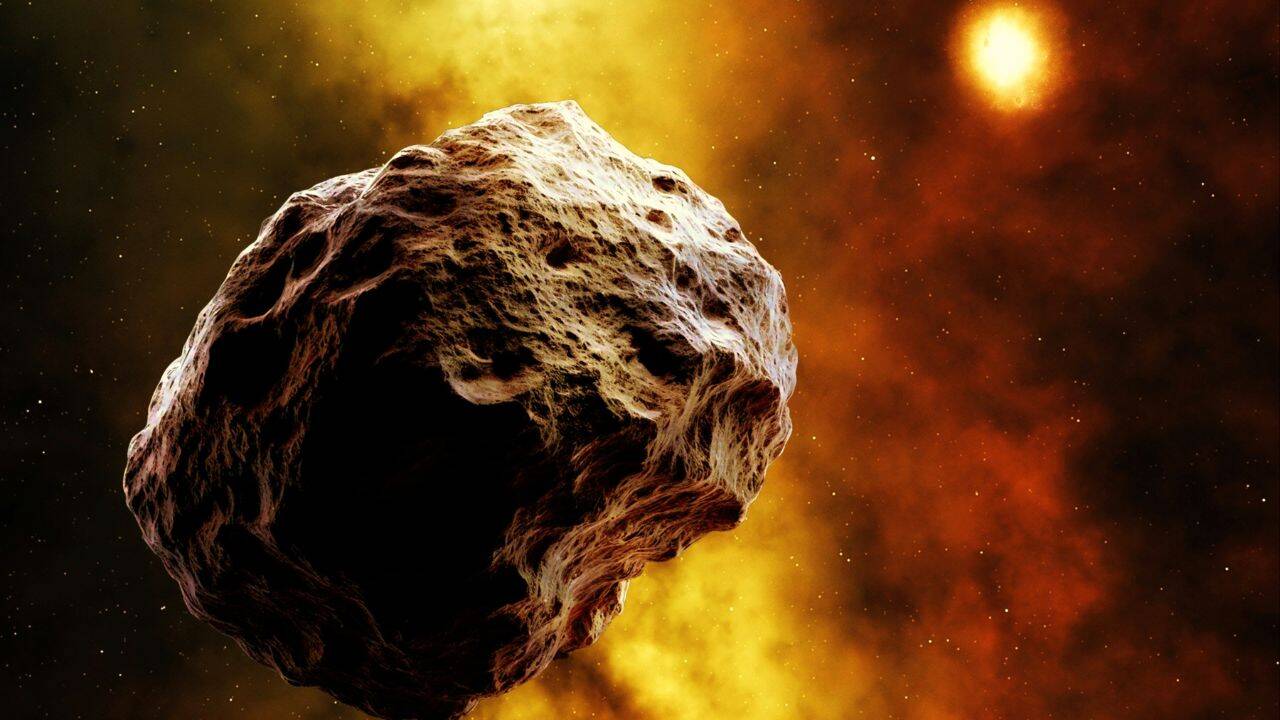
You have probably seen the breathless headlines about April 13, 2029. Tabloids love talking about the Apophis asteroid flyby like it is a looming doomsday scenario, a cosmic roll of the dice that might end civilization.
Let us set the record straight immediately. 99942 Apophis is not going to hit Earth in 2029. It is not going to hit us in 2036 either. In fact, radar data gathered in 2021 officially locked down its trajectory, ruling out any impact risk for at least the next century.
But just because we are safe doesn't mean this event is boring. What will actually happen on that Friday the 13th is arguably more insane than a Hollywood impact movie. A skyscraper-sized space rock will literally skim past our planet, passing closer than the giant communication satellites we rely on every single day. It is a once-in-a-millennium event, and nature is bringing the experiment right to our doorstep.
The Terrifying Reality of the Missing Distance
To understand why astronomers are losing their minds over Apophis, you need to understand the scale of its approach.
Apophis is massive. It measures roughly 1,100 feet across. That makes it taller than the Eiffel Tower and wide enough to span more than three football fields. When it makes its closest approach, it will slide within 19,000 miles of Earth's surface.
Think about that number for a second. Our geostationary satellites—the ones handling your TV signals and weather tracking—sit in orbit about 22,200 miles up. This means Apophis will cut inside our satellite ring. It will be closer to us than the moon is by a factor of ten.
We routinely see small asteroids fly inside this zone, but those are usually the size of a car or a house. An object as large as Apophis coming this close only happens once every few thousand years. We aren't just getting a front-row seat; we are practically on the playing field.
How to Actually See Apophis with Your Own Eyes
A common misconception is that you will need a massive research telescope to spot the asteroid. You won't.
If you are in the right spot on Earth, you can just look up. Around 90% of the world's population lives in areas where Apophis will technically be visible to the naked eye. It won't look like a burning meteor with a dramatic tail. Instead, you will see a distinct point of light—similar to a moving star—streaking surprisingly fast across the night sky.
The viewing schedule moves across the globe rapidly.
Australia gets the first look as the asteroid appears over the east coast, looking like a fast-moving dot gliding westward. It will travel at incredible speeds, crossing the width of a full moon in less than a minute.
From there, it crosses the Indian Ocean and moves directly over Africa. The absolute peak brightness will happen when Apophis passes over Cameroon. At that point, it will shine as brightly as the stars in the Little Dipper, offering perfect viewing conditions for billions of people across Africa, Europe, and Asia.
If you live in North America, you are mostly out of luck for the naked-eye show. The closest approach happens during daylight hours for the United States and Canada, meaning the sun will completely drown out the asteroid's faint light. By the time night falls in the West, Apophis will have already zoomed out into deep space.
Earth is About to Intentionally Break the Asteroid
Scientists aren't just watching Apophis; they are waiting to see how Earth's gravity violently alters the rock.
Apophis is an "Aten" class asteroid, meaning its orbit around the sun is currently smaller than Earth's annual path. When it flies past us in 2029, the massive gravitational pull of our planet will act like an invisible sling. It will permanently widen the asteroid's orbit, stretching its path around the sun and reclassifying it into the "Apollo" group of asteroids.
But the changes aren't just orbital. The tidal forces exerted by Earth's gravity will physically twist and squeeze the asteroid.
Because one side of Apophis will be significantly closer to Earth than the other, our gravity will pull unevenly. This will likely trigger massive internal shifts. Space agencies expect to witness actual asteroid quakes and surface avalanches in real-time. The asteroid's 31-hour rotational spin will also be radically altered, speeding up or stumbling into an entirely new tumbling motion.
The Multi-Million Dollar Missions Racing to the Rock
We aren't letting this opportunity go to waste. Two major space missions are actively preparing to intercept Apophis during its high-speed flyby.
NASA OSIRIS-APEX
NASA already has a spacecraft on the way. After the OSIRIS-REx mission successfully dropped off samples from the asteroid Bennu in 2023, scientists realized the spacecraft still had plenty of fuel left. They renamed it OSIRIS-APEX and redirected it toward Apophis. It will rendezvous with the asteroid right as it makes its close approach, tracking how the surface changes from the gravitational stress. NASA even plans to fire the spacecraft's thrusters directly at the asteroid's surface to blast away topsoil and reveal the pristine material hiding underneath.
ESA Ramses
The European Space Agency is building the Rapid Apophis Mission for Space Safety, or Ramses. The goal here is pure planetary defense. Ramses will meet up with Apophis before it reaches Earth, acting as a companion to film the entire flyby from a front-row seat. By observing how an asteroid behaves under intense gravitational strain, planetary defense teams can figure out exactly how solid or loose these space hazards really are. If we ever need to blow up or deflect a dangerous asteroid in the future, the data gathered from Apophis will tell us if our weapons will actually work or just turn one problem into a cloud of thousands.
Action Plan for the 2029 Flyby
Do not wait until April 2029 to figure out your plans. This is a highly localized astronomical event.
First, look at a visibility map online to see if your current city will actually get a dark night sky during the transit window. If you live in North America, accept right now that you will need to watch official livestreams from NASA or European observatories to see it move in real-time.
Second, if you are a serious astronomy enthusiast, book your travel early. Massive crowds of astrotourists are already planning trips to optimal viewing locations like the Canary Islands or the desert regions of North Africa, where clear skies and zero light pollution will guarantee an uninhibited view of the sky. Keep your eyes on the sky and stop worrying about the end of the world—this time, it is just a spectacular show.