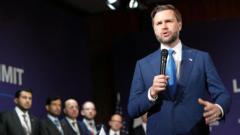
Don't let the scenic views of Lake Lucerne fool you. The high-level diplomacy kicking off at the luxury Bürgenstock resort in Switzerland isn't a victory lap. It's a high-stakes rescue mission.
Just days after Washington and Tehran signed a 14-point memorandum of understanding to halt the devastating US-Israeli war on Iran, top negotiators are meeting for a brutal 60-day sprint. The goal is to hammer out technical details for a permanent truce. But as US Vice President JD Vance and Iranian Parliament Speaker Mohammad Bagher Ghalibaf sit down with Qatari and Pakistani mediators, the fragile framework is already fracturing under real-world pressure.
If you want to know why this initial peace deal is teetering on the edge, look away from the Swiss mountains and focus on the two main choke points: the burning border of Lebanon and the heavily guarded waters of the Strait of Hormuz.
The Lebanon Blindspot
The core problem with the current agreement is that it relies on regional variables that neither Washington nor Tehran fully controls.
The first clause of the newly signed memorandum of understanding explicitly requires a ceasefire on all fronts. That includes Lebanon, where Israeli forces have dramatically ramped up attacks against the Iranian-backed militant group Hezbollah.
Iran claims that continued Israeli military operations in Lebanon directly violate the agreement. Because the US hasn't forced Israel to halt its campaign, Tehran has thrown a massive wrench into the Swiss proceedings. They kept the Strait of Hormuz closed.
This directly contradicts the initial spirit of the deal. Donald Trump touted the agreement just last week on Truth Social, telling the world to "start your engines" and let the oil flow. He warned that global oil reserves were only four weeks away from running out, threatening a worldwide recession. Now, the Iranian delegation is using the choke point as leverage. They won't open the shipping lanes until the US reins in Israel.
JD Vance acknowledged the crisis the moment he landed in Bürgenstock. He had to rewrite his own agenda on the fly. A schedule initially meant to focus strictly on unfreezing Iranian assets and lifting oil sanctions is now dominated by the escalating war in Lebanon.
Fury in Tehran and Political Vulnerability
Don't assume the Iranian delegation arrived in Switzerland with a unified mandate. Back in Tehran, a furious political civil war is exploding between reformists and hardliners.
President Masoud Pezeshkian has been desperately trying to calm the domestic mood. He publicly insists that every single provision of the memorandum of understanding favors Iran. He even went so far as to claim that Donald Trump's rhetoric has flipped 180 degrees. According to Pezeshkian, the only American demand is a signed guarantee that Iran won't pursue nuclear weapons—something Iran's leadership has historically claimed they don't want anyway.
But Iran's hardliners aren't buying it.
Mahmoud Nabavian, a prominent member of the Iranian political establishment and a fierce critic of the talks, has openly revolted. He claims the terms being discussed in Switzerland fundamentally violate the strict red lines originally set by the country's Supreme Leader, Mojtaba Khamenei. While the Supreme Leader permitted the talks to move forward out of deference to the president, that permission was entirely conditional on protecting the "axis of resistance" in Lebanon.
With Israel continuing its strikes, Iranian hardliners feel vindicated. They argue that the US cannot be trusted to enforce its side of the bargain. This domestic rift severely limits what the Iranian negotiators can concede during these 60 days. If they bend too much on the nuclear issue while Lebanon is under fire, the deal will be dead on arrival back home.
The 60 Day Technical Roadmap
If the mediators from Pakistan and Qatar manage to keep both sides in the room, the next two months will be an exhausting grind. The technical talks are split into two deeply interconnected phases.
Phase One: Compliance and Economics
Before anyone talks about long-term geopolitical strategies, the immediate focus is on economic relief and maritime security. Iran wants its frozen assets overseas unlocked and US sanctions on its oil exports dismantled. The US wants the Strait of Hormuz immediately reopened to stabilize global energy markets.
Phase Two: The Nuclear Question
This is the ultimate sticking point. The US wants airtight, verifiable guarantees that Iran will never develop the capability to build nuclear weapons. This means strict limits on uranium enrichment and intrusive international inspections.
What Happens Next
The Swiss foreign ministry has tightly secured the Bürgenstock complex to keep the prying eyes of global media away, but the clock is ticking loudly. JD Vance has indicated he can only remain at the resort for a couple of days before returning to Washington.
The immediate next step to watch isn't the rhetoric coming out of the luxury hotel suites. Watch the movement of oil tankers near the Persian Gulf and the intensity of missile strikes in southern Lebanon. If the quad-party meetings between the US, Iran, Qatar, and Pakistan fail to produce an immediate breakthrough on the Lebanon ceasefire, Iran's domestic political pressure will likely force its negotiators to walk away.
To keep track of whether these talks are succeeding, monitor the global price of crude oil over the next 48 hours. A sharp spike means traders are betting the Strait of Hormuz stays blocked, signaling that the Swiss peace initiative is failing behind closed doors.