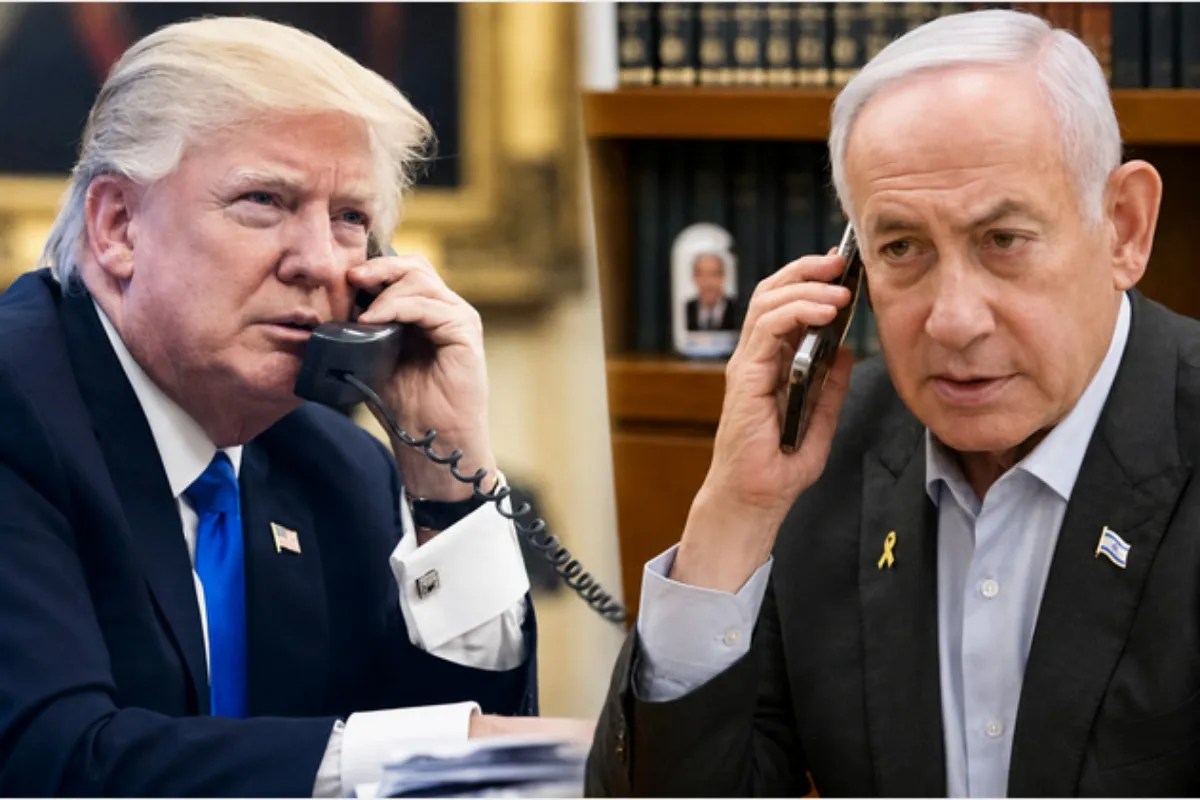
Benjamin Netanyahu just called Donald Trump to congratulate him on America's 250th Independence Day, but nobody is buying the pure holiday cheer. Behind the public pleasantries lies a frantic diplomatic scramble. The Israeli Prime Minister wants a face-to-face meeting at the White House, and Trump has publicly confirmed it could happen as early as next week or the week after.
But if you think this upcoming Benjamin Netanyahu Donald Trump phone call White House meeting is a sign of unbroken alliance, you're missing the real story. Meanwhile, you can read other events here: Why The Japan India Water Drama Highlights The Reality Of Geopolitics.
Trump didn't pull any punches when talking to reporters about the request. He openly bragged about his leverage. "We get along very good," Trump remarked before adding a line that turned heads across Jerusalem and Washington. "[Netanyahu] knows who the boss is."
That's not how world leaders usually talk about their closest allies. It sounds more like a corporate chief reminding a regional manager where the power sits. To understand why Netanyahu is willing to swallow that public humility and rush to Washington, you have to look at what's actually happening behind closed doors. To explore the complete picture, we recommend the detailed analysis by NBC News.
The Secret Friction Behind the Public Smiles
The relationship between these two men isn't what it used to be. The media loves to paint them as ideological twins, but the reality in 2026 is full of sharp edges. The upcoming White House meeting will be their first face-to-face sit-down since a dramatic, high-stakes meeting in the White House Situation Room back in February.
During that February session, Netanyahu presented a sweeping plan for a massive, joint military campaign against Tehran. He wanted a full-scale war to force regime change in Iran. What he got instead was a sharp lesson in Trump's current foreign policy priorities.
Trump didn't sign up for Netanyahu's war. Instead, he did something that shocked the Israeli security establishment. He signed a 14-point Memorandum of Understanding (MoU) that extended a ceasefire with Iran and restarted direct nuclear negotiations. Israel wasn't even invited to the table.
Think about how that looks for Netanyahu. He went to Washington looking for an American military blank check and walked away watching Washington cut a deal with his biggest adversary.
When Trump Called Netanyahu Crazy
The tension boiled over completely last month. Israel ramped up its military operations in Lebanon, crossing lines that Washington had explicitly warned against. Trump didn't hide his fury.
During a heated phone call in June, Trump lashed out at Netanyahu. According to administration officials, Trump explicitly called the Israeli Prime Minister "crazy" and accused him of profound ingratitude. Trump's frustration stems from a simple calculation. He believes Israel's continuous escalation in Lebanon is actively sabotaging his efforts to finalize a historic deal with Iran.
Trump wants a signature foreign policy win. He wants the deal. Netanyahu's military maneuvers keep getting in the way.
Trump has been pushing Netanyahu hard to scale back the Israel Defense Forces operations in Lebanon. He wants Israel to accept a framework agreement that begins with an immediate withdrawal from southern Lebanon. Netanyahu has resisted, creating a massive rift that is tearing at the edges of the traditional Republican-Israel alliance.
The MAGA Civil War Over Israel
It's not just Trump who's feeling the fatigue. The political ground under Netanyahu's feet has shifted dramatically within the conservative movement in the United States.
A few years ago, questioning Israel was a taboo subject for any Republican. Not anymore. Right now, influential figures within the MAGA movement are openly criticizing the relationship. Tucker Carlson and other prominent populist voices have corporate and grassroots ears, and they've been hammering Trump for being too tightly linked to Netanyahu's regional ambitions.
They're arguing that American interests shouldn't be held hostage by the political survival of a foreign leader. Trump hears this. He tracks his base's sentiment closely, and he knows that his voters aren't eager to get dragged into a prolonged land war in the Middle East just to satisfy Jerusalem's hardliners.
Netanyahu is Playing for His Political Life
So why is Netanyahu begging for this White House meeting right now? Look at the calendar. Israel is heading into a high-stakes general election this October.
Right now, Netanyahu is trailing badly in domestic opinion polls. His rivals are gaining ground, hammering him on security failures and economic strain. In Israeli politics, showing that you can handle the American president—that you can walk into the Oval Office and command respect—is a massive electoral asset.
Netanyahu needs that photo op. He needs to show Israeli voters that he is still the indispensable statesman who can manage Trump. If Trump gives him the cold shoulder, or if the meeting gets delayed indefinitely, it will send a clear signal to the Israeli electorate that Netanyahu has lost his magical touch with Washington.
An Israeli official noted that next week might be tough for a meeting because Trump is traveling to Ankara for the NATO summit on July 7 and 8. But Netanyahu's team is pushing for immediately after. They can't afford to wait.
The Iran Equation and Khamenei's Funeral
While Netanyahu watches the polls, Trump is watching Tehran. The context of this entire diplomatic drama is the fallout from the death of former Iranian Supreme Leader Ali Khamenei, who was killed at the start of the conflict.
Trump has been keeping a very close eye on the situation. He noted that the Iranians requested a temporary pause in negotiations for a week to conclude the funeral events surrounding Khamenei. Trump claims the Iranian leadership is absolutely desperate to lock in a deal with the United States. "They are begging to make a deal," Trump told insiders.
In true Trump fashion, he couldn't help but comment on the massive crowds at the funeral, admitting he was surprised to see so many people grieving someone he assumed was widely hated. But his focus remains on the transaction. He wants the treaty, and he wants it fast.
He even joked darkly about the concentration of Iranian leaders gathered for the funeral services, saying you could take them all out with one shot, but immediately dismissed the idea because then there would be nobody left to sign his contract. He wants a partner to sign the dotted line, not a vacuum of power.
What Happens Next
Don't expect the upcoming White House meeting to be a smooth rehearsal of old talking points. Netanyahu is walking into a trap of his own making. He needs Trump's blessing for his October election, but Trump is going to demand a steep price for that endorsement.
If Netanyahu wants that crucial public show of American solidarity, he will likely have to promise a real pullback in Lebanon and stop interference with the US-Iran nuclear tracks. Trump made it clear who the boss is. Now Netanyahu has to decide if he's willing to play the junior partner just to save his political skin at home.
Watch the statements coming out after the NATO summit closely. The real test won't be the initial handshakes, but whether Israel alters its military posture in southern Lebanon in the days immediately following the visit. That will tell you exactly who won the argument in the Oval Office.