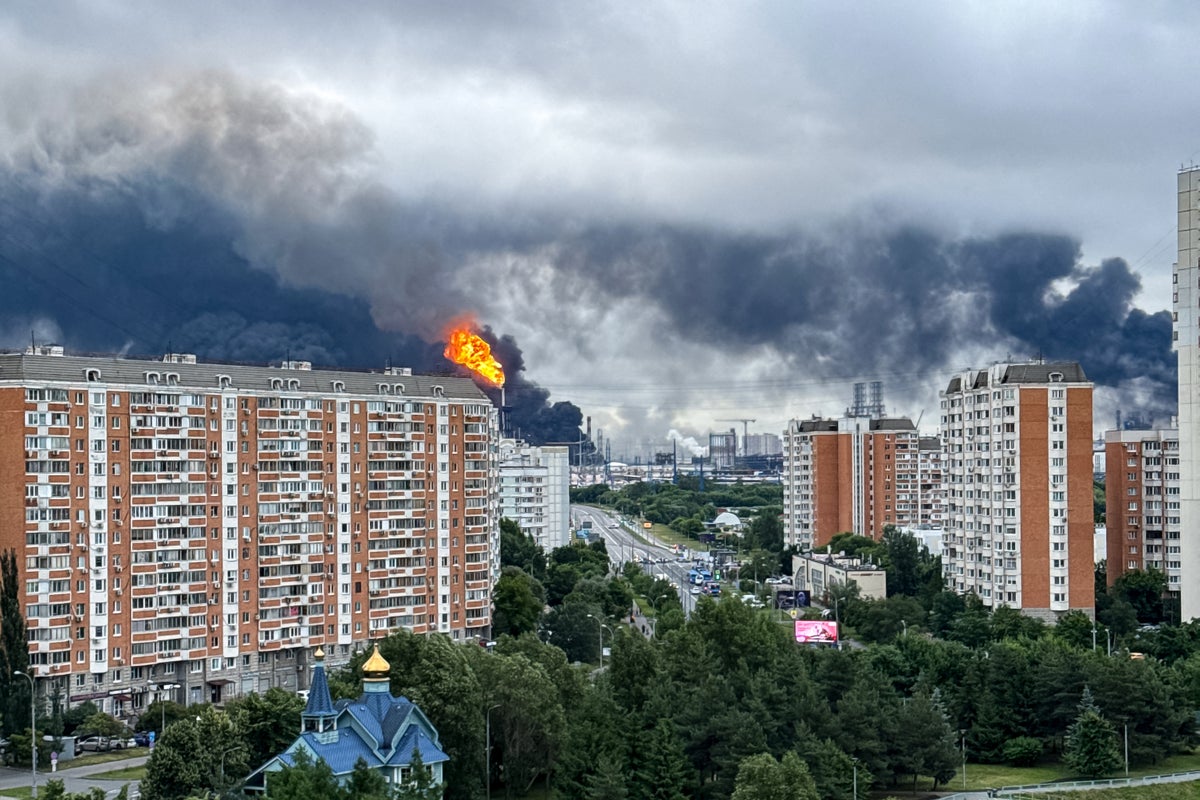
Ukraine just brought the reality of war directly to the doorsteps of the Russian elite. On June 18, 2026, a massive swarm of Ukrainian drones bypassed multiple air defense layers to slam into the Moscow Oil Refinery in Kapotnya, located just nine miles from the Kremlin. The resulting explosion sent a massive disc-shaped oil storage tank lid flying into the sky like a frisbee, turning the capital's southern horizon pitch black and raining down sooty, oil-slicked "black rain" on parked cars.
This wasn't a minor border skirmish or a symbolic pinprick. It was a targeted strike on an energy hub that supplies over a third of the fuel market in the Moscow region. It happened for the second time in a single week. While Russian state television barely whispered about the columns of smoke over the city, the strategic reality became impossible to ignore. Moscow is vulnerable, its air defenses are overstretched, and Ukraine is expanding its long-range drone campaign to hit Russia where it hurts most: its financial and energy heart. Meanwhile, you can find related stories here: Why South Korea and Japan Might Still Go Nuclear.
Moving Beyond Symbolic Damage to Real Industrial Choke Points
For years, critics argued that Ukrainian drone operations inside Russian borders were purely psychological operations meant to boost morale back home. This latest strike shatters that view. By hitting the primary refining infrastructure at Kapotnya, Kyiv knocked out a facility responsible for a massive chunk of Moscow's domestic fuel supply.
Expert analysis from the Carnegie Eurasia Center suggests the damaged processing unit accounts for roughly half of the refinery's primary capacity. In real numbers, that could instantly choke out 15% to 20% of Moscow's total fuel consumption. Within hours of the smoke clearing, Russia's federal anti-monopoly watchdog was already breathing down the necks of major fuel retailers, demanding explanations for sudden 19% hikes in popular gasoline grades. To explore the bigger picture, we recommend the detailed report by The Guardian.
The strategy here is cold and calculated. Ukraine isn't trying to match Russia's massive frontline artillery output shell for shell. Instead, they're using cheap, domestically produced long-range drones to squeeze Russia's war chest from the inside. They want ordinary Russian citizens to feel the direct economic weight of Vladimir Putin's decisions.
Behind the Failure of the Capital Protective Shield
The sheer volume of the assault caught Russian defense officials off guard. The Russian Defense Ministry claimed its air defenses shot down 555 drones across multiple regions overnight, with nearly 200 intercepted on their approach to Moscow alone. That is roughly double the volume of the missile and drone packages Moscow threw at Ukrainian cities during the exact same timeframe.
Even if you accept those high interception numbers, the fact that multiple drones got through to strike the single most heavily defended energy facility in the region points to systemic issues. Military analysts tracking the conflict note that Moscow is heavily reliant on Pantsir missile systems to guard its airspace. But these systems are struggling with a critical bottleneck.
Three intelligence sources familiar with the situation have confirmed that Russia is facing a growing shortage of interceptor missiles. Swarm tactics overwhelm the radar systems. Low-flying, composite-material drones are incredibly difficult for standard Russian radar networks to track. Without an extensive acoustic detection network or enough mobile fire groups to plug the gaps, the rings of protection around the capital are beginning to leak.
Splitting Putin's Focus and Puncturing the Illusion of Security
The timing of the strike served as a direct political embarrassment for the Kremlin. As the Kapotnya refinery burned and flight restrictions grounded more than 260 flights at Sheremetyevo and other major Moscow airports, Vladimir Putin was 700 kilometers away in Kazan. He was busy hosting prime ministers and heads of state from the Association of Southeast Asian Nations (ASEAN), trying to project an image of an unbothered, economically vibrant superpower.
While state media praised air defense performance and ran boilerplate footage of the Kazan summit, pro-government bloggers on Telegram were furious. Prominent state TV hosts openly called for the prosecution of Muscovites who uploaded videos of the burning refinery online, claiming that the footage allowed Ukrainian intelligence to assess damage and adjust the next strike.
That panic reveals the deeper tactical victory for Kyiv. By threatening assets deep inside Russian territory, from St. Petersburg to Moscow, Ukraine forces the Russian military into a logistical nightmare. They have to pull expensive air defense assets away from the active front lines in Donbas to protect fuel depots, rail lines, and political centers inside Russia proper.
A High Stakes Diplomatic Gambit in a Four Year War
This escalation comes at a pivotal diplomatic moment. Hours before the drones hit Kapotnya, Ukrainian President Volodymyr Zelenskyy held what he described as a critical coordination call with U.S. President Donald Trump and French President Emmanuel Macron. Zelenskyy used the momentum from the G7 summit in France to secure fresh pledges for air defense and technical assistance.
Zelenskyy's public messaging has taken a notably sharper, more aggressive tone. He openly stated that the refinery strikes are a direct response to Russian attacks on Ukrainian civilian infrastructure, including a recent strike that heavily damaged the historic Pechersk Lavra monastery complex in Kyiv. His warning to the Kremlin was unambiguous: if Ukraine is going to burn, Moscow will burn alongside it.
The primary objective is clear. Kyiv wants to force a breakthrough in diplomatic talks that have remained frozen for months. By proving that Russia cannot protect its own industrial base or its capital's airspace, Ukraine enters any future negotiations with a powerful hand.
Tracking the Strategic Shifts on the Ground
If you want to understand how this conflict is changing, look past the daily frontline maps and keep your eyes on these critical operational indicators.
First, track the volume and frequency of Ukrainian strikes targeting Russian oil assets located more than 500 kilometers behind the border. Continued success here indicates that Russian interceptor missile shortages are worsening.
Second, monitor domestic fuel pricing and export data coming out of the Russian Federation. Signs of localized fuel shortages or prolonged refinery shutdowns mean the economic squeeze is working.
Finally, watch the deployment of Russian air defense units. If satellite imagery reveals that Russia is moving anti-aircraft systems away from Ukraine's occupied southern and eastern regions to shield the capital, Kyiv's long-range drone strategy will have achieved its most significant tactical goal.