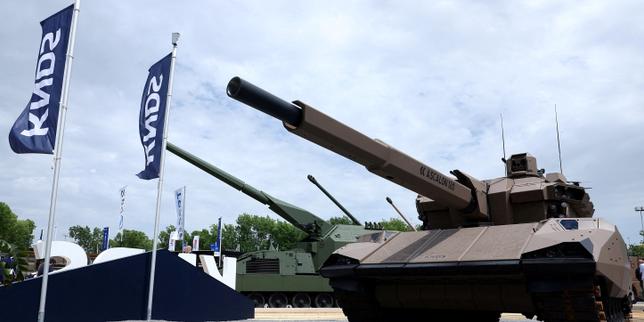
Just a week ago, the Franco-German tank manufacturer KNDS looked ready to pull off one of the biggest European stock market debuts in years. Bankers were lining up. Pre-marketing campaigns were flying. The dual listing in Paris and Frankfurt promised to give institutional investors a pure-play entry into a sector backed by a massive €33.1 billion order book.
Then everything changed overnight. On July 1, 2026, the defense giant abruptly hit the brakes.
It wasn't a minor delay. It was a complete U-turn. Officially, the company pointed to market volatility in the European defense sector. Unofficially, the cracks reveal a deeper clash over valuation, state control, and institutional cold feet. If you think the pan-European defense boom is an easy money machine, this sudden halt should wake you up.
The Trillion Euro Illusion of Defense Stocks
Let's look closely at why this deal froze.
The defense sector has seen surging order backlogs since geopolitical tensions flared across Europe. On paper, KNDS is a cash machine. In 2025, the company pulled in €4.4 billion in revenue and managed €661 million in earnings before interest and taxes. They build the legendary Leopard 2 tanks and Caesar howitzers. Armies across NATO want their gear, and they want it now.
But public markets are fickle.
Investing in defense isn't like buying shares in a standard manufacturing business. Investors are realizing that massive order books don't immediately translate to clean cash flows. Industrial ramp-ups require huge capital expenditure. KNDS itself projected spending roughly €750 million on property, plant, and equipment in 2026 alone.
When you pour that much cash back into factories, margins get squeezed. The company admitted its profit margin would drop in 2026 due to the scaling up of large domestic programs. Institutional investors looked at the declining short-term margins and started pushing back on the price tag.
The Family That Refused to Blink
You can't talk about KNDS without talking about who actually owns it. This isn't just a corporate entity. It's a complex marriage between the French state and Germany's private Wegmann group, controlled by the secretive Bode family.
Each side holds a 50% stake. To get this IPO off the ground, Germany's federal government agreed to buy a 40% stake from the Bode family. That move aimed to give Berlin a blocking minority while paving the way for a 20% public float.
The Bode family had a hard floor. They wouldn't settle for a company valuation below €12.5 billion.
- The French state wanted the liquidity and market validation.
- The German government wanted strategic oversight and stabilization.
- The private owners wanted their premium price.
When bookbuilding began, institutional investors hesitated. Rivals like Rheinmetall have experienced wild trading swings recently. Shares in major defense contractors dropped from their historic highs as markets priced in the realities of long-term production constraints and supply chain bottlenecks. The market simply refused to meet the Bode family's premium demands. Rather than accept a discounted valuation, the shareholders chose to walk away from the table.
Capital Markets Don't Care About Geopolitics
Many analysts assumed that because European defense spending is rising, any defense stock would fly off the shelves. That's a lazy assumption.
The reality of the 2026 capital markets is brutal. Inflation remains sticky. Interest rates have stayed higher for longer, meaning institutional funds have plenty of alternative places to park their capital for decent yields. If an IPO doesn't offer a clear, immediate upside, fund managers won't bite. They aren't buying into the hype anymore.
Furthermore, KNDS isn't a nimble startup. It's a massive, politically sensitive conglomerate. Any investor buying into a dual-listed entity in Paris and Frankfurt knows they are dealing with two distinct political masters. If France and Germany disagree on export rules to non-NATO countries, KNDS suffers. This political baggage adds a risk premium that institutional buyers want discounted from the final share price. KNDS refused to offer that discount.
What Happens Next for the Tank Maker
Don't expect KNDS to starve for cash without this public offering. Their massive multi-year backlog provides plenty of operational visibility. They'll continue building armor and expanding ammunition production lines in Munich and France.
However, the postponement throws a wrench into Europe's broader defense consolidation plans. Without public shares to use as currency, KNDS will find it much harder to launch cross-border acquisitions or merge with smaller tactical suppliers. They are stuck relying on traditional debt and state-backed injections.
Keep an eye on the German government's next move. If Berlin still intends to acquire its 40% stake directly from the Bode family outside of an IPO framework, it will require a massive direct hit to the German federal budget. That will trigger fresh political fights in Berlin over spending priorities.
The IPO isn't dead forever. The company insists it will resume the process when market conditions improve. But don't hold your breath. Until the valuation gap between stubborn private owners and cautious institutional fund managers closes, those Leopard tanks will stay off the stock exchange.
If you are tracking the defense sector, stop watching the order intake numbers. Start watching the free cash flow conversion and the actual cost of building new assembly lines. That's where the real story lives.