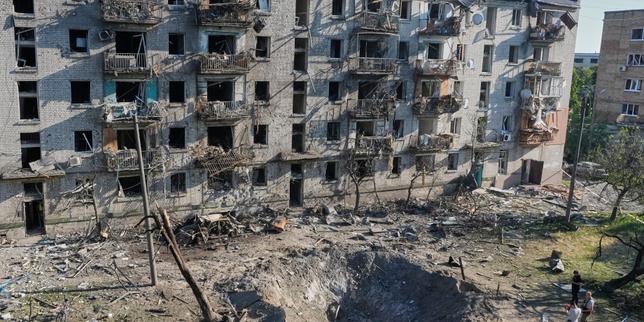
The sirens didn't just wail over Kyiv last night. They screamed for hours. If you think the air war in Ukraine has settled into a predictable, manageable pattern, yesterday's devastation completely shatters that illusion. Russia just launched what local officials are calling the single largest, most complex aerial assault on the Ukrainian capital since the full-scale invasion began more than four years ago.
We aren't talking about a few dozen stray drones. The scale of this attack is staggering, terrifying, and deeply revealing about where this war stands in the summer of 2026.
Ukrainian air defense teams pulled off near-miracles, but they couldn't stop everything. When you throw hundreds of targets at a city simultaneously, saturation happens. The math wins. The tragic result is at least 17 dead, dozens hospitalised, and entire sections of residential neighborhoods reduced to smoking rubble.
Let's break down exactly what happened, why the air defense net was overwhelmed, and what this tells us about the brutal new phase of this conflict.
Inside the Night of Horror
President Volodymyr Zelenskyy actually knew it was coming. Speaking from Dublin on Wednesday, he warned the nation that a massive, coordinated strike was imminent and scrambled to return to Kyiv immediately. He wasn't wrong.
According to the Ukrainian Air Force, Russia launched a staggering 74 missiles and a mind-boggling 496 drones in a single overnight barrage. Think about those numbers for a second. That is nearly 600 individual threats cutting through the night sky toward a single metropolitan area and its surroundings. It was a swarm designed specifically to bleed the city's air defense systems dry of ammunition.
The tactics were cruel but mathematically precise. First came waves of cheap, slow-moving Shahed-type suicide drones. They arrived from multiple directions, circling, zig-zagging, forcing Ukrainian mobile defense teams and surface-to-air missile units to track them, shoot them down, and expend precious interceptor missiles. Once the defensive net was thoroughly distracted and burning through its stockpiles, Moscow fired the heavy iron. Ballistic missiles, cruise missiles, and high-speed hypersonics slammed into the city while the drones were still clogging the radar screens.
Kyiv Mayor Vitali Klitschko didn't mince words on Telegram. He called it a night of terror, announcing that July 3 would be an official day of mourning in the capital.
The Physical Toll on the Ground
If you look at the footage filtering out of the capital, the destruction looks less like a targeted military operation and more like a deliberate attempt to erase civilian infrastructure.
Darnytskyi District Smashed
The worst destruction happened in the Darnytskyi district. A direct hit from a heavy missile tore clean through a nine-story apartment building. The first through sixth floors basically ceased to exist, collapsing into a mountain of concrete dust and tangled rebar. Rescue workers spent the morning digging through the debris with their bare hands, searching for families trapped underneath the weight of their own homes.
Holosiivskyi and Sviatoshynskyi Under Fire
The terror wasn't isolated. Over in the Holosiivskyi district, a 16-story building caught fire after being struck by falling debris or an intercept remnants. In Sviatoshynskyi, fires tore through private residences, trapping people in the ruins.
The Medical Infrastructure Hit
Perhaps the most cynical strike hit an ambulance station. Nine emergency vehicles were completely blown apart or shredded by shrapnel, and six medical staff members and drivers were wounded while preparing to go out and save lives. When you attack the people who treat the wounded, you aren't fighting a war. You're terrorizing a population.
The Retaliation Myth
The Russian Defense Ministry quickly issued a statement claiming they targeted key military plants, airports, and energy facilities. They also spun a narrative that this massive strike was direct retaliation for recent Ukrainian actions. Kremlin spokesman Dmitry Peskov warned that Russia would continue to increase pressure on Kyiv.
Don't buy into the Kremlin's retaliation narrative.
Yes, Ukraine has been executing a highly successful long-range drone campaign over the past few weeks, famously dubbed the "40 days" operation. These Ukrainian strikes hit massive Russian oil refineries, including a major facility near Moscow, causing widespread fuel shortages and major supply line disruptions inside Russia. Vladimir Putin even publicly admitted that these strikes were driving fuel crises.
But calling this overnight massacre "retaliation" implies that Russia wouldn't have done it otherwise. That's a fundamental misunderstanding of how Russia operates. An attack involving nearly 500 drones and 74 missiles takes months of planning, manufacturing, stockpiling, and intelligence gathering. You don't put together a 600-projectile strike over a weekend because your refinery got hit. This was a long-planned attempt to break the back of Kyiv's defenses.
Ukrainian Foreign Minister Andrii Sybiha, speaking from a diplomatic visit to Japan, rightly pointed out the immorality of the retaliation argument. In his words, there's an aggressor and a country defending itself. Ukraine has every right under Article 51 of the UN Charter to strike military targets inside Russia to protect its people. Russia has zero right to rain fire on apartment blocks in Kyiv.
The Cold Math of Air Defense Saturation
We need to talk honestly about why this happened despite billions of dollars in Western military aid. Ukraine has some of the best air defense systems in the world right now. Patriots, NASAMS, IRIS-T, and specialized electronic warfare units protect the capital.
The system works. It shot down the vast majority of the incoming threats last night. But the sheer volume of the attack exposed a critical truth. No air defense system is flawless when subjected to mass saturation.
If Russia fires 496 drones and 74 missiles, and the defense system stops 90% of them, that still leaves dozens of highly destructive projectiles getting through. Reports indicate that at least 25 ballistic missiles and 12 drones managed to pierce the umbrella, striking 33 different locations across the city.
The problem is twofold:
- Interceptor Scarcity: A Patriot missile or an IRIS-T interceptor costs millions of dollars. More importantly, they take a long time to build. Russia is using cheap, mass-produced drones to force Ukraine to use up these high-end interceptors. When the interceptors run low, the ballistic missiles get through.
- Radar Overload: Every radar system has a maximum number of targets it can track and engage at one time. When hundreds of drones fill the skies simultaneously, the system can get overwhelmed, allowing faster, more lethal missiles to slip past undetected or unengaged.
The anxiety isn't just felt in Kyiv. Neighbors are panicking too. Poland scrambled fighter jets as a preventive measure during the attack, watching the radar tracks closely to ensure no stray Russian missiles crossed into NATO airspace. We are one tracking error away from a much wider European conflict.
Immediate Action Needed to Protect Ukrainian Skies
This attack shouldn't result in more hand-wringing or generic statements of condemnation from Western capitals. It requires immediate, practical shifts in military supply chains. If the West wants to prevent Kyiv from being systematically ground into dust, these steps must happen now:
Flood Ukraine with Geared Gun Systems
Using a multi-million dollar missile to destroy a $20,000 drone is a losing strategy. Ukraine needs an immediate, massive influx of automated, radar-guided anti-aircraft gun systems like the German Gepard or similar mobile point-defense platforms. These systems use kinetic ammunition to shred drones at a fraction of the cost, preserving high-end missiles for the ballistic threats.
Unshackle the Rules of Engagement
The West needs to completely lift all remaining restrictions on how Ukraine uses long-range Western weapons. The only way to stop these massive air raids is to destroy the bombers on the tarmac and the missile launchers in the fields deep inside Russian territory before they can fire. Forcing Ukraine to fight a purely defensive air war inside its own borders is a recipe for endless civilian casualties.
Establish Direct Logistical Pipelines for Interceptors
Allies must prioritize manufacturing lines for Patriot and NASAMS interceptors, treating them not as occasional aid packages but as a continuous, active supply line. The current trickle-and-pause approach leaves predictable windows of vulnerability that Russian intelligence quickly exploits.