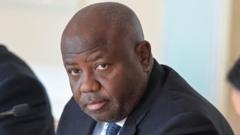
You don't see an entire national cabinet quit overnight very often. Yet, that's exactly what just went down in Equatorial Guinea. Prime Minister Manuel Osa Nsue Nsua and his entire ministerial team packed up their offices and handed in their collective resignation.
The official reason? They supposedly failed to meet their goals. In similar news, take a look at: Why Chasing Beijing Validation Is the Ultimate Lifeline for Myanmar.
Vice President Teodoro Nguema Obiang Mangue announced the move on X, stating the cabinet had barely hit 10% of its targets. He wrote that public responsibility must come with results, adding that the state provided significant resources only to get an "insufficient" performance in return.
But if you look past the official press releases, a much deeper story emerges. In a nation ruled by the world's longest-serving president, political reshuffling is rarely just about meeting Key Performance Indicators (KPIs). It's a calculated survival tactic designed to protect the ruling family while giving the public a convenient scapegoat for a tanking economy. TIME has analyzed this fascinating issue in great detail.
The Performance Excuse vs Economic Reality
Let's look at the numbers. The ruling Democratic Party of Equatorial Guinea claimed this mass exit was part of a routine institutional reorganization to adapt to new state priorities. They pointed out that the outgoing government had worked on infrastructure, public administration, and economic development.
What they skipped over was the macroeconomic reality. According to data from the Ecofin Agency, Equatorial Guinea's gross domestic product contracted by an estimated 5.4% in 2025. This comes after a period of stagnant, incredibly modest growth in 2024. The country's structural weaknesses run deep. Unemployment sits at a stubborn 13.7%, and formal employment opportunities are rare for the average citizen.
When a government says its cabinet achieved "barely 10 percent" of its goals without ever naming what those goals actually were, it's a red flag. You don't fire a whole administration because they missed a vague checklist. You fire them because the economic pain is getting too loud to ignore, and someone's head has to roll.
Keeping Power in the Family
To understand why this happens, you have to understand who really pulls the strings. President Teodoro Obiang Nguema Mbasogo has been in power since 1979. He took control via a bloody coup, overthrowing his brutal uncle, and has managed to hold onto that seat for nearly half a century.
The man delivering the news about the cabinet's failure wasn't just any government official. It was Vice President Teodoro Nguema Obiang Mangue, who also happens to be the president's son and presumed successor.
This isn't the first time this script has been played out. Go back to August 2024. The previous Prime Minister, Manuela Roka Botey—the first woman to ever hold the position in the country—was forced out after just 18 months. The president called her administration "ineffective" and blamed them for a collective inability to solve corruption and economic stagnation.
So, Manuel Osa Nsue Nsua, a former bank director, was brought in to save the day. He lasted less than two years before facing the exact same fate.
See the pattern? The prime minister position in Equatorial Guinea isn't a seat of true executive power. Kinda looks like a shield. When the economy tanks or public frustration builds over oil wealth disappearing into luxury lifestyles instead of public infrastructure, the Obiang family simply dissolves the cabinet. It lets them hit the reset button, blame the bureaucrats, and pretend they're taking decisive action to fix the country.
The Oil Curse and the Illusion of Accountability
Equatorial Guinea is a major oil producer in West Africa, yet the vast majority of its population lives below the poverty line. Organizations like the United Nations and Human Rights Watch have spent decades calling out the extreme wealth disparity and the severe repression of political dissent.
The state has the money. It just doesn't make it to the streets.
When the Vice President lectures the public about how the state puts "significant human, material, and financial resources" at the disposal of the government, it sounds like an accountability speech. It's not. True accountability doesn't exist in a country where the lower house is completely dominated by the ruling party and the Senate hasn't held a meaningful opposition seat in over a decade.
What we're seeing right now is a regime managing its own survival. By framing the economic crisis as a failure of administrative execution rather than a failure of systemic governance, the ruling family shifts the blame away from their 47-year rule.
What Happens Next
Don't expect a sudden wave of democracy or a massive shift in economic policy. The playbook here is highly predictable.
- A new Prime Minister will be named shortly. The president will likely choose another technocrat or financial insider, just like he did with the former bank chief in 2024.
- A "new vision" will be announced. The state media will promote a fresh set of economic targets focused on diversifying the oil-dependent economy.
- The core power structure will remain untouched. True decision-making power stays firmly within the presidential palace.
If you're watching geopolitical trends in Central and West Africa, keep your eyes on the Vice President's movements. His highly public role in firing this cabinet is a clear sign that he's continuing to cement his authority as the face of governance, preparing the ground for an eventual dynastic succession. The players change, but the game stays exactly the same.


 (1)-1725271686977.jpg)