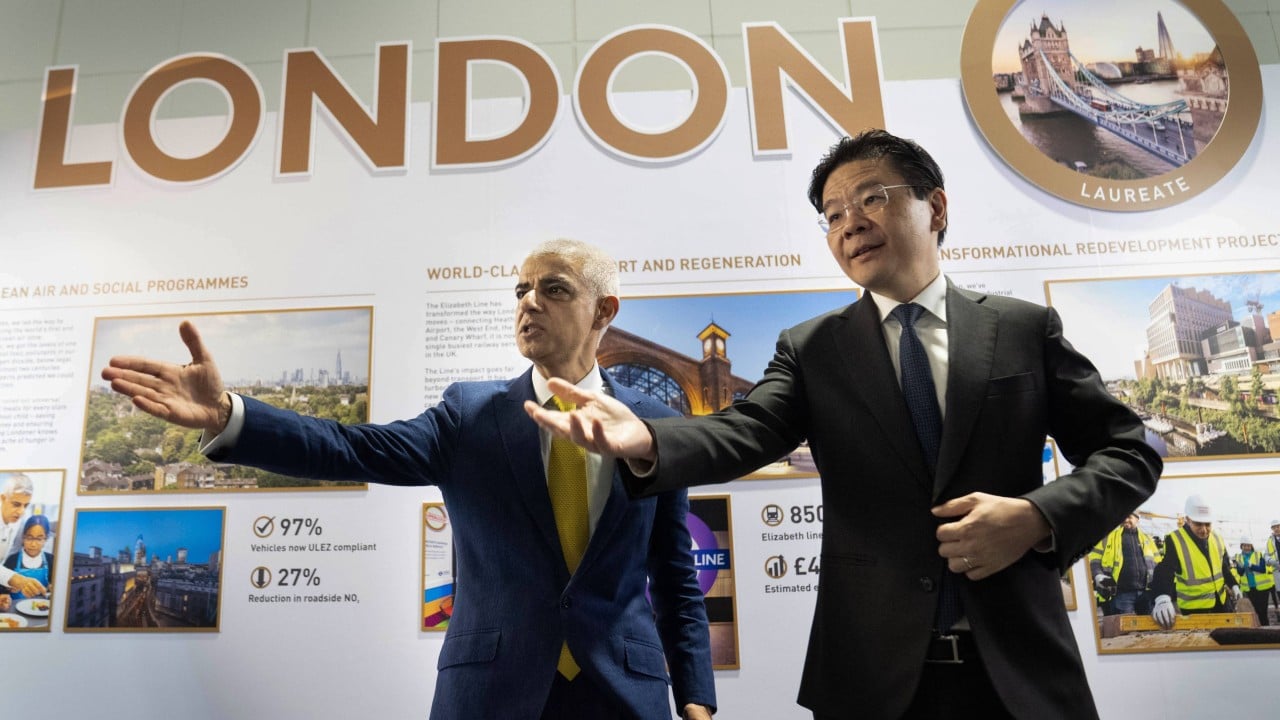
When London Mayor Sadiq Khan posted a photo of himself grinning against the Marina Bay skyline this week, he probably expected the usual diplomatic platitudes to roll in. Instead, his caption calling London and Singapore two global powerhouses uniting ignited a fierce digital brawl over city reputations. Critics immediately ripped into the comparison.
The backlash highlights a growing frustration with how politicians talk about global cities. London and Singapore share deep historical ties and massive financial influence, but treating them as matching pairs ignores reality. One is a sprawling, historic capital wrestling with infrastructure decay and public safety crises. The other is a hyper-managed, highly disciplined city-state where the streets are spotless and crime is famously negligible. They are not equals in the way they function, and pretending they are only infuriates residents who deal with the stark differences daily.
The real debate isn't about which city has more skyscrapers or bigger banks. It is about how they are governed, how safe people feel on their streets, and whether a Western democracy can successfully mimic the top-down municipal strategies of an East Asian city-state.
The Social Media Backlash That Broke the Diplomatic Script
Sadiq Khan arrived in Singapore to accept the 2026 Lee Kuan Yew World City Prize on behalf of London, a major accolade celebrating urban innovation. He also used the trip to lead a high-profile trade mission aimed at bringing tech and real estate investments back to the UK. But the marketing push hit a wall when Khan tried to frame the two cities as identical urban titans.
Commenters on X and Instagram wasted no time pointing out the safety gap. While Londoners frequently complain about knife crime, phone snatches, and open fare evasion on the Underground, Singapore remains a place where people leave their laptops unattended on cafe tables to save a seat. The contrast is jarring. Critics noted that you do not get randomly mugged or watch people casually hop ticket barriers in Singapore without immediate, severe consequences.
This pushback exposes a massive disconnect. To the political class, global powerhouses are measured in foreign direct investment, banking assets, and corporate headquarters. To ordinary citizens, a global powerhouse doesn't mean much if you have to look over your shoulder while checking your phone at a bus stop. By flattening the two cities into a single marketing catchphrase, the mayor inadvertently invited a harsh audit of his own city's public safety record.
Law and Order vs Personal Freedom
To understand why the comparison falls flat, you have to look at how each city defines the relationship between the state and the citizen. Singapore operates on a model of strict social engineering and high surveillance. It prioritizes collective order over individual liberty.
- Public safety metrics: Singapore consistently ranks near the top of global safety indexes. Vandalism, petty theft, and violent crime are met with swift judicial penalties, including caning and the death penalty for drug trafficking.
- The surveillance network: The city-state is blanketed by thousands of police cameras, and the government maintains tight control over public protests and political speech.
London approaches governance from the exact opposite direction. It is a city built on centuries of civil liberties, political dissent, and individual freedom. It is messy, loud, and unpredictable.
- The enforcement crisis: London's Metropolitan Police has struggled with underfunding, systemic trust issues, and rising rates of anti-social behavior. Shoplifting and low-level thefts are frequently left unprosecuted, driving a sense of lawlessness in certain commercial districts.
- The freedom trade-off: Londoners value their right to protest and live without intrusive state interference. But that same openness makes the city far harder to police than a compact island nation of six million people.
When critics say the former colony has surpassed its former colonial master, they are reacting to this visible divergence in day-to-day order. London feels like it is managing decline, while Singapore feels like it is executing a flawless, albeit rigid, script.
Can London Really Build Houses Singapore Style
The most tangible outcome of Khan's visit was the announcement of a 100 million pound investment into a new housing development scheme at Silvertown in the Royal Docks. The mayor proudly declared this the launch of a Singapore-style housing development arm for London, aiming to deliver 7,000 new homes. He wants City Hall to act as a direct developer, taking a leaf out of Singapore's legendary Housing and Development Board book.
On paper, learning from Singapore makes total sense. The city-state is a global anomaly in public housing. Around 80 per cent of Singapore residents live in government-built flats, and the vast majority own their homes through a unique system backed by the Central Provident Fund. It has effectively eliminated the housing affordability crises that plague almost every other major Western capital.
But trying to export this model to London ignores the fundamental structural differences in land ownership and legal frameworks.
The Land Ownership Monopoly
Singapore's government owns roughly 90 per cent of the land in the country. This allows the state to acquire land easily, plan decades in advance, and build massive, integrated estates without getting bogged down in legal disputes with private owners.
London is a fragmented patchwork of private estates, historic landowners, borough councils, and corporate developers. City Hall does not own the land. Buying it up at market rates to build public housing is astronomically expensive and legally tortuous. A 100 million pound investment is a drop in the ocean when compared to the multi-billion-pound budgets required to overhaul London's housing market.
Planning Bottlenecks and Local Politics
In Singapore, if the government decides to build a new public housing estate, it builds it. Local opposition is minimal, and the planning process is centralized.
In London, every major development faces an army of local objectors, heritage protection laws, environmental impact assessments, and political squabbling between local boroughs and the central government. The planning system is slow and combative. Khan's initiative to make City Hall an active developer is an ambitious step, but it faces structural hurdles that simply do not exist in Southeast Asia.
The Real Economic Underpinning of the Alliance
Despite the social media warfare, the economic relationship between London and Singapore is real, massive, and expanding. The total trade in goods and services between the UK and Singapore reached 28.3 billion pounds in 2025. Singapore is the UK's 19th largest trading partner, acting as a crucial gateway into the wider Asia-Pacific region.
The capital flows run deep in both directions.
- Real estate investments: Singaporean sovereign wealth funds and private developers are major players in London's skyline. In 2022, Singapore's sovereign wealth fund GIC purchased a massive stake in the Paddington Central development for 694 million pounds. The Royal Group of Companies has poured 110 million pounds into a luxury hotel project in Piccadilly.
- Capital injection: Singaporean bank OCBC recently partnered with the UK government to unlock 10 billion pounds of investment into UK energy, infrastructure, and real estate sectors.
This is why Khan was banging the drum in Singapore. London desperately needs Asian capital to fund its infrastructure projects and regeneration schemes. The diplomatic posturing might look silly on social media, but behind the scenes, the financial ties are essential for London's economic survival post-Brexit.
Moving Beyond Surface Level City Comparisons
We need to stop using lazy comparisons that treat completely different urban centers as interchangeable nodes on a global map. London winning the Lee Kuan Yew World City Prize shows that it still possesses immense cultural clout, a talent pool, and a capacity to reinvent itself. Its diversity and openness remain its biggest strengths, drawing in creative minds and innovators from every corner of the earth.
But city leaders cannot use international awards to obscure domestic failings. When a mayor travels abroad to study world-class infrastructure, the takeaway should not be a superficial social media post about matching powerhouses. The takeaway must be an honest acknowledgment of what is broken at home.
If London wants to implement Singaporean efficiency, it cannot just copy the branding. It needs to address the foundational issues holding the city back. That means fixing the broken planning system, reforming public safety enforcement, and ensuring that municipal investments are not swallowed up by bureaucracy.
To get maximum value from tracking these global urban trends, stop looking at the polished PR statements and focus on the structural mechanics. Look at how land is utilized, how local budgets are allocated, and how public transport systems are funded. True urban improvement comes from adapting specific policy mechanisms to your own city's unique political realities, not from pretending your city is something it isn't.