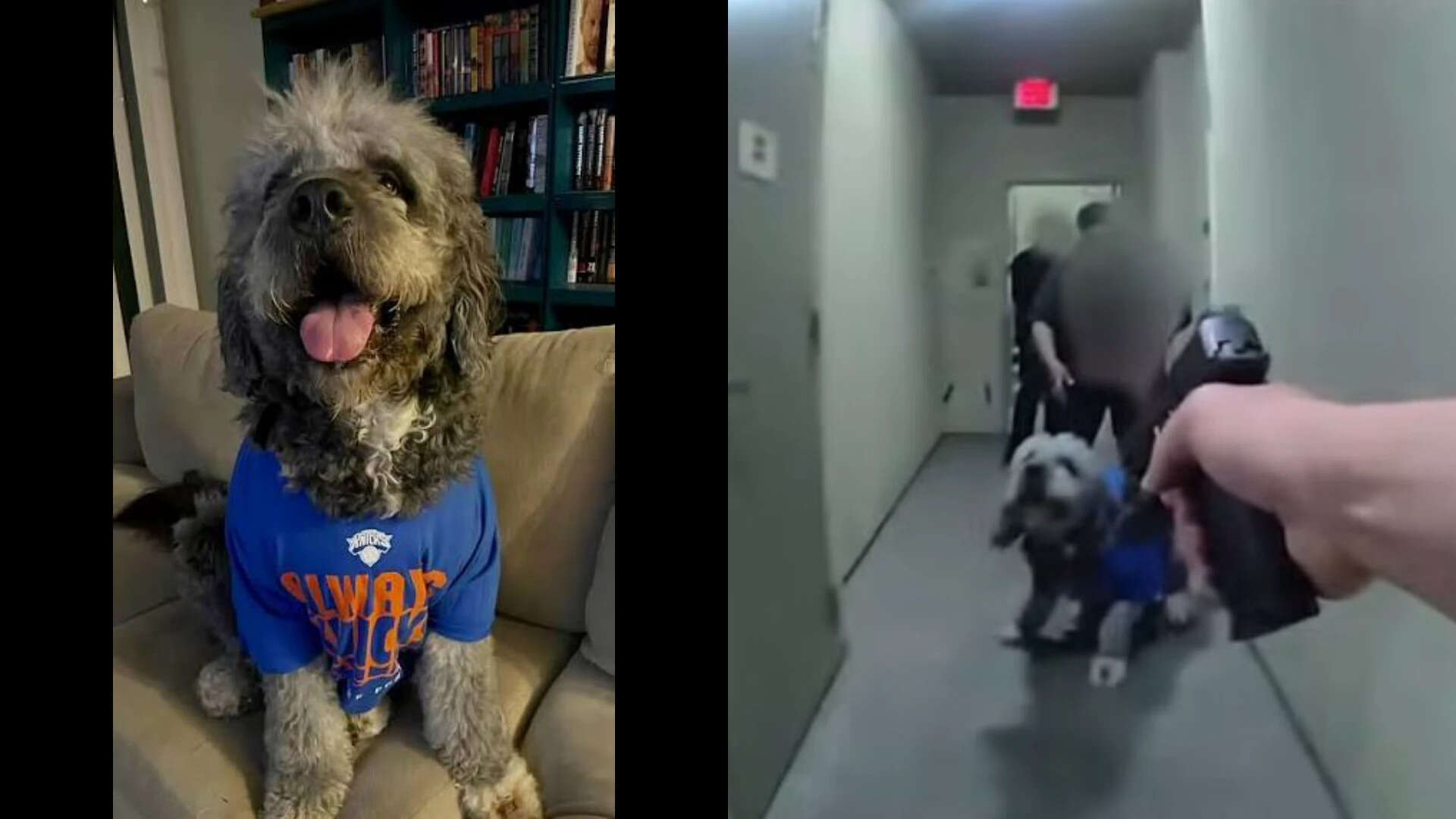
A joyful sports celebration should never end with a dead family pet and a federal lawsuit. Yet that is exactly what happened in Canoga Park when a Los Angeles Police Department officer shot a 106-pound Labradoodle named Jameson. The dog was wearing a New York Knicks t-shirt. He was shot four times in a regular apartment hallway. Now, his owner is fighting back in court, raising serious questions about how law enforcement officers handle domestic animals.
Marie Marseille filed a federal lawsuit against the city of Los Angeles and the involved officers. The complaint states clearly that Jameson did not growl, bare his teeth, or try to attack anyone. The filing alleges excessive force, negligence, and a complete failure by the department to follow its own internal rules. This case highlights a massive gap between how police are trained to react and how companion animals actually behave.
For pet owners everywhere, this case is a nightmare scenario. It shows how quickly a misunderstanding can turn fatal when officers default to lethal options.
The Fatal Misunderstanding Built on Bad Timing
The incident happened because a fan was happy. Marie Marseille, a 45-year-old nurse, is a lifelong New York Knicks fan. When the Knicks won their first NBA championship title in 53 years, defeating the San Antonio Spurs, she screamed with joy. She yelled inside her home.
A neighbor heard the screaming. They thought someone was in danger. The neighbor dialed 911, reporting that a woman had been screaming for 20 minutes. It was supposed to be a standard welfare check. The police arrived at the Canoga Park apartment complex to ensure a citizen was safe. Instead, the interaction turned into a tragedy within seconds.
When officers knocked, they did not find a victim of a violent crime. They found an excited family celebrating a historic sports victory. They also found Jameson.
What the Bodycam Video Reveals
The LAPD released edited body-worn camera footage of the encounter. The audio paints a clear picture of the officers' immediate anxiety. Before the dog even stepped out of the apartment, the officers expressed fear based entirely on the animal's physical size.
One officer muttered about the size of the animal. Another openly stated he would not get bitten. They told Marseille to put her dog away. She briefly closed the door to comply.
When the door opened again so Marseille could speak with the officers, she tried to reassure them. She explicitly told them that the dog was not aggressive. But Jameson slipped past her legs. He entered the hallway, moving toward the officers while barking.
He did not lung. He did not snap his jaws. He did not crouch to attack.
The officer backed away, pulled his service weapon, and fired four rounds in rapid succession. Jameson collapsed right near the doorway. Marseille cried out in horror. Her son was on a FaceTime call with her at that exact moment and heard the gunshots pierce the air.
Breaking Down the LAPD Use of Force Policy
The lawsuit rests on the argument that the officer violated standard operating procedures. The LAPD manual has specific guidelines for dealing with animals. Officers cannot just shoot a dog because they feel uncomfortable.
Under the department's manual, officers can use force against an animal only when that animal poses an immediate threat of injury. The lawsuit argues that an excited dog is not the same thing as a dangerous dog.
- The Immediate Threat Requirement: The animal must show clear signs of imminent attack. Barking alone does not meet this threshold.
- Proportional Response: Officers are expected to utilize non-lethal tools or allow owners a reasonable chance to control their animals when possible.
- POST Guidelines: The California Commission on Peace Officer Standards and Training provides clear guidance on dog encounters. These rules state that officers must read canine body language accurately.
The lawsuit asserts that the officer failed every single one of these criteria. He did not attempt to calm the situation. He did not give Marseille a fair chance to secure her pet after he slipped out. He simply resorted to maximum force.
Energetic Versus Aggressive Behavior in Canines
The core of this legal battle rests on dog psychology. Jameson was a mix of Golden Retriever, Saint Bernard, and Poodle. The lawsuit describes Labradoodles as highly enthusiastic, intelligent, and vocal animals. They bark to get attention. They bark when they sense excitement or stress in the room.
There is a vast difference between an energetic dog and an aggressive one. Experts in animal behavior note that a truly aggressive dog shows specific warning signs:
- Rigid body posture with a lowered head.
- Curled lips revealing teeth.
- Deep, guttural growling rather than high-pitched barking.
- Ears pinned flat back against the skull.
According to the legal complaint, Jameson displayed none of these signs. He was excited because his owner was excited. He ran out to see the new people in the hallway. The lawsuit argues that the officer misread normal canine excitement as a lethal threat, leading to a catastrophic overreaction.
The Systemic Issue of Police Canine Shootings
This is not an isolated incident in Southern California or across the United States. Dog advocates often refer to this issue as canineicide. The Department of Justice estimated in past reviews that law enforcement officers shoot thousands of companion dogs each year.
Many police departments do not mandate deep, ongoing training for animal encounters. Officers are heavily trained to manage human threats, but their default training for an approaching animal is often fear-based. When a 106-pound dog moves quickly, an untrained officer sees a weapon rather than a family pet.
The fallout from Jameson's death has reached the highest levels of city government. Los Angeles Mayor Karen Bass called the bodycam footage disturbing and tragic. She publicly called for a complete reevaluation of how the LAPD handles force against pets. LAPD Chief Jim McDonnell also acknowledged the deep pain in the community and promised a thorough internal investigation. But for Marseille and her family, words cannot replace their companion. A GoFundMe campaign raised over $170,000 from sympathetic citizens, proving that the public is tired of these avoidable tragedies.
How to Protect Your Pet During Police Encounters
Every pet owner must understand the stark reality of these situations. You cannot assume an officer knows how to handle a dog. You must take immediate, proactive steps to protect your animal if law enforcement comes to your door.
Secure the Animal Instantly
If police knock on your door, do not just hold the dog by the collar. Put the dog in a completely separate room and close the door tightly. Turn a key if the door locks. Do not open the main door until the animal is physically contained behind a solid barrier.
Communicate Clearly Through the Door
Before you open the door, speak to the officers clearly. Tell them you have a dog inside. Inform them that you are locking the dog away before you open the door so everyone stays safe. This sets a calm tone and removes the element of surprise.
Never Rely on Verbal Assurances
Saying "he's friendly" or "he won't bite" does not work. Officers are trained to ignore these statements because owners are frequently wrong about their pets' behavior under stress. Rely on physical barriers, not verbal promises.
Know Your Local Laws
Understand the use of force policies in your specific city. If an incident occurs, secure any video evidence immediately. Neighbors' doorbell cameras, apartment hallway cameras, and personal phone recordings are critical for establishing the truth.
The lawsuit over Jameson's death will take months to move through the federal court system. It may result in a financial settlement or policy tweaks in Los Angeles. The real change will only happen when police departments treat the lives of family pets with the seriousness they deserve. Until then, the burden of protection falls squarely on the owners. Securing your animal before opening the door is the single best way to ensure a happy day does not turn into a legal battle for justice.