Domestic politics is a brutal, unforgiving meat grinder. One minute you're standing outside Number 10 Downing Street celebrating a landslide victory, and the next, your own party has shown you the exit sign.
Keir Starmer learned this lesson the hard way. He's stepping down as UK Prime Minister on July 20, 2026, after losing the confidence of his own Labour colleagues. Yet, just days before he hands over the keys of the country to Andy Burnham, Starmer stood in Paris under a completely different spotlight. Don't miss our previous article on this related article.
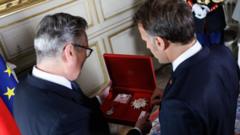
French President Emmanuel Macron presented Starmer with the Légion d’honneur, France’s highest national honour. It makes Starmer the first sitting or outgoing UK Prime Minister to receive the award from a French president. Winston Churchill got one in 1958, but that was over a decade after his wartime premiership had ended.
This isn't just about a shiny medal. It reveals a fascinating paradox. While British voters and Labour MPs grew deeply frustrated with Starmer's domestic policy slips, international leaders viewed him as a heavyweight diplomatic asset. To read more about the history here, Al Jazeera provides an informative summary.
The Foreign Policy Triumph British Voters Ignored
If you look at the discussion on British doorsteps, Starmer’s record looks messy. Prison overcrowding scandals, controversial decisions on winter fuel payments, and sinking approval ratings eventually tanked his authority at home. But across the English Channel, the perspective changes entirely.
Macron explicitly praised Starmer for his "historic role" in reshaping European security. When Europe faced an existential crisis following Russia’s invasion of Ukraine, Starmer didn't just maintain the status quo. Alongside Macron, he helped spearhead the "Coalition of the Willing" in early 2025—a strategic alliance of more than 30 nations designed to secure long-term military funding, sanctions enforcement, and post-war reconstruction plans for Ukraine.
Previous Conservative prime ministers, including Boris Johnson, Rishi Sunak, and Liz Truss, gave strong material backing to Kyiv. Nobody denies that. However, their post-Brexit relationships with European leaders were frequently aggressive and deeply strained. Macron regularly clashed with them.
Starmer changed the tone completely. He brought a sense of international decency back to the table. By aligning British defence capabilities with European networks, he rebuilt trust that had been shattered by years of bitter Brexit divorces.
Why the Légion d’honneur Matters Right Now
The timing of this award isn't accidental. Presenting the Légion d’honneur during the Bastille Day celebrations in Paris sent a massive signal to the rest of the world.
For the first time in over 20 years, British armed forces marched alongside French troops in the historic Paris military parade. Ukrainian President Volodymyr Zelenskyy and German Chancellor Friedrich Merz watched from the stands.
Standing next to these leaders, Starmer looked like a cohesive force for Western unity. Zelenskyy praised his "constant, steadfast support," while Merz openly joked about how much he would miss calling Starmer to bounce policy ideas off him.
Consider the political ironies at play here:
- The domestic failure: Starmer is forced out by his own MPs after failing to manage internal party politics and public expectations.
- The international success: He's hailed by global leaders as a reliable, highly competent partner who saved European alignment during a crisis.
- The contrast: While the UK press focused on his lack of charisma, European partners valued his predictability and lack of drama.
This dynamic explains why rumors are already swirling about Starmer’s next move. You don't build that level of goodwill with Washington, Paris, and Berlin just to disappear into the House of Lords. Don't be surprised if his name pops up for a major international diplomatic post or a senior NATO role in the near future.
What Happens to the UK's Global Stance Next
The big question for anyone watching British politics is whether this diplomatic reset survives Starmer's exit.
Andy Burnham is set to take over as Prime Minister on Monday. Burnham built his reputation as a domestic operator—the "King of the North" who focused heavily on local transport, healthcare, and working-class struggles in Greater Manchester. International diplomacy isn't his natural playground.
Starmer has spent his final days in office trying to reassure allies that Britain’s foreign policy won't shift an inch. The UK's commitment to the Coalition of the Willing and European defence treaties is locked in.
But executing that strategy requires personal relationships. Starmer had a unique chemistry with Macron and Merz built on shared crises. Burnham will have to prove he can command the same respect on the global stage while simultaneously fixing the broken domestic landscape that destroyed his predecessor's premiership.
If you want to track how this transition impacts global British influence, keep your eyes on the upcoming European security summits this autumn. Watch whether Burnham maintains the close, weekly dialogue Starmer established with Paris and Berlin, or if the UK slips back into isolation while managing its internal economic headaches.