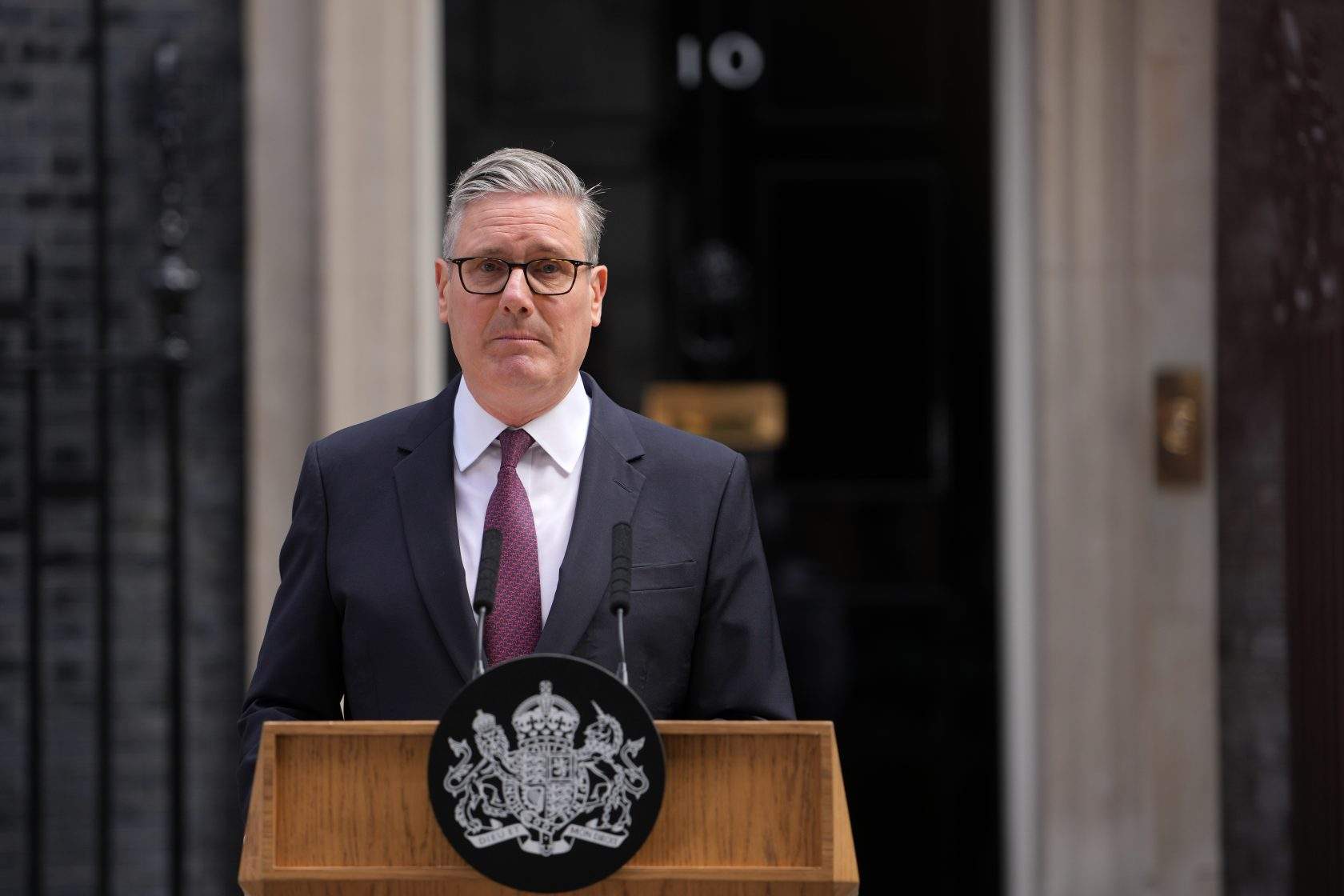
The political shelf life of a modern British prime minister is now roughly equivalent to a bag of salad. Keir Starmer just proved it. Less than two years after securing a massive parliamentary majority, Starmer stood outside 10 Downing Street to announce his resignation. His voice cracked. His political career lay in ruins.
How does someone go from a historic, 411-seat landslide victory to a tearful exit in less than 24 months? Don't forget to check out our previous article on this related article.
The short answer is that Starmer managed to alienate everyone at the exact same time. Left-wing voters felt betrayed by his swift policy reversals. Right-wing voters watched net migration numbers with fury. His own members of Parliament panicked over abysmal polling numbers and a rising threat from populist parties. Then came the Peter Mandelson disaster. It was a self-inflicted wound so toxic it completely obliterated his remaining authority.
People are looking at this as a sudden shock. It wasn't. The rot started the day he won. To read more about the context of this, The New York Times provides an in-depth breakdown.
The Myth of the 2024 Landslide
To understand why Starmer collapsed so fast, you have to look at how he won in the first place. On paper, July 4, 2024, was a triumph. Labour crushed the Conservatives.
But seasoned political operatives knew the truth. It was a loveless landslide. Labour didn't win because the public loved Keir Starmer. They won because the British public absolutely loathed the Conservative Party after 14 years of austerity, public service decay, and the chaotic prime ministerships of Boris Johnson and Liz Truss.
Labour took home a massive majority in the House of Commons with just 34 percent of the popular vote. Think about that. Two-thirds of the country voted for someone else. Starmer walked into Downing Street with an incredibly shallow base of support. He had no goodwill bank to draw from when things got tough.
He promised a government of quiet competence. He told voters he would make politics boring again after years of Tory soap operas. Instead, he delivered a different kind of drama: an endless loop of unforced errors, elite hypocrisy, and catastrophic lapses in judgment.
Freebies and Faux Pas
The cracks appeared early. For an ex-prosecutor who built his entire brand on rules, integrity, and being a straight shooter, Starmer showed a staggering blind spot regarding personal ethics.
Within months of taking office, journalists revealed that Starmer had accepted more than £100,000 in personal gifts and freebies since 2019. It wasn't just small things. He accepted high-end designer spectacles, expensive tailored clothing for his wife, and free corporate box tickets to see Taylor Swift. While ordinary British citizens struggled with a brutal cost-of-living crisis, the Prime Minister was living like a tech billionaire on someone else's dime.
The optics were terrible. They became downright lethal when matched with his fiscal policy.
Just as the news of his free designer glasses hit the front pages, Starmer's government announced it was stripping the winter fuel allowance from millions of British pensioners. The administration claimed it needed to plug a multi-billion-pound hole in the public finances. The message to the public was unmistakable: austerity for vulnerable grandmothers, luxury VIP treatment for the Prime Minister.
Rank-and-file Labour lawmakers warned Downing Street that this decision would destroy their local support. Starmer ignored them. He dug in his heels, insisting that tough choices were required to stabilize the economy.
His popularity immediately nosedived. By early 2026, his personal approval rating plummeted to a staggering minus 46. He became a political anchor dragging his entire party down with him.
The Diplomatic Hand Grenade Named Peter Mandelson
If policy blunders weakened Starmer, it was his appointment of Peter Mandelson that ultimately broke him.
Seeking an experienced hand to navigate a complex geopolitical relationship with U.S. President Donald Trump, Starmer chose Mandelson to serve as the U.K. ambassador to Washington. Mandelson was an old Labour heavyweight, a master strategist from the Tony Blair era. He was slick, connected, and comfortable around global elites.
He also carried massive historical baggage. Mandelson had well-documented past ties to the disgraced financier Jeffrey Epstein. In fact, Mandelson had once described himself in a 2003 phone call as Epstein's "best pal."
Starmer believed Mandelson's diplomatic utility outweighed his past. It was an astonishingly naive gamble. In September 2025, fresh documents emerged detailing the sheer depth of that relationship. The public backlash was immediate and fierce. Starmer tried to contain the firestorm by firing Mandelson, but the damage was done.
The crisis went nuclear in February 2026 when police arrested Mandelson on suspicion of misconduct in public office. The British media went into overdrive. Every single day, reporters asked Starmer why he had vetted and appointed a man embroiled in such a toxic web. The "boring competence" brand was officially dead. Starmer looked weak, compromised, and dangerously out of touch.
The Rise of the King Across the Water
While Starmer withered in London, a major threat was growing in the north of England. Andy Burnham, the highly popular, charismatic former Mayor of Greater Manchester, had been watching Downing Street's stumbles with quiet intent.
Burnham represents a different flavor of Labour politics. He is unpretentious, relatable, and deeply attuned to the working-class northern towns that Labour historically needs to win. He has long harbored leadership ambitions, but he faced a structural problem: you cannot be prime minister unless you are a sitting Member of Parliament in the House of Commons.
That obstacle vanished. Burnham stepped down as mayor to run in a crucial parliamentary special election in Makerfield, a traditional post-industrial seat.
Labour strategists were terrified of Makerfield. Nigel Farage's right-wing Reform UK party was surging in national polls, capitalizing on public anger over immigration and crumbling public services. If Reform UK captured Makerfield, Starmer's leadership would face an immediate challenge.
Burnham didn't just win the seat; he blew the doors off. He ran a campaign focused on raw economic patriotism and a pledge to protect local public services. He completely blunted the Reform UK surge in that constituency.
The contrast was devastating for Starmer. In London, you had an unpopular Prime Minister bogged down in scandals. In Makerfield, you had a charismatic, proven winner with a fresh democratic mandate.
The parliamentary Labour Party made their choice almost instantly. Lawmakers began flocking to Burnham. He was openly treated as the prime minister in waiting. Political scientists called it an impending coronation. Starmer was suddenly a ghost in his own government.
The Long Weekend at Chequers
The final collapse happened with brutal speed. Following a disastrous showing in nationwide local elections in May, where Labour lost hundreds of council seats to both the Green Party on the left and Reform UK on the right, the internal mutiny spilled into the open.
Cabinet ministers realized the party was heading for an absolute slaughter at the next general election if Starmer remained at the helm. Over a tense weekend, more than half a dozen senior cabinet members privately contacted Starmer. Their message was uniform: it is over.
Starmer spent that weekend at Chequers, the Prime Minister's country estate, drafting his exit plan with a small circle of loyal aides. He was furious. He felt he had rescued the party from financial and political ruin after the Jeremy Corbyn years, only to be cast aside at the first sign of sustained trouble.
Even international leaders saw the writing on the wall. U.S. President Donald Trump couldn't resist twisting the knife, posting on social media that Starmer was finished due to failures on immigration and energy policy before Starmer even had a chance to announce it himself.
By Monday morning, Starmer bowed to the mathematical reality. He had lost his party.
What Happens Next
The United Kingdom is now preparing for its seventh prime minister in ten years. The political instability that Starmer promised to cure has returned with a vengeance.
The immediate path forward for the country involves a rapid transition of power.
- July 9: Official nominations for the Labour leadership contest open.
- Mid-July: If the parliamentary party unifies behind Andy Burnham as expected, he could be sworn in as Prime Minister by King Charles III without a prolonged public vote.
- September 1: The absolute deadline for a new leader to be in place when Parliament returns from summer recess.
Starmer will remain as a caretaker prime minister through the early summer, representing the U.K. at the upcoming NATO summit. He is a leader with a title but no actual power.
For anyone managing teams, running organizations, or navigating public-facing careers, the downfall of Keir Starmer offers a cold, clear lesson. You cannot govern purely on the flaws of your opponents. Landslides built on a foundation of public anger rather than genuine enthusiasm are inherently unstable. If you don't build a deep reservoir of trust through consistent, authentic action, the crowd that put you in power will tear you down the second you slip.
The Labour Party is about to get its reboot. Whether a new leader can fix the deep structural problems facing modern Britain remains an open, volatile question.