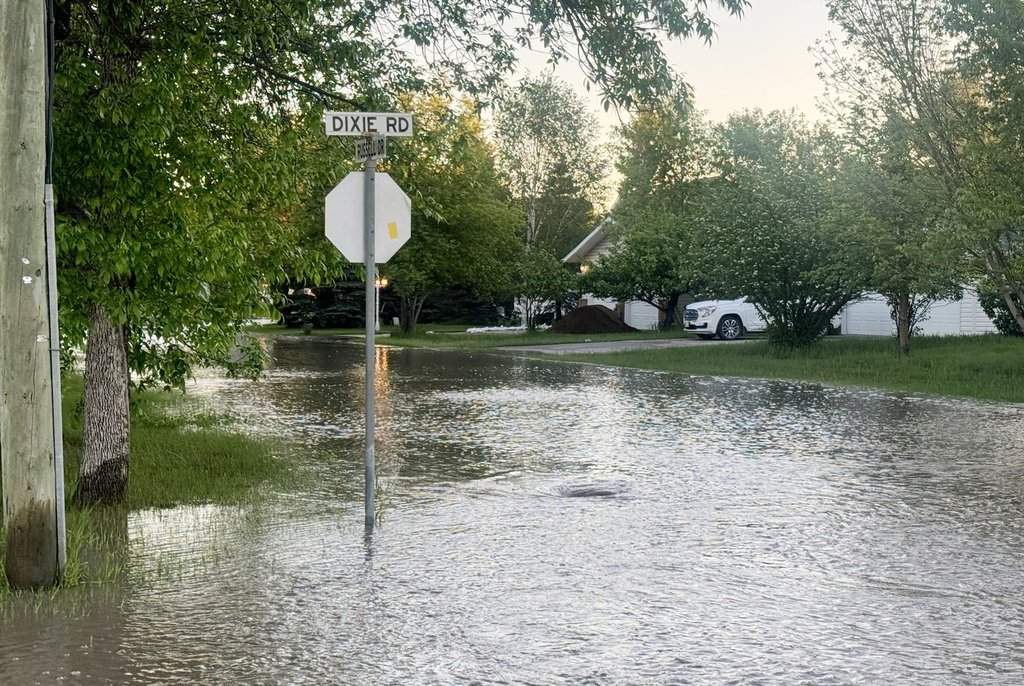
Summer hasn't even hit its peak, and Canadians are already paying a massive price for severe weather.
Newly released data from Catastrophe Indices and Quantification Inc. (CatIQ) confirms that severe storms and sudden flash flooding across Canada throughout June triggered a jaw-dropping $1.1 billion in insured property damage. This isn't a projection for the future. It's the bill for a single month, and it highlights a harsh truth: our communities are entirely unprepared for the water that's coming.
The financial hit from these storms hit two main regions. First, a violent system on June 9 and 10 hammered Manitoba and Saskatchewan with tornadoes, baseball-sized hail, and destructive winds, racking up $728 million in insured losses. Just ten days later, on June 20 and 21, a separate deluge drowned Montreal and its surrounding communities under torrential rain, forcing another $409 million in insurance payouts.
If you think your home insurance policy is safe from premium hikes, you need to look closer at these numbers.
The True Toll Behind the Billion Dollar Price Tag
When a weather event crosses the billion-dollar threshold, it's easy to get lost in the macroeconomics. But the localized damage shows just how brutal these systems were for everyday homeowners.
Take Regina, for instance. The June 9 hailstorm turned the city into a battleground for vehicles and roofing. Saskatchewan Government Insurance reported a massive influx of over 10,000 auto claims and 800 property claims from that single storm system. Early estimates for Regina alone sat near $80 million.
Then look at Montreal. The city saw streets turn into rivers and basements turn into indoor pools during the June 20-21 flash floods. Overland flooding and sewer backups overwhelmed city infrastructure in hours.
The Insurance Bureau of Canada (IBC) points out that water-related insured losses have skyrocketed by more than 300% over the last 20 years compared to the two decades before that. For context, insurers used to pay out roughly $701 million annually for severe weather back in the early 2000s. Now, a random month in early summer easily blows past $1.1 billion.
Why Insurance Alone Can't Save Your Property
A common mistake Canadians make is assuming their standard home policy covers whatever nature throws at them. It doesn't.
"Flooding is Canada's costliest and most pervasive climate risk. Insurance alone cannot solve Canada's flood problem." — Liam McGuinty, Vice-President of Federal Affairs, Insurance Bureau of Canada.
The reality is that overland flood insurance is often an optional add-on, and in high-risk areas, it's becoming incredibly expensive or outright unavailable. When infrastructure fails on a massive scale, insurance companies end up footing bills that inevitably drive up premiums for everyone, even if your specific neighborhood stayed dry.
Municipal stormwater systems built decades ago simply lack the capacity to handle 50mm to 100mm of rain falling in a couple of hours. Until municipal, provincial, and federal governments stop debating policy and start aggressively funding physical flood defenses, upgraded culverts, and concrete storm-water diversions, these billion-dollar months will become the baseline.
How to Protect Your Own Home Right Now
You can't fix your city's aging storm sewers, but you can heavily mitigate your own risk before the next cloudburst hits. Waiting for government infrastructure upgrades is a losing strategy.
- Install a sump pump with a battery backup: If the power goes out during a violent storm, a standard sump pump is useless. A battery backup keeps the water moving away from your foundation.
- Put in a backwater valve: This prevents sewage from backing up through your drains into your basement when the main city lines overflow. It's a messy, expensive disaster that this simple valve stops completely.
- Check your grading and downspouts: Make sure your downspouts extend at least two meters away from your foundation. Ensure the ground slopes away from your home, not toward it.
- Review your insurance policy policy today: Call your provider. Ask specifically if you have "overland flood damage" and "sewer backup" coverage. Do not assume they are bundled into your basic fire and theft policy.
The June storms proved that extreme weather isn't a seasonal anomaly anymore. It's an active threat to your bank account and your home stability. Get your policy reviewed and your basement prepped before the next system rolls through your province.