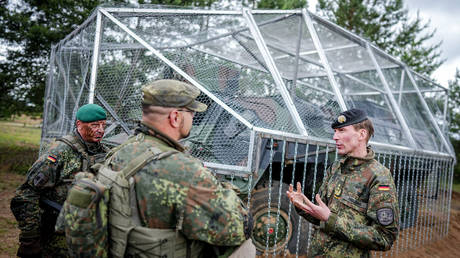
Berlin is finding out that building a frontline deterrent against Russia is a lot easier on paper than it is in the barracks.
When the German government announced it would permanently station a full combat brigade in Lithuania, it was hailed as a historic shift in post-Cold War foreign policy. For the first time since World War II, German troops would be permanently based outside their home country, directly facing a potential adversary. The plan sounded decisive. It showed leadership.
There is just one massive problem. German soldiers do not want to go.
Recent leaks from the defense ministry exposed a stark reality. For the initial phase of deploying the newly formed 45th Panzer Brigade, the military needed nearly 2,000 volunteers to fill core combat roles in artillery, reconnaissance, and engineering. Only 209 soldiers stepped forward. That is a miserable 10% turnout.
This is not a minor recruiting hiccup. It is a structural crisis that threatens to derail Berlin's promises to NATO. It reveals a deep disconnect between political ambition in Berlin and the actual willingness of German service members to uproot their lives and move to the Baltic woods.
The Recruitment Math Just Does Not Add Up
Let's look at the actual numbers because they paint a grim picture. The 45th Panzer Brigade—often called the Litauenbrigade in German media—is supposed to grow to roughly 5,000 military and civilian personnel by the end of 2027. Right now, there are about 1,700 soldiers assigned, with plans to nudge that past 2,000 later this year.
But those numbers hide the core issue. Many of those initial troops are part of an advance command element or rotating units already tied to NATO's existing presence. When the military tried to secure long-term, permanent volunteers for the core combat battalions—specifically the 203rd Tank Battalion and the 122nd Mechanized Infantry Battalion—interest plummeted.
Enlistment rates for those specific frontline units crawled along between 28% and 47%. The specialized support units fared even worse. If you are an engineer or a reconnaissance specialist in the Bundeswehr, a multi-year deployment to rural Lithuania apparently looks like a career dead end or a family nightmare.
Defense Minister Boris Pistorius initially insisted this entire deployment could be handled on a purely voluntary basis. He wagered that the historical weight of the mission, combined with financial incentives, would be enough to fill the ranks. He lost that bet.
Why German Troops Are Rejecting Lithuania
It is easy to look at this from a distance and assume soldiers are simply afraid of the Russian threat. That is a lazy explanation. The real reasons are far more practical, mundane, and deeply tied to modern German military culture.
First, consider geography and lifestyle. The two main bases for the German brigade are Rukla and the Rūdninkai military training area. Rūdninkai is a remote, heavily forested area near the Belarusian border. It is not exactly a bustling cultural hub.
For a modern German soldier, moving there means uprooting their entire life. Unlike American troops, who are culturally accustomed to moving every few years to massive, self-contained foreign bases with American schools and grocery stores, German troops rarely build their lives around permanent foreign displacement.
Then you have the family dynamic. If a soldier relocates permanently for several years, their partner has to come along. What happens to that partner’s job? The financial reality is that many families rely on two incomes. Moving to rural Lithuania often means the spouse must quit their job, sacrificing a career and a second income.
While Lithuania has promised to build German-language schools and kindergartens, the infrastructure is still a work in progress. A leaked confidential note from the German embassy revealed that the two nations have actively bickered over who pays for what. Lithuania is funding the direct military infrastructure, but it balked at footing the bill for the high-standard housing and civilian luxuries German officials demanded. Vilnius argued that these standards were significantly higher than what they provide for their own troops, creating a massive political headache.
Money Is Not Fixing the Problem
Berlin tried throwing cash at the issue. They offered substantial bonuses, with some reports indicating soldiers could receive up to €2,000 per month on top of their standard pay. In Lithuania, where that bonus exceeds the average national monthly salary, it looks like a fortune. To a German soldier weighing the long-term career impact and family strain, it has not been enough.
The defense ministry is scrambling. They are launching an aggressive internal marketing campaign, sending informational letters to 43,000 soldiers across the force. They are offering free informational trips to Lithuania so troops can see the area firsthand. They are even slashing the minimum mandatory tour length from two years down to twelve months, hoping a shorter commitment will make the pill easier to swallow.
These measures feel like desperation. They do not fix the fundamental issue that the volunteer pool is dry.
The End of the Volunteer Experiment
So what happens when an army cannot find volunteers for a critical geopolitical mission? You stop asking. You start commanding.
Thomas Revekamp, the head of the Bundestag Defence Committee, made the political reality clear. He openly stated that if the volunteer shortage persists, the military must make service in Lithuania mandatory.
This is the dirty secret that sensational headlines often leave out. The Bundeswehr is an army, not a voluntary civic club. During past operations, like the decade-long deployment in Afghanistan, the military used volunteers where possible but routinely ordered units abroad when numbers fell short.
Lithuanian political figures are watching this closely but trying to project calm. Former Lithuanian Defense Minister Laurynas Kasčiūnas publicly reminded observers that this is just a snapshot of an early phase. He pointed out that if the volunteer doors do not yield results, Germany will simply activate its compulsory mechanisms.
That shift changes the entire nature of the deployment. Instead of a highly motivated brigade of willing volunteers, Germany risks sending a force populated by personnel who were ordered there against their preferences. That is a dangerous way to build a frontline combat unit meant to deter a highly aggressive neighbor.
The Geopolitical Stakes at the Suwałki Gap
To understand why Berlin cannot afford to let this brigade fail, you have to look at a map. Lithuania is caught in a terrifying geographic vice.
To its north and south are NATO allies, but to its east lies Belarus, a staunch Russian partner. To its west sits Kaliningrad, a heavily militarized Russian exclave packed with anti-ship missiles, electronic warfare units, and nuclear-capable systems.
Connecting Lithuania to Poland—and the rest of continental Europe—is a narrow, 60-mile strip of land known as the Suwałki Gap. If a conflict erupts, Russian forces could easily choke off this corridor from both sides, completely isolating the Baltic states from NATO reinforcement.
The Vulnerability Matrix
- The Eastern Threat: A long, exposed border with Belarus, serving as a staging ground for Russian assets.
- The Western Choke: Kaliningrad’s massive missile arrays can deny NATO air and sea access.
- The Suwałki Variable: A single narrow land corridor that represents NATO’s greatest geographical weakness.
This vulnerability is exactly why Lithuania spent years begging for a permanent Western military presence. They did not want rotational units that pack up every six months. They wanted skin in the game. They wanted foreign troops whose families live in Vilnius and Kaunas, ensuring that an attack on Lithuania is instantly an attack on Germany.
If Germany fails to deliver a fully manned, combat-ready 45th Panzer Brigade by 2027, the political damage to NATO’s deterrence posture will be severe. It tells Moscow that despite all the rhetoric of the "Zeitenwende"—Germany's supposed historic turning point in defense policy—the nation cannot even convince or compel 5,000 soldiers to man the front lines.
Practical Next Steps for European Defense Observers
If you are tracking European security, corporate risk, or geopolitical shifts, stop watching the political speeches in Berlin. They are mostly noise. Instead, watch these specific indicators over the next twelve months to see if Germany can actually pull this off.
First, monitor the legislative shift in the Bundestag. Watch closely for any formal policy directives that officially transition the Lithuania brigade from a volunteer assignment to a mandatory posting. The moment Berlin formally issues deployment orders rather than requests, you will know the voluntary experiment is officially dead.
Second, track the construction milestones in Rūdninkai. The Lithuanian government claims Phase I of the military town is moving ahead of schedule, with a target completion date in late 2026. If construction delays hit the housing complexes, schools, or training ranges, it will give German soldiers a legitimate administrative excuse to delay their relocation.
Finally, watch the broader recruitment data for the entire Bundeswehr. The military has set an overall target to grow its force to 203,000 personnel, but it has consistently bled active-duty members over the last few years. If the overall force continues to shrink, filling a 5,000-man brigade in the Baltic woods becomes a mathematical impossibility without hollowed-out units back home.
Germany has reached the limits of its comfortable, peacetime military model. The struggle to fill the ranks of the 45th Panzer Brigade proves that rewriting defense strategy on a laptop in a cozy office is simple. Executing it in the cold reality of a changing Europe is another story entirely.
Germany's 45th Panzer Brigade has already begun conducting its first major battle drills on Lithuanian soil during the Freedom Shield exercises, demonstrating how the unit operates under intense realistic combat scenarios. For a visual breakdown of these deployment maneuvers and a look at the actual terrain these troops are operating in, watch Germany's Tank Brigade participates in its First Exercise in Lithuania. This footage offers concrete context on the scale of the hardware and the environment at the center of this recruiting crisis.