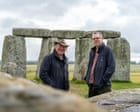
Thousands of people are currently heading to Wiltshire to watch the sunrise over the massive sarsen stones for the summer solstice. They think they're participating in an ancient ritual that started with the monument standing before them. They're wrong.
A massive discovery by Wessex Archaeology reveals that people were celebrating the solar cycle on these same hillsides 500 years before the famous stone circle was even built.
Archaeologists uncovered a 5,000-year-old wooden monument near Bulford, just three miles east of Stonehenge. It's essentially a prehistoric prototype. By placing two massive timber posts 120 meters apart, Neolithic humans created a highly precise solar tracking system around 2950 BC.
The discovery completely upends the timeline of southern England's sacred geography, proving that the obsession with the solstices wasn't a byproduct of building Stonehenge. It was the entire reason Stonehenge was built in the first place.
Decoding the Bulford Timber Prototype
The setup at Bulford was remarkably elegant. Instead of dragging multi-ton megaliths across miles of terrain, these early architects used what was readily available in the ancient British woodlands: massive ash trees.
Excavator Phil Harding, a veteran archaeologist known across the UK for his work on television's Time Team, identified distinct post pits measuring roughly a meter deep and 50 centimeters across. While the timber rotted away millennia ago, the pits contained specific ash charcoal fragments. Ash grows straight and strong, making it the perfect choice for a pair of towering 4-meter-high pillars.
When you draw a straight line between these two post holes, the trajectory is unmistakable. It runs perfectly parallel to the main solstice sightlines at Stonehenge. Skyscape archaeologist Dr. Fabio Silva verified this layout using digital reconstructions of the Neolithic horizon and sky. The result showed the wooden posts aligned with the midsummer rising sun and the midwinter setting sun to within a single degree of accuracy.
The narrow window of radiocarbon dates suggests the timber monument didn't stand for centuries. Instead, it was likely a temporary sacred site used for just a few years. It likely served its purpose while construction crews a few miles away were busy digging the earliest circular earthworks and ditches for what would eventually become Stonehenge.
Evidence of Prehistoric Mass Gatherings
This wasn't a lonely outpost for a couple of stargazers. The team from Wessex Archaeology discovered 48 separate pits surrounding the main alignment, and what they found inside points to massive, coordinated community events.
The pits contained a treasure trove of Neolithic garbage:
- Coarse pottery shards
- Worked flint tools
- Abundant charcoal
- Animal bones, including the remains of aurochs (extinct, giant wild cattle)
The volume of bones indicates that hundreds of people gathered on the hillside for highly organized, short-term feasts. Harding described the sheer volume of meat being consumed as "one hell of a barbecue." These gatherings required immense logistical planning, forcing scattered farming communities to unite, pool resources, and sync their calendars to the movements of the sun.
The most fascinating artifact pulled from the dirt is an incredibly rare, disc-shaped flint knife. Its circular design stands out from typical utilitarian tools of the era. The researchers believe the object was deliberately deposited in a specific "viewing station" pit as a symbolic offering to the sun disc itself.
Debating the Two Point Alignment
As with any major breakthrough, the discovery has sparked healthy debate within the archaeological community. Skeptics point out the inherent difficulty of proving an intentional layout based on minimal physical markers.
Jim Leary, a senior lecturer in field archaeology at the University of York, voiced some caution. He notes that two postholes don't automatically make a convincing alignment and that he would typically expect a longer row of markers to confirm a deliberate astronomical track. However, he freely admits that such a feature fits perfectly within the known behavioral patterns of the Neolithic period.
Vince Gaffney, a landscape archaeologist at Bradford University who led the Stonehenge Hidden Landscape Project, similarly notes that while proving intent using only two points is difficult, it's certainly not impossible. If the team's analysis holds up to ongoing peer review, it bridges a massive gap in our understanding of how the Salisbury Plain transformed into a unified ritual landscape.
The truth is that earlier wooden structures at Stonehenge itself may have existed to track the sun, but they were entirely obliterated when the massive sarsen stones were hauled into place 500 years later. The Bulford site survived simply because it was left alone on a nearby hillside, safely out of the way of later construction upgrades.
What This Discovery Changes for British Prehistory
For decades, popular history framed Stonehenge as a sudden, monumental leap forward in architectural and astronomical capability. The Bulford discovery proves it was actually the culmination of a deeply ingrained, multi-century tradition.
Dr. Matt Leivers, a senior research manager at Wessex Archaeology, stresses that the solstice wasn't treated merely as an astronomical curiosity by these communities. It was a core component of their religion, acting as the primary mechanism for structuring their universe, tracking the passage of time, and navigating their relationship with the natural world.
The days of discovering massive, untouched stone circles in Britain are largely over. Most of the intensive fieldwork on the Stone Age landscape over the last two decades has wrapped up, transitioning into the long, slow phase of laboratory analysis and publication. Finding a completely unknown, highly significant ceremonial site just five kilometers from the most famous monument in Europe is a stark reminder of how much history remains buried just beneath our feet.
Unfortunately, you won't be able to visit the Bulford prototype yourself. The excavations took place on Ministry of Defence land as part of the Army Basing Programme, which built housing for military personnel returning from Germany. To preserve the remaining archaeology, the pits have been carefully backfilled and covered over, sealing this ancient solar observatory back into the Wiltshire landscape.
If you want to explore the artifacts and deeper context of this transition from wood to stone, your best move is to skip the immediate crowded fields and visit the Wiltshire Museum in Devizes or the Stonehenge Visitor Centre, where the physical evidence of these 5,000-year-old sun feasts is currently being processed for future displays.