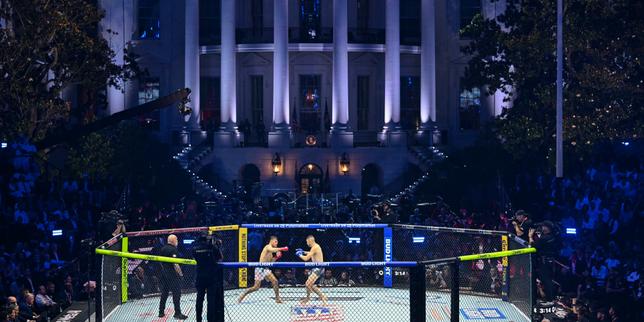
You think you've seen it all in political theater, and then a cage match happens on the South Lawn of the White House. But what was supposed to be a bizarre, high-octane celebration for Donald Trump's 80th birthday quickly turned into a near-disaster that security experts are going to study for decades.
On June 16, 2026, FBI Director Kash Patel dropped a bombshell. Federal agents stopped a coordinated, multi-state terrorist plot aimed directly at the UFC Freedom 250 event held just two days prior. We aren't talking about a lone wolf with a sign or someone trying to hop the fence. This was a sophisticated, multi-tiered assault plan involving weaponized drones, stockpiled ammunition, and positioned snipers. Also making news in this space: What Most People Get Wrong About the Trump Vance Iran Peace Deal.
If you're wondering how close the US came to a historic tragedy on federal grounds, the answer is uncomfortably close. Here's exactly what happened, how the feds broke the network, and why the security landscape just shifted permanently.
The Chilling Blueprint of the White House Attack
The Department of Justice unsealed charges against five men arrested across a multi-state dragnet spanning Ohio, Missouri, Nebraska, and California. Court documents reveal an assassination and mass-casualty playbook that reads like a military operation. Further information into this topic are explored by The Washington Post.
The plotters didn't try to sneak weapons past Secret Service checkpoints. Instead, they planned to bypass ground security entirely by flying commercial drones laden with explosives directly over "The Claw," the temporary outdoor arena built on the South Lawn. The plan was to detonate the drones above the crowd of over 4,000 VIP guests, which included Trump, Vice President JD Vance, and various high-ranking officials.
The horror wouldn't have stopped with the blast. The group anticipated that the explosions would trigger an immediate, chaotic stampede. According to the federal criminal complaint, the suspects had planned to position snipers outside the secure perimeter to fire directly into the fleeing crowd, specifically targeting "high-value" government figures.
How the Plot Fell Apart
The entire operation unraveled because of a single phone call from a concerned mother. On June 10, just four days before the fighters stepped into the octagon, an Ohio woman called local police to report her 19-year-old son, Tycen Proper. She was terrified by his recent behavior, his rapid accumulation of firearms, and his highly suspicious online communications.
The FBI stepped in immediately. When agents interviewed Proper, they uncovered a massive digital footprint linking him to an extremist network operating across encrypted messaging apps since March. The group shared deep anti-government sentiments, with some members explicitly stating they wanted to eliminate any political figures associated with the late sex offender Jeffrey Epstein.
The feds moved with terrifying speed. Within 96 hours, a coordinated multi-state sting operation arrested five key players:
- Tycen C. Proper, 19, from Danville, Ohio
- Bryan Omar Roa, 24, from Calimesa, California
- Michael Alan Thomas, 32, from Pinon Hills, California
- Daniel K. Eskridge, 32, from Kidder, Missouri
- Abraham Hermosillo Alvarez, 31, from Omaha, Nebraska
Fox News reported that investigators eventually flagged up to 23 people potentially tied to the broader network. By the time the first punch was thrown under the White House lights on Sunday night, the core cell was already sitting behind bars.
The Reality of Low-Cost, High-Threat Warfare
I've watched event security evolve for years, but this incident highlights an ugly truth that the Secret Service has been quietly stressing: traditional security perimeters don't work against modern, decentralized threats.
The White House is arguably the most secure piece of real estate on earth. It features heavy perimeter fencing, surface-to-air defense capabilities, elite sniper teams, and a permanent, heavily armed quick-reaction force. Yet, a handful of individuals operating from regular suburban homes in the Midwest and West Coast almost turned a high-profile birthday bash into a war zone using off-the-shelf consumer tech.
Drones are the ultimate asymmetric threat. They're cheap, require minimal training to pilot, and can carry enough payload to cause devastating structural and human damage. When you combine aerial explosives with coordinated ground snipers, you create a logistical nightmare for teams trained to look for lone attackers on foot. Secret Service Director Sean Curran admitted as much, pointing to a "spectacular increase in threats" against high-profile targets in recent months.
Political Fallout and the Blame Game
Predictably, the political machinery didn't waste a second capitalizing on the foiled attack. Before the ink on the indictments was even dry, Vice President JD Vance went on Fox News to control the narrative. Vance labeled the incident a "coordinated planned terrorist plot" and explicitly tied the suspects to radical left-wing networks, accusing Democrats of fomenting violence through relentless anti-Trump rhetoric.
The reality inside the court documents paints a more complex, chaotic picture. The suspects' stated motives—ranging from general anti-government extremism to specific fury over elite political corruption and historical ties to figures like Epstein—don't neatly align with standard partisan talking points. They reflect a deeper, deeply volatile undercurrent of radicalization that doesn't care about traditional party lines.
Meanwhile, Donald Trump himself seemed detached from the immediate drama. Speaking to reporters in Évian-les-Bains, France, where he was attending the G7 Summit, Trump casually remarked that he hadn't even been fully briefed on the plot yet.
Next Steps for Large Scale Security
If you run large events, manage executive protection, or work in public safety, the White House plot is a massive wake-up call. You can no longer rely on physical gates and metal detectors to keep people safe.
Moving forward, security strategies must adapt to three concrete realities:
- Invest heavily in Counter-UAS (Unmanned Aircraft Systems) technology. If your security plan doesn't include active radio frequency jamming, drone detection radar, or net-spoofing capabilities, you have a massive vulnerability. Airspace control is now just as vital as ground control.
- Prioritize behavioral intervention and community threat assessment. The feds didn't catch this plot using multi-million dollar surveillance software; they caught it because a family member spoke up. Building clear, accessible pipelines for reporting radicalized individuals or sudden weapon hoarding saves lives.
- Redesign evacuation choke points. The scariest part of the suspects' plan wasn't the initial blast—it was the secondary attack on the fleeing crowd. Security teams must ensure that emergency exit routes are structurally shielded from long-range line-of-sight weapons to prevent bottlenecks from becoming shooting galleries.
The UFC event went on, the fights happened, and the crowd went home happy. But the margin between a successful night of sports entertainment and a national catastrophe was a single, brave phone call from a mother in Ohio. Relying on luck like that isn't a strategy.