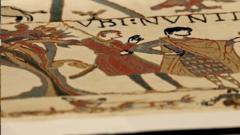
A 70-meter piece of cloth stitched a millennium ago just crossed the English Channel in the dead of night. It moved inside a shock-absorbing cradle, packed accordion-style into a climate-controlled case, protected by a police escort. The cargo wasn't gold or high-tech weaponry. It was the Bayeux Tapestry, making its first journey to English soil since the 11th century.
The French culture minister announced that the medieval masterpiece arrived in a "wonderful state" after its highly secretive journey to the British Museum. For context, this is a massive win for international museum logistics. Conservators in France had been fiercely debating the safety of the move, worried that the vibrations from a lorry and train trip through the Channel Tunnel would destroy the fragile linen. It took multiple dry runs with fake tapestries rigged with sensors to prove the trip wouldn't shake the artifact to pieces.
The public response has been wild. When tickets dropped, the British Museum's website faced nine-hour queues. The first block of dates through December sold out instantly. Around 7.5 million people are expected to see it during its year-long stay.
If you're wondering why people are waiting hours online just for a chance to stand in a room with an ancient embroidery, you have to look at what this object actually represents. It isn't just a relic. It's the ultimate political propaganda piece, a crime drama, and a rare window into everyday medieval life all stitched into one.
The Irony of Its Return
You can't talk about the Bayeux Tapestry without addressing the glaring irony of its current location. The artwork tells the story of the Norman Conquest of 1066, the last time England was successfully invaded. It shows William the Conqueror taking the English throne after defeating King Harold at the Battle of Hastings.
Yet, most historians agree the artifact was actually created in England, likely by Anglo-Saxon needleworkers in Canterbury, before being shipped off to Normandy. The conquered people were forced to stitch the victory lap of their conquerors. Bringing it to London is, in a weird way, a homecoming.
The British Museum is leaning hard into this narrative. They're displaying the entire 70-meter length completely flat and continuous for the first time. Usually, it's curved or tightly wound in corners due to space constraints. Seeing it stretched out lets you view the scale of the Norman invasion like an 11th-century IMAX screen.
What the Clean Version Misses
When you see photos of the tapestry in history textbooks, they usually show the dramatic moments: King Harold getting an arrow to the eye or Norman cavalry charging up a hill. But the margins of the cloth are where things get weird.
The borders are filled with mythological beasts, hunting scenes, and unexpectedly graphic, lewd figures. There are literal naked men and crude depictions scattered along the edges, totally unrelated to the battles happening in the center panel. Scholars still argue about why the makers included these. Some think the English embroiderers were sneaking in subtle commentary or jokes under the noses of their new French bosses.
There's also a massive gender imbalance. Across 58 complex scenes packed with hundreds of soldiers, horses, and ships, only a tiny handful of women are depicted. One of them, a woman named Ælfgva, is shown being touched on the face by a priest. It's a highly specific, scandalous nod to a contemporary event that everyone at the time would have recognized, but the exact context has been entirely lost to history.
Spotting the Fake News of 1066
We tend to treat ancient artifacts as absolute historical truth, but the Bayeux Tapestry is heavily biased. It was commissioned by Bishop Odo of Bayeux, who happened to be William the Conqueror’s half-brother.
Unsurprisingly, Bishop Odo gives himself a massive starring role in the narrative. In scenes toward the end of the battle, he's shown rallying the Norman troops with a massive club, looking heroic when contemporary written sources suggest his actual involvement was much smaller. The entire piece functions as a justification for the invasion, painting Harold as a oath-breaker who deserved what he got, and William as the rightful king.
Your Move If You Missed Tickets
If you didn't snag a ticket during the initial mad scramble, don't panic. The museum is holding back batches of tickets for the 2027 stretch of the exhibition, with the next release happening in October.
If you want to catch this slice of history, set a calendar reminder for early October 2026 to grab a spot for the January-March 2027 window. Keep an eye on the British Museum's official newsletter to get the exact drop time, and prepare to jump into the digital queue the second it opens. Alternatively, look out for the nationwide "Bayeux around Britain" events happening at local cathedrals and libraries if you want to skip the Bloomsbury crowds entirely.
The Bayeux Tapestry arrives in UK for first time in 900 years under police guard video shows the intense security measures and the early morning arrival of this historic piece at the British Museum.