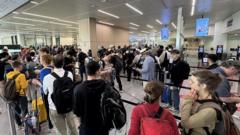
You pack your bags, arrive at the terminal early, and check your luggage. You get through security with time to spare. Then you see it. A massive, sluggish queue snaking out of the passport control area, out of the terminal doors, and onto the hot asphalt outside. By the time you reach the front, your flight has already taken off. Your plane left with half its seats empty because hundreds of passengers were trapped in the exact same line.
This isn't a worst-case hypothetical scenario. It's happening right now across Europe.
The European Union's brand-new digital border tracking initiative is triggering unparalleled gridlock at major tourist hubs. Aviation bosses are panicking. Border guards are overwhelmed. If you have a trip planned to Europe during July or August, you need to understand exactly what you are walking into. The traditional European summer getaway has hit a massive, bureaucratic wall.
The Five Hour Nightmare Waiting For You At Europe Gates
The root of the current travel disaster is the Entry/Exit System, universally known as the EES. It officially became fully operational across the Schengen Area on April 10, after multiple delays. The policy was designed to replace manual passport stamping with a modern system. It registers non-EU travelers using biometric data like facial images and fingerprints.
The reality on the ground has been anything but modern.
Aviation industry groups just sent a blistering joint letter to European Commission President Ursula von der Leyen. The letter came from Airports Council International Europe, Airlines for Europe, and the International Air Transport Association. They did not hold back. They warned that waiting times at EU border control have climbed drastically. Peak travel periods are now seeing wait times of up to five hours.
Think about that for a second. Five hours just to get your passport looked at. That is longer than most flights within Europe.
The timing could not be worse. The aviation sector estimates that European airports will handle roughly 40 million more passengers during July and August than they did in the previous two months. Shoving that massive wave of summer tourists through a broken digital system is a recipe for absolute disaster. Industry leaders are saying the system has officially hit a critical point.
Inside the Bureaucratic Failure Blighting Schengen Airports
Why is a digital system causing longer queues than old-fashioned ink stamps? It comes down to the sheer volume of data collected during a traveler’s first visit.
When you cross a Schengen border for the first time under the new rules, you cannot just flash your passport. You have to stand at a self-service kiosk. You must have your face photographed. You have to press your fingers against a digital scanner. Border authorities then have to verify this data.
In theory, subsequent visits should be faster. In practice, the system is choking on the initial enrollment phase.
The infrastructure simply cannot cope with peak holiday traffic. Airport operators do not have enough physical space to house the required kiosks. They do not have enough border staff to monitor them. Stefan Schulte, a prominent European airport executive, publicly stated that politicians need to stop pretending the system is working well. It plainly isn’t.
Even worse, the long-promised mobile app meant to let travelers pre-register their details at home is delayed. Travelers are forced to do every single step of the registration process live at the border. When thousands of people arrive simultaneously from international flights, the system grinds to a halt.
Half Empty Planes and Stranded Passengers Are Already Happening
The financial and emotional toll on travelers is already mounting. We have seen repeated instances of airlines being forced to make an impossible choice. They either delay their schedules and ruin their entire operational day, or they take off on time without their passengers.
They are choosing to leave.
- The Milan Incident: Over 100 passengers were recently stranded at a Milan airport when a flight to Manchester took off without them. The passengers were trapped in a three-hour passport queue and could not physically reach the gate.
- The Athens Mess: A large group of holidaymakers missed their flight from Athens to Luton due to intense border queues, leading to furious arguments at the terminal.
- The Ground Reality: Carriers like Ryanair, easyJet, and Jet2 are routinely watching their aircraft depart with dozens of empty seats because the passengers are stuck behind border glass.
The World Travel & Tourism Council released alarming data about this trend. Their research shows that regular delays of three hours or more could wipe out up to 41 million visitor arrivals to Europe. That translates to an estimated loss of 45.4 billion dollars in visitor spending.
British travelers are showing the highest level of anxiety. A recent poll indicated that 39% of UK adults would be far less likely to travel to Schengen countries if these multi-hour queues remain normal. Americans and Canadians follow closely behind, with roughly a third saying they are reconsidering their European travel plans.
The Technical Glitches Keeping Airport Staff Awake At Night
The systemic breakdown is not just about a lack of staff. The technology itself is failing under basic summer conditions.
Reports from major European hubs reveal that hardware limitations are compounding the delays. During recent hot spells, fingerprint scanners at several high-volume border points repeatedly stopped working. Why? Because the glass screens became smeared with sweat from thousands of anxious passengers waiting in un-airconditioned lines. The scanners could not read the prints. Staff had to take them offline repeatedly to clean them.
Furthermore, critical software updates for the automated kiosks remain uninstalled at several vital entry points. This includes major French airports, the Eurotunnel terminals, and the Port of Dover.
The European Commission is downplaying the crisis. Their spokespeople claim the system works fine. They blame the delays on pre-existing issues like general airport staff shortages or airlines scheduling too many flights in the same arrival slots. But the airlines and airports are not buying that excuse. They are dealing with angry crowds every day.
How To Keep Your Holiday Plans Alive Amid The Chaos
You cannot change EU border policy. However, you can change how you prepare for it. If you are determined to head to Europe this summer, you have to abandon your old travel habits.
First, ignore the standard advice of arriving two hours early for an international flight. If you are flying into a major Schengen hub, you need to build a massive buffer into your schedule. Three hours is the bare minimum. Four hours is safer if you are traveling during weekend peaks.
Second, think carefully about your flight connections. Booking a tight 45-minute connection through Amsterdam Schiphol, Paris Charles de Gaulle, Frankfurt, or Lisbon is a terrible idea right now. If your first flight lands and you have to clear an EES checkpoint to catch your connecting flight, you will almost certainly miss it. Ensure your layovers are at least two to three hours long.
Third, stay hydrated and bring snacks in your carry-on luggage. People are regularly getting trapped in hot, unventilated hallways or outside on the airport tarmac for hours before they even see a border guard. You cannot access airport shops once you are stuck in the main border queue.
Finally, keep a close eye on airline notifications. Airlines are adapting to this crisis daily. Some are altering baggage drop-off times or changing boarding procedures to mitigate the queue times. Do not assume your flight departure protocol will be identical to your last trip.
Aviation groups are currently begging the EU to grant member states the power to completely suspend the digital checks during July and August whenever passenger volumes overwhelm capacity. Some temporary reprieves have happened. French police briefly paused the biometric requirements at Dover back in May to clear massive holiday traffic. Greece tried a similar pause for British nationals before reversing course under regulatory pressure.
Until the European Commission provides official, permanent flexibility, the reality of European travel this summer is simple. Pack your patience, prepare for a wait, and do not expect your plane to wait for you.