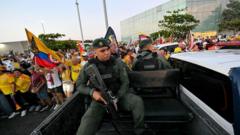
Colombia stands at a terrifying fork in the road. As voters head to the polls for the 2026 presidential runoff, the choice isn't just about political ideologies or economic promises. It's a raw, high-stakes referendum on survival. Colombia's presidential election has become entirely defined by a brutal, escalating internal conflict that many hoped was fading into history a decade ago. Instead, the violence is back with a vengeance, tearing through rural communities and forcing a deeply polarized electorate to choose between two irreconcilable paths forward.
On one side is Abelardo de la Espriella, a controversial, media-savvy right-wing defense lawyer who has never held elected office but has captured the fury of an exhausted public. On the other is Iván Cepeda, a veteran left-wing senator who wants to salvage what is left of the state's peaceful overtures. The middle ground hasn't just shrunk. It has completely vanished.
This election matters because the winner will inherit a nation where illegal armed groups, dissident guerrilla factions, and powerful drug cartels control vast swathes of territory. The idealistic promises of yesterday have collided with a grim reality on the ground, making security the only issue that truly moves the needle for Colombian voters today.
The Illusion of Total Peace and the Rise of De la Espriella
To understand how Colombia ended up here, you have to look at the spectacular collapse of the current administration's security strategy. Outgoing President Gustavo Petro entered office with a grand vision called Total Peace. The idea sounded beautiful on paper. The government would negotiate simultaneously with every armed group in the country, from the National Liberation Army (ELN) to the stubborn dissident factions of the FARC who rejected the historic 2016 peace accord. The administration even tried to bring criminal syndicates and drug trafficking networks to the table.
It didn't work. While the government restricted military actions and suspended airstrikes to build goodwill, the armed groups used the breathing room to consolidate power. They expanded their reach into illegal mining, drug running, and logging. They didn't disarm. They grew stronger. Rural Colombians paid the price as forced recruitment, displacement, and massacres surged.
This security vacuum created the perfect launchpad for Abelardo de la Espriella. He didn't rise through the traditional political establishment. In fact, the mainstream right-wing parties completely collapsed in the first round of voting on May 31. Voters rejected the old political elite, leaving the establishment candidate, Paloma Valencia, with a measly 6.3% of the vote.
De la Espriella stepped into that void with an unapologetic, hardline message. He speaks directly to the fears of citizens who feel abandoned by a government that prioritized talking over protecting. His platform is a total reversal of the current strategy. He promises an immediate end to all peace negotiations. He wants to resume heavy aerial bombardments of illegal armed groups and restart the controversial aerial fumigation of coca crops using chemical herbicides. It's a return to the all-out military offensive style of the early 2000s. For millions of Colombians living in constant fear, that iron-fist rhetoric sounds like the only thing that can save them.
Iván Cepeda and the Battle to Keep Dialogue Alive
Standing directly in opposition is Iván Cepeda. He represents the left-wing coalition and carries the heavy burden of defending the concept of a negotiated peace. Cepeda argues that returning to a full-scale military offensive will only bring back the darkest days of Colombia's history, where civilians bore the brunt of state and paramilitary violence.
Cepeda's strategy is focused on fixing the implementation of the 2016 peace agreement and continuing structured, conditional dialogues with groups willing to disarm. He believes that the root causes of Colombia's internal conflict are poverty, lack of education, and the complete absence of state institutions in rural areas. His supporters argue that dropping bombs might kill a few guerrilla leaders, but it won't stop a teenager in a forgotten village from picking up a rifle when there are no jobs or schools available.
However, Cepeda faces an uphill battle. It's incredibly hard to sell a message of patience and dialogue when the daily news is filled with stories of violence. Rural towns like San Carlos in northwestern Colombia showcase this exact tension. San Carlos is a place that has suffered through every single wave of the country's conflict. It was once devastated by both left-wing guerrillas and right-wing paramilitary groups. Today, many residents are leaning heavily toward De la Espriella's hardline promises because they feel the current government's soft approach allowed the guerrillas to regain a chokehold on their lives.
Yet, even in these battered regions, some still cling to Cepeda's vision. They fear that a return to total war means their children will once again be caught in the crossfire of state-sponsored offensives.
What the Mainstream Media Misses About the Conflict Economy
Most international coverage frames this election as a simple left-versus-right ideological battle. That's a lazy analysis. The driving force behind Colombia's internal conflict isn't Marxist ideology or conservative doctrine anymore. It's pure, unadulterated economics.
The armed groups fighting for control of Colombia's hinterlands—whether they call themselves FARC dissidents, the ELN, or the Clan del Golfo—are deeply corporate entities. They operate like violent multinational corporations. They control strategic river routes, command illegal gold mining operations, dominate local extortion rackets, and manage the supply chains that move cocaine out of the country and into global markets.
When a government halts military operations to pursue peace talks without forcing these groups to give up their economic lifelines, the talks become a shield. Armed groups use the ceasefires to eliminate local rivals, recruit minors, and expand their financial empires.
The next president won't just be dealing with political rebels. They will be fighting heavily armed syndicates that possess more cash and better equipment than many local police forces. De la Espriella's plan to fumigate coca crops aims directly at this financial heart. But critics point out that past fumigation campaigns didn't stop drug trafficking. They just pushed the crops deeper into protected national parks and indigenous territories while poisoning local water supplies and destroying the legal crops of poor farmers.
The Tragic Toll on Civil Society and Environmental Defenders
The group with the absolute most to lose in this election is Colombian civil society. Human rights defenders, indigenous leaders, and environmental activists are living in a nightmare. Despite all the progressive rhetoric from the Petro administration about protecting life, Colombia has consistently ranked as the deadliest country in the world for environmental and land rights defenders.
In regions like the Pacific coast and the Amazon basin, indigenous and Afro-Colombian communities are trapped. If they speak out against illegal logging or mining operations run by armed groups, they are assassinated. If the military launches a strike against a guerrilla camp, their villages are caught in the middle.
The military's recent resumption of airstrikes has already sparked intense human rights debates after strikes killed minors who had been forcibly recruited by armed groups. It's a sickening cycle. Armed groups kidnap children and force them into their ranks, and then those children become casualties of state operations.
Under a De la Espriella presidency, civil society organizations fear a dramatic closing of civic space. Hardline governments in Colombia's past have frequently accused human rights defenders of being guerrilla sympathizers, painting a target on the backs of activists. Conversely, under a Cepeda presidency, there is deep concern that without a massive shift in military strategy, these communities will simply be left to the mercy of the cartels while endless, unproductive peace talks drag on in foreign capitals.
The Long Shadow of the Paramilitary Era
You can't talk about Colombia's current political divide without addressing the deep scars left by state-paramilitary collusion. This isn't ancient history. It shapes how voters view the candidates right now.
Just recently, the Superior Tribunal of Antioquia handed down a massive 28-year prison sentence to Santiago Uribe, the brother of former President Álvaro Uribe, for crimes against humanity and leading a notorious 1990s paramilitary group known as "The 12 Apostles." The court confirmed that this group carried out brutal "social cleansing" operations with direct collusion from state security forces.
For left-wing voters, this ruling is a stark reminder of what happens when the state adopts an unregulated, iron-fist approach to security. They look at De la Espriella—who built his career defending powerful, controversial figures—and see a terrifying return to that era of extrajudicial killings and paramilitary alliances.
For right-wing voters, however, the fear of guerrilla dominance outweighs everything else. They remember Álvaro Uribe's presidency as a time when you could finally drive across the country without being kidnapped by the FARC. They are willing to look past structural flaws and historical abuses if it means regaining control of the highways and pushing the rebels back into the jungle.
How to Track and Understand the Election Fallout
The results of this vote will instantly reshape the security landscape of South America. Whether you are an analyst, an investor, or someone who cares about global human rights, you need to watch specific indicators over the coming weeks to understand where Colombia is heading.
Here is exactly how to monitor the immediate aftermath of the election.
- Watch the ELN Negotiation Table: If Cepeda pulls off an upset, look for whether he sets hard deadlines for a permanent ceasefire or continues the current, open-ended format. If De la Espriella wins, watch for an immediate formal termination of the talks and a mobilization of military assets to the Catatumbo and Arauca regions.
- Monitor Coca Eradication Metrics: A De la Espriella victory will trigger an immediate push to reverse the moratorium on aerial glyphosate spraying. Watch the Colombian Constitutional Court, as it will likely become the primary battleground where environmental groups attempt to block the resumption of chemical fumigation.
- Track Forced Displacement Data: Keep a close eye on reports from the United Nations High Commissioner for Refugees (UNHCR) and local organizations like INDEPAZ. A sudden spike in displacement numbers in the departments of Cauca, Nariño, and Antioquia will tell you exactly how armed groups are responding to the new president's security policy.
- Observe International Electoral Missions: Given the intense polarization and early accusations of fraud during the preliminary counts, read the final reports from the European Union and the Organization of American States (OAS) observation missions to verify the stability and legitimacy of the transition.
The country is completely out of easy options. Colombia's next leader will either have to find a way to make peace profitable for groups that prefer war, or launch a military campaign against an enemy that is wealthier and more deeply entrenched than ever before. Either way, the internal conflict is firmly back in the driver's seat of Colombian destiny.