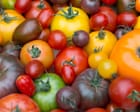
The watery, perfectly round, uniformly red supermarket tomato is finally losing its grip on the British kitchen. For decades, grocery baskets were dominated by the predictable six-pack of salad tomatoes. They didn't taste like much, but they were red, they were cheap, and they looked exactly how we thought a tomato should look.
That era is over. British shoppers are spending over £1bn a year on tomatoes, but where that money goes has radically shifted. We are witnessing an explosion of rainbow shades and premium vine-grown varieties that are rapidly turning the traditional salad bowl on its head.
Data from the grocery analyst Worldpanel by Numerator shows overall tomato sales grew by 3% in the year leading up to 14 June. But hidden inside that growth is a massive consumer revolt against the boring red round standard. Sales of non-red tomatoes—yellow, orange, purple, green, and even zebra-striped varieties—have surged by 21% this year alone. Look back over a two-year period, and the market for these colourful alternatives has doubled to £50m.
The financial reality for the classic round tomato is grim. While it remains the single highest seller by volume at £190m annually, its popularity is dropping fast. Sales fell by £5m compared to 2025 levels. Meanwhile, its direct upmarket rival, the premium cherry-on-the-vine tomato, shot up by £16m to reach £180m. Industry insiders openly predict the premium vine varieties will completely overtake the classic round before the year ends.
The Flavour Problem of the Traditional Red
The decline of the classic tomato isn't an accident. It's the result of decades of industrial farming prioritising shelf life over taste. Traditional supermarket rounds were bred to possess thick skins so they wouldn't bruise during transport. They were bred for uniform ripening genes that made them turn red all at once, even if their sugars hadn't fully developed.
The result was a beautiful, shiny, tasteless sphere.
Commercial growers admit they previously got the balance wrong. In the past, seed breeders rolled out colourful varieties that looked intriguing but tasted terrible. Consumers bought them once for the novelty and never went back.
Today, agricultural breeding has caught up with consumer expectations. New varieties manage to look striking while packing a serious punch in flavour. Growers are so confident in this shift that Evesham Vale Growers, a major supplier to retail giants Sainsbury’s and Aldi, recently converted 20% of its entire growing area exclusively to an orange, cherry, on-the-vine variety.
The Science of Rainbow Tomatoes
Different colours don't just look pretty on a plate. They represent completely distinct chemical profiles that alter how we experience taste. Understanding these differences changes how you cook.
Yellow and Orange Varieties
These options generally contain lower levels of malic and citric acids compared to standard red varieties. The result is a much mellower, sweeter profile. Many orange varieties also contain higher concentrations of tetra-cis-lycopene, a form of lycopene that is more easily absorbed by the human body. They taste noticeably fruitier, making them ideal for eating raw or tossing into light summer salads.
Green and Striped Varieties
Green varieties like the green tiger tomato retain a firm texture and a high level of acidity. This gives them a sharp, tangy, almost citrus-like bite. They work beautifully when paired with rich foods, such as fresh mozzarella or avocados, where their sharpness cuts through the fat.
Purple, Brown, and Maroon Varieties
Darker tomatoes are packed with anthocyanins, the same powerful antioxidants found in blueberries. From a flavour perspective, these dark varieties offer a deep, rich, deeply savoury profile dominated by umami. They have a complex earthy notes that makes them excellent candidates for roasting, slow-cooking, or slicing thickly onto sourdough toast with a sprinkle of sea salt.
Theatre in the Produce Aisle
Supermarkets have realized that the produce section needs to feel less like a clinical warehouse and more like a marketplace. Symmetrical plastic punnets of identical red globes are boring. Large variety boxes containing a mix of heritage types offer what industry experts call visual theatre.
Simon Conway, the chair of the British Tomato Growers’ Association, points out a structural challenge in the market. Almost every household buys tomatoes already. You cannot easily grow the market by finding brand-new customers. Instead, you have to convince existing buyers to upgrade their purchases. Mixed variety boxes do exactly that.
These larger mixed boxes also solve a major consumer pain point: price. Buying individual small packs of premium varieties gets incredibly expensive. Variety boxes, like the popular £5 heritage collection box at Waitrose, which saw sales jump 22.5% this summer, often work out significantly cheaper per kilogram than buying smaller, single-variety packs. It allows families to experiment with premium flavours without blowing their grocery budget.
The shift is even more dramatic in online retail. The Isle of Wight Tomatoes brand grows up to 55 different varieties annually. They sell through a mix of high-end supermarkets like Marks & Spencer and Ocado, alongside a direct-to-consumer online subscription model. Their year-on-year sales through Ocado surged by a staggering 86%. This highlights a massive appetite for premium produce among shoppers who are willing to seek out specialized growers.
Why British Food Culture is Changing
This tomato revolution is tied directly to broader shifts in how people eat across the UK. British consumers have become vastly more confident in the kitchen. The old preference for uniform, predictable ingredients has been replaced by a desire for culinary exploration and intense flavours.
The rise of plant-based eating and a general desire to cut down on meat consumption play a massive role here. When meat is no longer the central focus of a meal, vegetables can't just be a bland afterthought. They have to do the heavy lifting to deliver excitement. A deep, umami-rich brown tomato or a tangy green striped variety provides the sensory satisfaction that a standard salad tomato simply cannot match.
There is a psychological element too. Eating healthily used to be viewed as a chore involving plain, uninspiring ingredients. Vibrant colours change that perception. Seeing a plate filled with bright yellows, deep purples, and rich oranges creates an instant sensory reward. It makes healthy eating feel indulgent.
How to Buy and Store Premium Tomatoes
If you want to move away from the basic six-pack and get the most out of these new premium varieties, you need to change how you select and handle them.
- Look at the vine: If you are buying cherry-on-the-vine varieties, look at the green stem. It should be bright green, flexible, and intensely fragrant. If the vine is dry, brittle, and brown, the tomatoes were picked a long time ago and have lost their peak flavour.
- Feel the weight: Pick up the tomato. It should feel heavy for its size, indicating a high water and sugar content. Avoid anything that feels hollow or overly squishy.
- Check the skin: For heritage and non-red varieties, don't worry about minor webbing or slight cracks near the stem. This is common in heirloom genetics and often indicates a high sugar content. Avoid tomatoes with deep, soft bruises or mold.
- Step away from the fridge: This is the single biggest mistake people make. Cold temperatures destroy the enzyme activity that gives tomatoes their distinct flavour. It also breaks down the cell walls, resulting in a mealy, woolly texture. Keep your tomatoes on the kitchen counter in a bowl away from direct sunlight.
- Eat them at room temperature: If you absolutely must refrigerate tomatoes because they are overripe, take them out at least three hours before you plan to eat them. Cold masks the volatile compounds responsible for taste.
The classic round red tomato will always have a place in cheap catering and mass-produced sandwiches. But for anyone cooking at home, the standard has permanently changed. The British public has tasted what a real tomato can be, and they aren't going back to the bland red card. Overhaul your next shopping list and grab a mixed heritage box instead of the standard six-pack. Your salads will never be the same again.