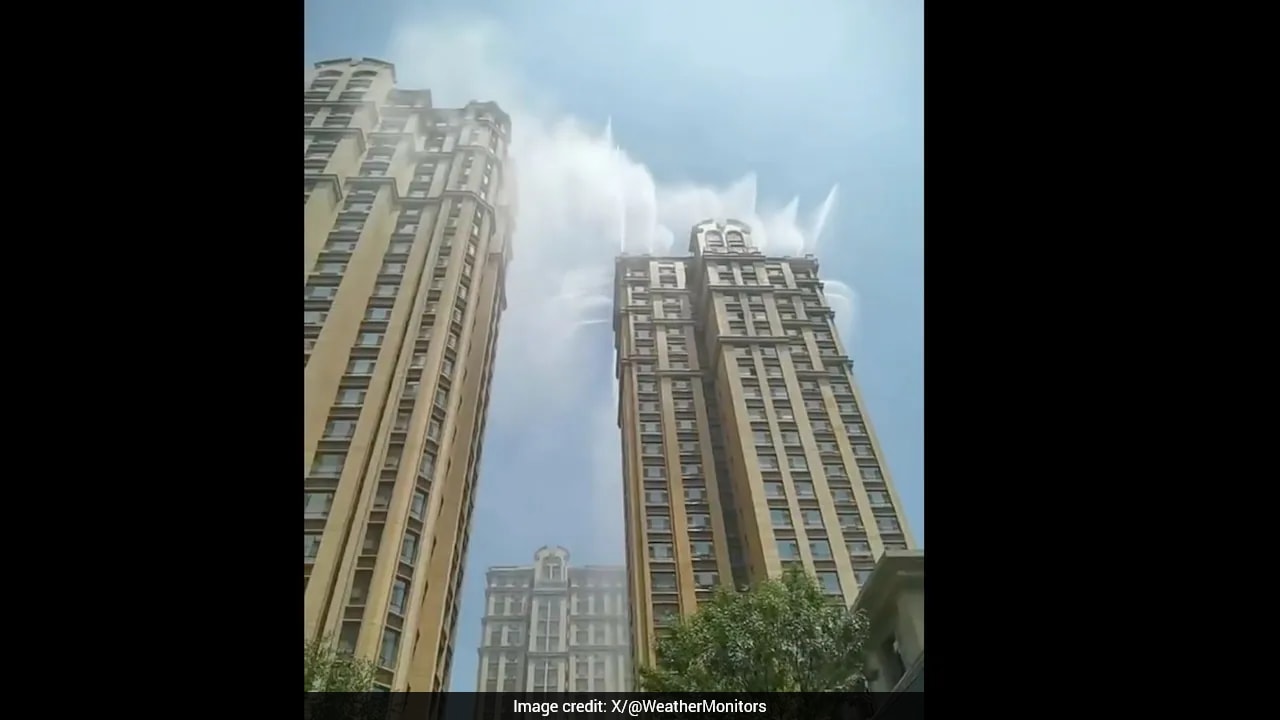
Videos showing entire residential complexes and commercial streets shrouded in a cool, thick white mist are racking up millions of views across social media. Netizens in Europe, currently melting under record-breaking heatwaves, look on with absolute envy.
The internet quickly dubbed these systems China's outdoor AC.
But if you think these cities are pumping traditional, compressed-refrigerant air conditioning directly into the open sky, you're mistaken. Doing that would be an environmental nightmare and a staggering waste of money. What you're actually seeing is a massive, highly efficient deployment of industrial evaporative mist cooling systems. It's an aggressive, urban-scale defense mechanism against 40-degree Celsius (104 Fahrenheit) summer spikes. It works incredibly well, but it relies on strict laws of physics that don't apply everywhere.
How Urban Misting Actually Drops the Temperature
Traditional indoor air conditioners use a closed loop of chemical refrigerants and a ton of electricity to pull heat out of a room and dump it outside. Try that on a public sidewalk and the cold air just drifts away.
Instead, these viral outdoor systems rely on flash evaporation.
High-pressure pumps force treated water through specialized networks of ultra-fine ruby or ceramic nozzles. This pressure, usually hitting between 70 and 120 bars, shears the water into micro-droplets measuring less than 10 microns in diameter. For context, a human hair is about 70 microns wide.
When water drops are that minuscule, their surface-area-to-volume ratio skyrockets. The droplets absorb ambient thermal energy from the scorching air and evaporate instantly before they even hit the ground. Because changing liquid water into a gas requires latent heat, the energy is stripped right out of the local atmosphere.
The result is a fast, dramatic temperature drop of 3 to 6 degrees Celsius (roughly 5 to 11 degrees Fahrenheit) right in the middle of a concrete jungle. Walk through the mist and you won't get wet. Your clothes stay dry because the water turns to vapor almost instantly.
The Catch Most Viral Videos Conveniently Ignore
Before you run out to buy a high-pressure pump for your backyard or lobby your local city council to install these on every street corner, you need to understand the thermodynamic catch.
Evaporative cooling only works in dry heat.
The system relies entirely on the air's capacity to absorb more moisture. If the ambient relative humidity is already sitting at 80% or 90%, the air is essentially full. The micro-droplets won't evaporate. Instead of flash-cooling the plaza, the system will just turn the street into a miserable, damp sauna where puddles collect on the pavement and everyone feels sticky.
Cities like Chongqing, Beijing, and various urban centers across northern and central China experience brutal, dry heat spikes during mid-summer heatwaves. In those specific conditions, relative humidity drops as the temperature climbs, making the environment perfect for flash evaporation. The system acts as a highly targeted shield for public areas like:
- Outdoor restaurant terraces and open-air shopping districts
- Public park walkways and high-traffic plazas
- Courtyards within massive residential high-rise complexes
- Logistics warehouses where traditional AC is structurally impossible
Why This Tech is Decimating Traditional Cooling Costs
If a city tried to cool an equivalent outdoor area using raw fan power or localized traditional cooling units, the energy grid would collapse. China's grid already faces record electricity demands during peak summer months, forcing municipal governments to look for ultra-efficient alternatives.
Misting systems are incredibly cheap to run compared to traditional HVAC setups. The only major energy draw comes from the water pump motor. There are no heavy compressors or power-hungry condenser fans running 24/7.
By utilizing water pressure rather than chemical refrigerants like hydrofluorocarbons (HFCs), these systems completely bypass the direct carbon footprint associated with traditional cooling. They use raw water pressure to generate a natural microclimate. Additionally, the constant blanket of dense moisture knocks down airborne dust, filters out urban PM2.5 particulates, and drives away flying insects like mosquitoes, which can't fly through the dense micro-droplets.
What You Should Do Next
If you're managing a commercial space, an outdoor venue, or looking into localized climate mitigation for a property, don't just blindly buy a cheap misting kit online. Cheap low-pressure systems attach straight to a garden hose and operate at 4 bars of pressure. They create massive droplets that don't evaporate; they just soak everything and create slipping hazards.
Instead, follow these specific parameters to assess if industrial outdoor cooling will work for your space:
- Check your local summer humidity data. If your peak heat days consistently see relative humidity above 60%, pass on misting systems entirely. Look into shading architectures or high-velocity directional fans instead.
- Target a true high-pressure setup. Ensure any system you evaluate utilizes a pump capable of at least 70 bars (1,000 PSI) of pressure. This is the minimum threshold required to achieve true atomization and flash evaporation.
- Audit your water source. Industrial misting nozzles have microscopic orifices that clog instantly with mineral scale or sediment. You will need a dedicated multi-stage filtration system, and ideally a water softener, inline before the pump to keep the system running without constant maintenance.