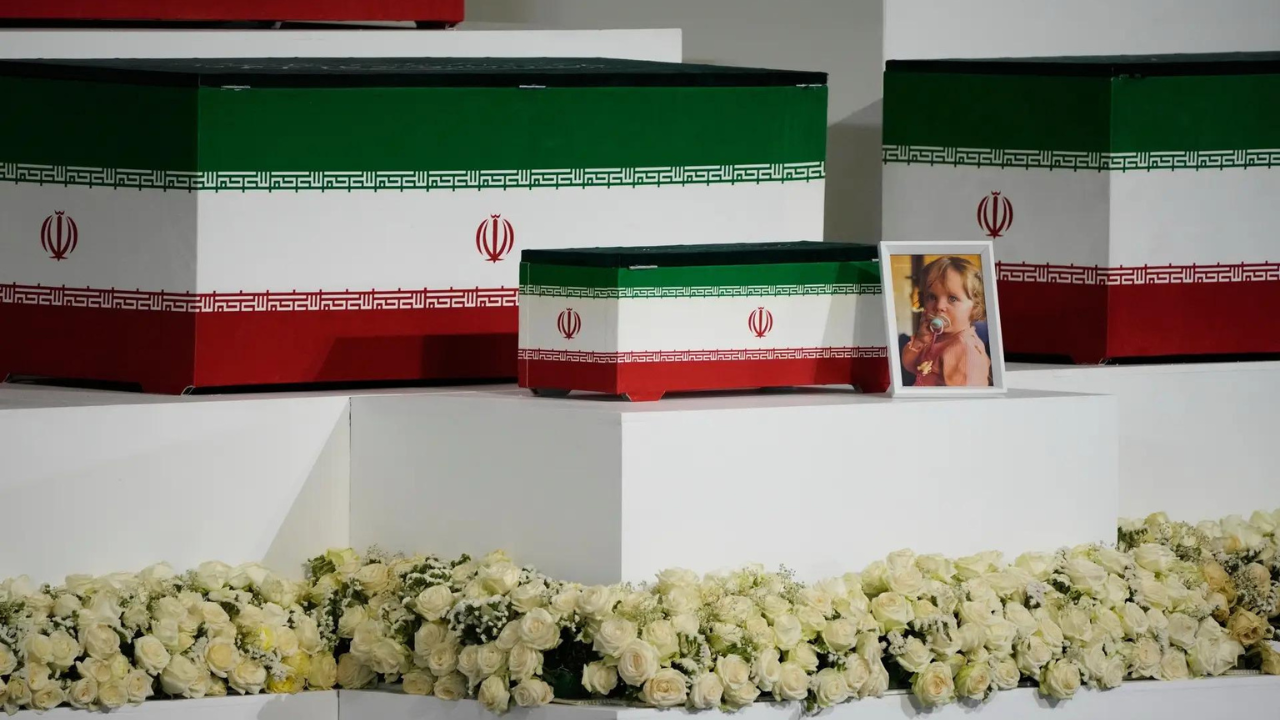
You don't usually see state funerals in Tehran stripped of their rigid, militaristic armor. They're heavily staged. They're exercises in raw political theater, designed to project absolute defiance to the West. But the multi-day farewell for Iran's late Supreme Leader, Ayatollah Ali Khamenei, shattered that script with a single, heartbreaking visual.
Right next to the massive, flag-draped casket of the 86-year-old cleric sat a tiny coffin. It belonged to his 14-month-old granddaughter, Zahra Mohammadi Golpayegani.
She died in the exact same February 28 airstrike that took out the Supreme Leader. The strike didn't just decapitate the regime's leadership. It wiped out an entire family circle, including Khamenei’s eldest daughter, his son-in-law, and the wife of the newly appointed Supreme Leader, Ayatollah Mojtaba Khamenei. By placing that tiny, flag-covered box right in the center of the Grand Mosalla mosque, the regime made a calculated choice. They turned a massive geopolitical crisis into an intimate family tragedy, aiming straight for the emotional core of the Iranian public.
The Raw Emotion Inside Tehran Grand Mosalla
The state media footage broadcast from the Imam Khomeini Mosalla Grand Mosque wasn't just the usual roll call of black-clad officials chanting slogans. The atmosphere felt distinctly different. Thousands of mourners packed the halls, throwing personal items like scarves and handkerchiefs toward the front of the room. Attendants caught them and brushed them against the coffins before tossing them back. It's an old Shiite ritual. People believe it brings blessings, a physical connection to those deemed martyrs.
You could see the country's top civilian and military leaders standing shoulder-to-shoulder, looking visibly shaken. President Masoud Pezeshkian, Parliament Speaker Mohammad Bagher Qalibaf, and Foreign Minister Abbas Araghchi stood right at the front. They weren't just paying respects to a political boss. They were staring at the literal wreckage of the regime's inner sanctum.
Foreign delegations from over 90 countries arrived in Tehran to witness the proceedings. Pakistani Prime Minister Shehbaz Sharif, alongside high-level representatives from Russia, China, India, Oman, and Qatar, walked past the caskets. The presence of these foreign dignitaries shows that despite the devastating blows Iran took during the recent war, its regional alliances haven't completely fallen apart.
The Red Flag of Vengeance
If you want to understand where the Middle East is heading next, you have to look at the cloth draped over Khamenei's casket. Mid-ceremony, officials covered the national flag with a bright red banner bearing the white calligraphic words "Ya Hussein."
This isn't a simple decorative piece. This specific flag was brought directly from the golden-domed shrine of Imam Hussein in Karbala, Iraq. In Shiite theology, Imam Hussein, the grandson of the Prophet Muhammad, is the ultimate symbol of resistance against oppression. He was unjustly killed in the 7th-century Battle of Karbala.
In the Iranian cultural lexicon, a red flag signifies two things. First, it marks the unfair spilling of innocent blood. Second, it serves as an open, public vow that the blood will not go unavenged. By pairing this intense religious symbol of retaliation with the image of a dead 14-month-old baby, the regime is setting the stage for a long-term ideological struggle. They're telling their base that the war isn't over. It's just entering a deeply personal phase.
A Legacy of Iron Fist Rule
Ali Khamenei wasn't just a leader. He was the state itself for nearly four decades. He took power in 1989 after the death of the Islamic Republic's founder, Ayatollah Ruhollah Khomeini. Back then, Khamenei wept openly at Khomeini's funeral before taking the reins of a nation recovering from a brutal eight-year war with Iraq.
Over the next 37 years, he ruled with absolute authority. He built the Islamic Revolutionary Guard Corps (IRGC) into a massive economic and military empire. He funded and armed a network of regional proxies, stretching from Yemen to Lebanon. He consistently rejected any meaningful rapprochement with the United States and Israel.
The regime is explicitly trying to mirror the massive public outpouring of grief seen during Khomeini's 1989 burial. Banners cover the streets of Tehran, urging the public to rally around the theocracy. The government wants millions to flood the streets during the public funeral processions scheduled across Qom and Tehran, culminating in the final burial at the Imam Reza shrine in Mashhad. They need these crowds. They need them to prove to the world, and to their own citizens, that the state still commands loyalty despite the catastrophic intelligence failures that allowed the February 28 strike to happen.
The Secretive Succession and the Threat of More Blows
While the public mourns, a tense political drama is unfolding behind closed doors. Ayatollah Mojtaba Khamenei, Ali Khamenei's son, has reportedly succeeded his father as the new Supreme Leader. But he didn't show up to the funeral.
His absence is telling. Reports suggest Mojtaba was wounded in the same February strike that killed his father, daughter, and wife. He remains deep in hiding, terrified of another targeted attack. The fact that the absolute ruler of Iran cannot safely attend his own father's state funeral shows just how deeply the regime's security has been compromised.
Instead of the new Supreme Leader leading the prayers, other figures are stepping into the spotlight to project strength. General Ahmad Vahidi, a hardline commander who hadn't been seen in public since early February, suddenly reappeared at a planning meeting for the funeral. He sat prominently next to the caskets during a smaller, private service. Vahidi spoke directly to state television, declaring that the "pure blood of our martyred imam" would lead to new victories. He claimed the nation's enemies would go to their graves before seeing Iran surrender.
Vahidi’s reemergence is crucial. Experts track him as a core member of the tight security clique currently managing day-to-day operations and handling fragile ceasefire negotiations. His fiery rhetoric indicates that the hardline faction inside the IRGC is consolidating power, using the emotional weight of the tragedy to silence moderate voices who might want to de-escalate the conflict.
The Human Cost Behind the Geopolitical Chessboard
It's easy to get lost in the grand strategy of the Middle East. We talk about proxy networks, missile defense systems, and regime survival. But the image of Zahra's small coffin forces a pause. It reminds everyone that war doesn't care about theological titles or supreme power. When an airstrike hits a residential compound or a leadership bunker, the debris falls on everyone inside.
For the critics of the regime, the state's sudden focus on the death of an innocent child feels hypocritical. They point out the hundreds of young Iranians killed by security forces during domestic protests over the years. For the regime's loyalists, however, the infant's death is a unifying rallying cry. It transforms a political dispute into a moral crusade.
The regime will spend the next week channeling this collective grief into political capital. They'll use the images of the funeral to rebuild national pride, reinforce the authority of the hidden Mojtaba Khamenei, and justify the massive economic hardships the country faces due to the war.
Next Steps for Following the Situation in Iran
If you're tracking the fallout of this massive transition in Iranian leadership, don't just watch the official state broadcasts. Keep your eyes on three specific pressure points over the coming weeks.
Monitor the first official public address or written decree from the new Supreme Leader, Ayatollah Mojtaba Khamenei. His words will signal whether Iran plans to pursue an immediate, aggressive retaliation or if they'll focus on rebuilding their broken intelligence and security apparatus first.
Watch the movements of General Ahmad Vahidi and the IRGC high command. Their public statements and internal appointments will tell you if the military faction is completely sidelining civilian leaders like President Pezeshkian in the post-Khamenei era.
Track the progress of the multi-city funeral procession as it moves toward Qom and Mashhad. The actual size and energy of the crowds will give you a realistic gauge of the regime's domestic legitimacy. It will show if the public is truly unified by the tragedy or if the cracks in the Islamic Republic's foundation are growing too wide to hide.


