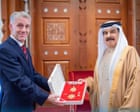
The rules inside the Foreign Office are perfectly clear. British heads of mission are not supposed to accept medals from foreign governments during or after their postings. It prevents conflicts of interest. It stops the uncomfortable spectacle of a democratic nation's representative getting pinned with a shiny badge by an autocratic ruler.
Yet, Alastair Long, the British Ambassador to Bahrain, smiled for the cameras this week as King Hamad bin Isa Al-Khalifa presented him with the Order of Bahrain (First Class).
It isn't a one-off mistake. It's a pattern. Long is actually the fourth consecutive British ambassador to Manama to accept this exact honor, following Roderick Drummond, Simon Martin, and Iain Lindsay. This ongoing sequence of rule-bending has triggered furious blowback in London, with politicians and human rights advocates warning that the UK's diplomatic integrity is being eroded for the sake of royal flattery.
The Friction Between Protocol and Protocol Avoidance
The Foreign, Commonwealth and Development Office (FCDO) explicitly states that diplomats should decline foreign awards. If a foreign state wants to give a medal to a UK national, they must formally request permission. According to internal sources, Bahrain didn't even bother to ask for permission before honoring Long.
This isn't just about administrative paperwork. It reveals a deep systemic vulnerability. Liberal Democrat peer Lord Scriven sent an urgent letter to Foreign Secretary Yvette Cooper warning that the situation sends an incredibly dangerous message. He argued it shows British diplomats and civil servants are essentially up for grabs.
Freedom of Information requests from earlier ambassorships reveal that British diplomats know exactly what they are doing. Internal emails from 2023, when Roderick Drummond was ambassador, showed FCDO officials advising that the medal should be declined. But then came the classic diplomatic pivot. They decided it should be accepted anyway "to avoid embarrassment," with the caveat that it should be kept as a "service gift."
This reveals who is actually calling the shots in these relationships. When a Gulf autocrat offers a medal, the UK government folds because it fears a minor social awkwardness more than it values its own ethical standards.
The Real Cost of a First Class Medal
While British diplomats collect jewelry, the situation on the ground in Bahrain is actively deteriorating. Human rights groups point out the grim reality behind the smiles in the palace.
Sayed Ahmed Alwadaei, an activist and advocacy director at the Bahrain Institute for Rights and Democracy, survived torture before fleeing the country. He points out that Long praised King Hamad's "visionary leadership" right before receiving the award. Alwadaei argues that accepting these honors makes British envoys morally compromised.
The timing is incredibly dark. Consider what else is happening in Bahrain right now:
- Custody Deaths: A 32-year-old man named Sayed Mohamed Almosawi was forcibly disappeared in March. Human Rights Watch confirmed he died in custody showing clear signs of physical abuse and torture.
- Statelessness: The regime continues its systematic campaign of revoking citizenship for Shia Muslims of Iranian heritage, effectively rendering families and young children stateless.
- Targeted Arrests: Shia clerics and political dissidents face routine detention for speaking out against the government.
When a British ambassador accepts a medal under these circumstances, it isn't an innocent token of appreciation. It functions as a valuable public relations shield for a dictatorial regime.
A Systemic Revolving Door
The issue stretches far beyond the active diplomatic corps. The cozy alignment between British officials and Gulf regimes frequently continues long after diplomats leave public service.
Look at Lord Ahmad, the former UK Middle East minister. In 2025, he faced intense scrutiny and accusations of breaching transparency guidelines after taking a paid advisory job with an organization closely tied to the Bahraini government. The watchdog group Advisory Committee on Business Appointments cleared the move, but critics like Lord Scriven openly called the decision a whitewash.
This creates a scenario where diplomats spend their active postings avoiding tough conversations on human rights, knowing that lucrative post-government consulting opportunities await them if they remain cooperative.
The standard defense from the FCDO is that maintaining close ties allows Britain to exert behind-the-scenes influence on regional security and trade, especially during active UK-GCC Free Trade Agreement negotiations. But when the human rights metrics keep getting worse, that argument collapses. The influence is clearly flowing in the opposite direction.
Next Steps for UK Foreign Policy
If the British government wants its diplomatic code of conduct to mean anything, it needs to stop treating its own rules as optional suggestions. The current hands-off approach isn't working.
To fix this structural credibility gap, the Foreign Secretary needs to take three immediate steps. First, implement an absolute ban on foreign state honors for active civil servants, with zero exceptions for "avoiding embarrassment." Second, mandate an immediate independent review into all post-tenure employment taken by former Gulf diplomats. Finally, future trade packages must be explicitly linked to verifiable human rights benchmarks rather than vague promises of reform.
Failing to act simply confirms what critics suspect. The UK's foreign policy priorities are dictated by foreign rulers, and its diplomats are entirely comfortable acting as part of the machinery.
The video Trade, Diplomacy & Partnership: A Conversation with British Ambassador Alastair Long provides crucial context on how Ambassador Long publicly frames the UK-Bahrain relationship, emphasizing trade and the UK-GCC Free Trade Agreement just as these controversies over human rights and state awards come to a head.