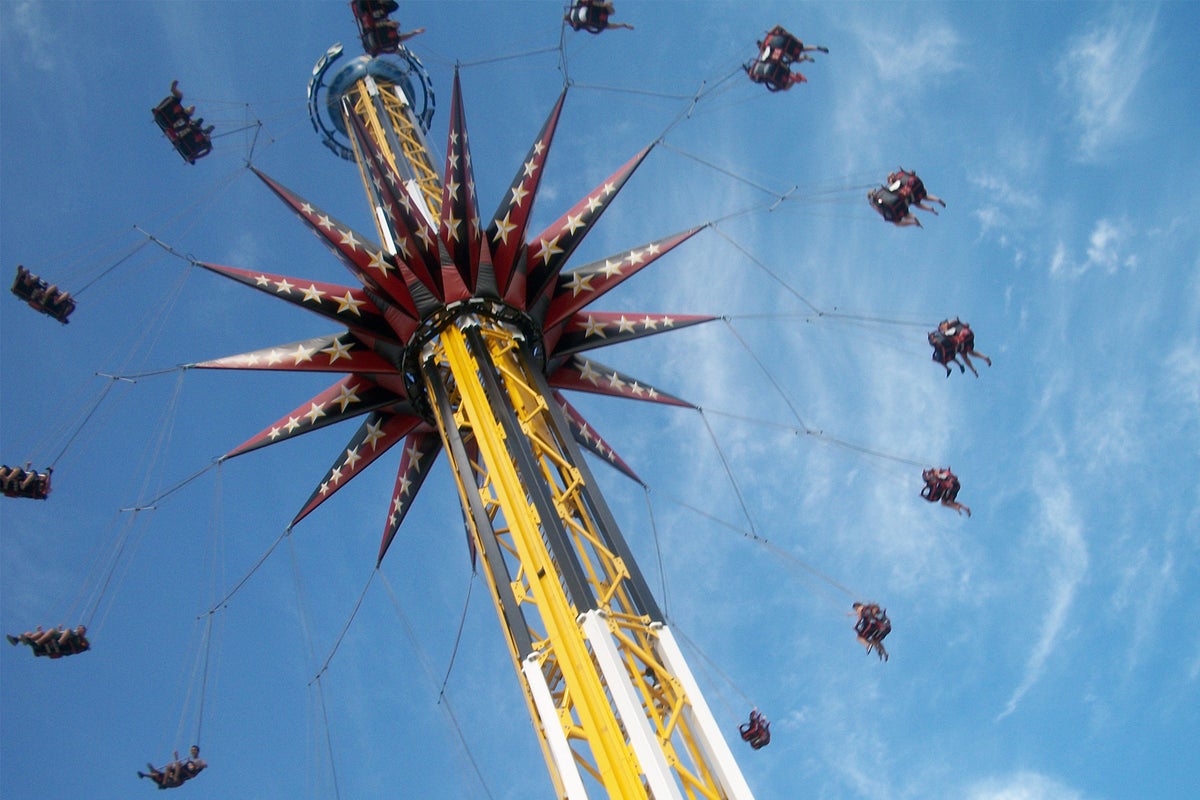
You are sitting 120 feet in the air, legs dangling over nothingness, while dark storm clouds roll toward you on the horizon. The wind starts to pick up. Below you, the giant metal gears that were supposed to spin you safely around a 239-foot tower have completely quit.
This isn't a hypothetical horror movie scene. It just happened to a family of four, including two teenagers, at Six Flags St. Louis in Eureka, Missouri. On Thursday night, June 11, 2026, the park’s Sky Screamer ride stopped dead mid-cycle. Even worse, the mechanical manual backup systems failed. The park couldn't lower the swings. Also making news in this space: Why the Trump Kennedy Center Name Debate Matters for Executive Power.
The riders were stuck at the top for hours as a severe weather system closed in. Local first responders had to race against the clock, riding a massive crane basket up into the sky to pluck the family to safety.
While headline writers love to play up the terror of these moments, the reality of amusement park safety is wildly different from what you see on your social media feed. Let's look at what actually happened high above the ground, why rides fail like this, and what it means for your next trip to a theme park. Further insights regarding the matter are detailed by USA.gov.
The Race Against The Weather in Eureka
When the Sky Screamer locked up, Six Flags technicians immediately tried to use manual overrides to bring the four passengers down. When those safety backups didn't work, park officials called the Eureka Fire Protection District.
The timing couldn't have been worse. The St. Louis region was tracking severe storms capable of producing high winds and heavy lightning. Firefighters Brad Trower and Brian Lucas were part of the crew that got the call. They arrived at the park within four minutes.
Because the ride's own lowering systems were totally unresponsive, crews had to deploy a specialized crane. Trower and Lucas rode a rescue basket 120 feet straight up into the air.
"It's one of those things you get up there like, 'Oh wow, that's far down,' but then it goes away pretty quick," Trower later told local reporters.
The rescue team pulled off a high-angle rope operation, transferring the family from the dangling swings into the rescue basket. Everyone made it to the ground safely with zero injuries before the storm hit. While the media immediately labeled the first responders as heroes, the crews chalked it up to intense, repetitive training.
The Engineering Reality Behind The Stall
It sounds terrifying when a ride "malfunctions," but a halt is usually the safety system doing exactly what it was designed to do. Theme park rides are built with redundant computer systems that monitor thousands of data points per second. If a sensor detects a slight variation in wind speed, a mechanical hiccup, a minor power fluctuation, or a brake timing issue, the computer triggers a fail-safe stop.
Basically, the ride chooses to freeze in place rather than risk running with an unknown variable.
The real complication with the Sky Screamer incident wasn't the initial stop. It was the failure of the manual backup lowering system. Sky Screamer rides, manufactured by Funtime, rely on a central lift chassis that raises and lowers the swing assembly along a massive tower. When the primary motors stop, operators typically use a secondary mechanical release or a backup generator to winch the carriage back down to the loading platform.
When both the main system and the manual override fail simultaneously, it points to a more complex mechanical or electrical lock. Six Flags St. Louis shut the ride down immediately for a rigorous, top-to-bottom safety inspection. The rest of the park reopened the following day.
How Safe Are You Really on a Modern Ride
Statistically, you are safer on a major amusement park ride than you are during the drive to the park.
The International Association of Amusement Parks and Attractions (IAAPA) tracks ride data across the country. According to their safety reports, the chance of sustaining a serious injury on a fixed-site amusement park ride in the United States is roughly 1 in 15.5 million. To put that in perspective, you have a higher statistical chance of being struck by lightning twice.
| Activity | Statistical Risk of Injury or Incident |
|---|---|
| Riding a U.S. Amusement Park Ride | 1 in 15.5 Million |
| Being Struck by Lightning (Lifetime) | 1 in 15,000 |
| Car Accidents (U.S. Annual average) | 1 in 366 per 1,000 miles driven |
The reason these numbers stay so low comes down to rigorous regulatory frameworks and constant maintenance cycles.
- Daily Inspections: Ride mechanics spend hours every morning inspecting welds, testing computer systems, and running empty test cycles before the front gates ever open to guests.
- Bi-Annual Walkthroughs: Local fire departments and structural engineers conduct extensive walkthroughs and emergency drills on major attractions. The Eureka firefighters had practiced high-angle rope rescues on that exact Sky Screamer tower twice over the previous few years.
- State and Third-Party Oversight: State regulators and independent safety inspectors routinely audit park logs and mechanical operations to ensure compliance with strict ASTM International standards.
What to Do If You Get Stranded on a Ride
If you ever find yourself stuck on a rollercoaster lift hill or a tower ride, your actions in the first few minutes are vital to staying safe. Panic is your biggest enemy.
First, stay exactly where you are. Never attempt to undo your safety harness, lap bar, or over-the-shoulder restraint, even if you think the ride is completely dead and help is far away. Modern restraints require a mechanical or pneumatic release signal to open; forcing them can damage the mechanism or put you in immediate danger of falling.
Second, listen for announcements. Park operators use loud P.A. systems or send staff up the service stairwells to communicate directly with stranded riders. They will tell you exactly what went wrong and what the plan is to get you down.
Third, sit back and preserve your energy. If you are stuck in the sun or high in the air, flailing around or screaming only raises your heart rate and speeds up dehydration. Keep your hands inside the car or on the harness and wait for the mechanics or local fire crews to do their work. They have a plan, they have the training, and they will get you down.
Check the official park app or local news updates for status reports before you head out to a park. If an attraction is listed as "temporarily closed," it means the maintenance teams are doing their jobs to keep you safe.