Bolivia is running out of time, gasoline, and patience.
When President Rodrigo Paz stepped in front of the television cameras early Saturday morning to declare a nationwide state of emergency, he wasn't just announcing a policy shift. He was acknowledging that his government had lost control of the nation's physical infrastructure. For 50 brutal days, anti-government protesters have choked off the country’s main arteries, stranding over 5,000 supply trucks, cutting off cities like La Paz and El Alto, and causing an estimated $50 million in economic losses every single day. If you liked this piece, you should look at: this related article.
If you think this is just another localized political squabble in South America, you're missing the bigger picture.
What's happening right now in Bolivia is a textbook case of what happens when a country runs completely out of foreign currency, attempts to break a decades-long addiction to state subsidies, and hits a geopolitical brick wall. The crisis has reached a tipping point where internal security laws are colliding with an aggressive indigenous and labor rebellion. It's a messy, volatile situation that offers a stark warning to other developing nations grappling with fiscal deficits and rising energy costs in 2026. For another angle on this story, refer to the latest coverage from The Washington Post.
The Fifty-Day Siege Paralyzing South America's Heartland
To understand why President Paz finally triggered the "State of Exception," you have to look at the sheer scale of the paralysis. This isn't a series of standard street marches. It is a systematic, highly coordinated economic blockade.
Rural associations, miners, farmers, and transport workers have erected more than 3,500 roadblocks across the country. They’ve used downed trees, boulders, and burning tires to slice the country into isolated fragments. Cochabamba, the agricultural hub connecting eastern and western Bolivia, is completely locked down. The administrative capital of La Paz and its neighboring industrial giant, El Alto, have been under an effective siege for weeks.
The consequences on the ground are immediate and devastating.
- Choked Supplies: Basic food items are rotting in the backs of stranded trucks. Meat, vegetables, and milk aren't reaching city markets, driving local food inflation to astronomical highs.
- Medical Collapse: Oxygen tanks, critical pharmaceuticals, and medical supplies cannot bypass the checkpoints. Hospitals are turning patients away, and authorities have already linked at least ten deaths directly to the transit disruptions.
- The Fuel Irony: In a desperate twist, truck drivers stranded at the roadblocks are spending their nights sleeping in their cabs, chanting "We want gasoline!" The very vehicles meant to transport fuel are trapped without it.
The economic hemorrhage is staggering. Local residents' boards in El Alto report that their city alone is losing roughly $6.5 million every 24 hours. When a country's total daily losses cross the $50 million mark, a state of emergency isn't an aggressive executive overreach—it's a desperate survival mechanism.
The Toxic Mix of Subsidies, Dollars, and Sovereign Debt
How did Bolivia get here? The mainstream narrative focuses heavily on the political rivalry between President Paz and former leftist leader Evo Morales. That rivalry is real, but it's only the match. The fuel for this fire was poured months ago by structural economic decay.
For nearly twenty years, the Bolivian government artificially kept the country running by heavily subsidizing gasoline and diesel. It was a popular policy that kept the cost of living low, but it relied entirely on a booming natural gas export sector.
Then the gas started running out.
With production plummeting and no foreign currency flowing back into the central bank, Bolivia hit a severe U.S. dollar crunch. The country lacked the greenbacks needed to import the very fuel it was subsidizing. In December 2025, President Paz made the politically explosive decision to eliminate national fuel subsidies to shrink a runaway fiscal deficit. Overnight, fuel prices skyrocketed.
When the government tried to offset its financial woes in May 2026 by fast-tracking a controversial agrarian law allowing land to be used as collateral for loans, the countryside exploded. Small farmers and indigenous communities viewed the law as a direct threat to their ancestral lands, suspecting it was a backdoor mechanism for large-scale corporate land grabs.
Paz quickly rolled back the land reform and tried to stabilize fuel prices, but the damage was done. The strikes evolved from a specific protest against austerity into a sweeping, nationwide anti-government movement demanding higher wages, an end to the dollar shortage, and ultimately, the president's resignation.
Politics by Other Means: The Shadow of Evo Morales
You can't analyze a Bolivian crisis without talking about Evo Morales. Though President Paz managed to secure a shaky peace deal on Friday night with the Bolivian Workers' Confederation (COB)—the country’s largest trade union federation—the roads remained blocked on Saturday morning.
Why? Because the union bureaucracy doesn't control the highways; rural indigenous movements loyal to Morales do.
Morales, who governed Bolivia for nearly 14 years and remains a towering figure among the country's rural majority, has publicly backed the protest movement. From his stronghold in the Chapare region, he has framed the blockades as a legitimate "indigenous rebellion" against right-wing austerity and political persecution. Paz, conversely, openly accuses Morales of using narcoterrorism and rural syndicates to orchestrate a coup d'état.
Paz took office just seven months ago, breaking nearly two decades of rule by Morales's Movement to Socialism (MAS) party. His centrist administration immediately pivoted toward Washington, exploring a $1.5 billion economic cooperation package backed by the United States to secure alternative fuel channels and stabilize the economy. For Morales and his base, this pivot to the West and the involvement of the International Monetary Fund (IMF) represents a betrayal of Bolivian sovereignty. The highway blockades are their way of proving that while Paz may hold the presidential palace, they hold the territory.
What the State of Emergency Actually Changes
By declaring a State of Exception, President Paz is shifting from political negotiation to military force.
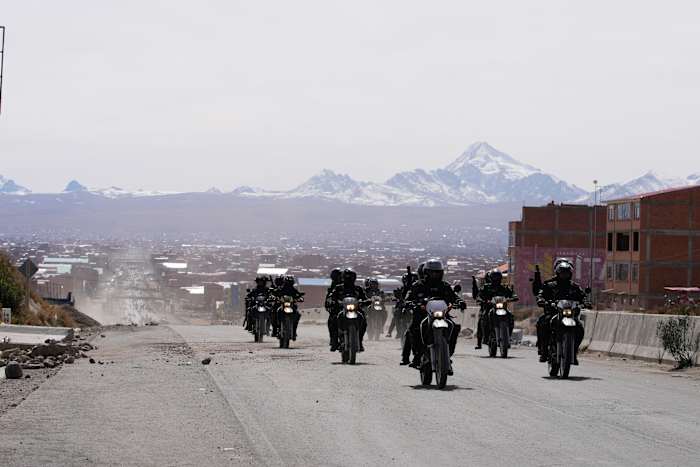
Thanks to a security law fast-tracked through the legislature earlier this month, the executive branch now has the explicit legal framework to deploy the Armed Forces alongside national police to clear strategic transit chokepoints. We’re already seeing this play out. Hours after the decree, a massive convoy of tractors, police vehicles, and armed soldiers rolled out of headquarters in La Paz to forcibly clear debris from Route 9 and other major highways.
Paz has been careful to frame this as a defense of personal freedom rather than a crackdown on civil liberties. In his address, he stated plainly: "This is not a state of emergency to restrict people's lives. It is a state of emergency to give freedom back to the people."
But history suggests that clearing roadblocks with infantry is incredibly dangerous. A joint police and military operation on Route 9 earlier this month quickly degenerated into a firefight, leaving dozens injured, including several by gunfire. With the defense ministry now mulling temporary curfews and restrictions on public gatherings in "sensitive" regions, the potential for a severe escalation in violence is high.
The Broader Implications for Global Resource Markets
If you don't live in South America, you might think a highway blockade in Cochabamba doesn't affect you. Honestly, it does.
Bolivia sits directly on top of the "Lithium Triangle," holding some of the largest untapped lithium brine reserves on the planet. As the global transition toward electric vehicles and renewable energy storage intensifies, any prolonged structural instability in Bolivia sends shockwaves through mining investment circles. International consortiums looking to develop extraction facilities are watching these blockades with extreme caution. If a government cannot guarantee that a highway will remain open for transport, multi-billion-dollar infrastructure investments evaporate.
Furthermore, the regional energy grid is tightly intertwined. While Bolivia's natural gas exports have declined, neighboring countries like Argentina and Brazil still rely on regional stability to manage their own energy corridors and agricultural supply chains. A total economic collapse in Bolivia threatens to destabilize the Southern Cone's broader economic balance.
What Happens Next
The immediate future of Bolivia will be decided in the legislature and on the asphalt over the next 72 hours.
Under Bolivian constitutional law, President Paz must notify Congress of the emergency decree within 24 hours. The Legislative Assembly then has 72 hours to either ratify or reject the measure. Because opposition lawmakers are deeply divided—some warning that military deployment will only supercharge the violence—the political battle in the capital will be just as fierce as the physical battles on the highways.
If you are tracking this situation for business, logistics, or geopolitical risk analysis, keep your eyes on these critical indicators:
- The Cochabamba Chokepoint: Watch whether the military successfully clears and maintains control of the highways cutting through central Bolivia, or if protesters successfully regroup and re-establish the blockades.
- Legislative Ratification: Monitor the congressional vote on the emergency decree. If Congress rejects the state of emergency, Paz will be left legally exposed and politically isolated.
- The Chapare Reaction: Look for statements or mobilization orders from Evo Morales and rural cocalero unions. If the military pushes deep into pro-Morales territory to clear roads, the conflict could easily shift from civil unrest to a low-intensity armed conflict.
Bolivia's attempt to transition away from populist subsidies and stabilize its empty treasury has triggered a structural crisis that cannot be resolved with simple political compromises. The coming days will prove whether the military can restore order by force, or if the highway siege will ultimately break the presidency of Rodrigo Paz.