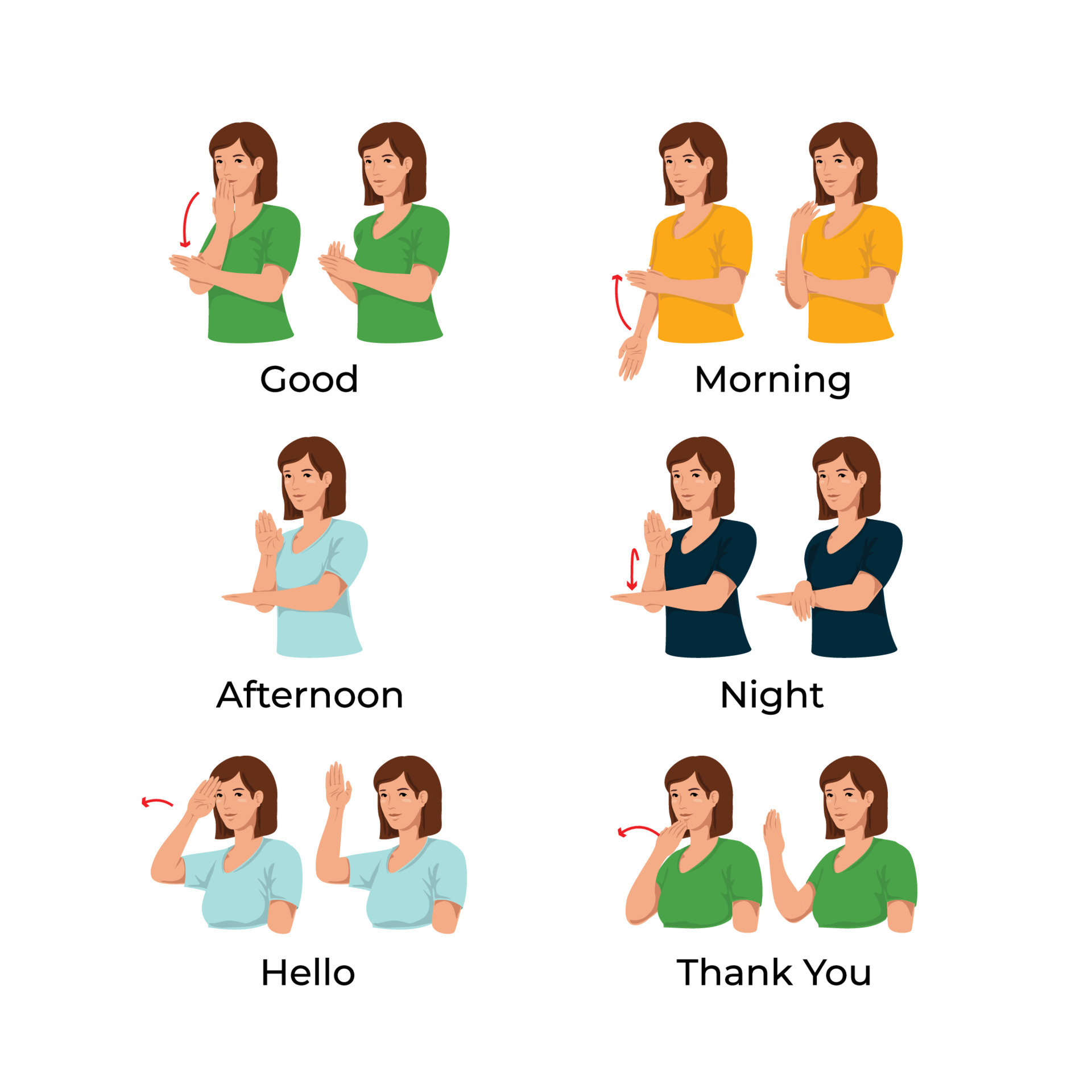
We’ve been taught that language is a bridge, but in the specific world of visual communication, a bridge can also be a wall. Most hearing people who pick up a basic handbook or watch a thirty-second social media clip believe they’re unlocking a door to a new community when they memorize a few gestural pleasantries. They focus on the mechanics of the hands, the specific arc of a palm, and the speed of a movement, thinking that a greeting is a universal constant. It’s not. In the American Deaf community, the literal translation of Asl Nice To Meet You often functions less like a warm welcome and more like a linguistic speed bump. Most people assume that lead-in phrases are the most vital part of a conversation, but in this context, they’re often the least authentic thing you can say. We’ve spent decades fetishizing the "beauty" of sign language while ignoring the actual cultural mechanics that make it work. If you think you’re being respectful by leadenly signing your way through a textbook greeting, you’re likely missing the point of the interaction entirely.
The misconception starts with the way we view translation as a one-to-one exchange of data. Hearing culture is obsessed with the phatic function of language—those "how are yous" and "nice days" that fill the silence without actually conveying information. Deaf culture, born from a necessity for clarity and directness, operates on a different frequency. When a hearing beginner approaches a Deaf person and meticulously executes the signs, they’re often performing a ritual for their own benefit rather than participating in a shared language. It’s a performance of "being a good ally" that can feel clinical or even patronizing to the person on the receiving end. The reality is that the community often values efficiency and visual information over the fluffy social padding that hearing people find so comfortable. By clinging to these scripted moments, you aren’t actually communicating; you’re just reciting.
The Cultural Weight of Asl Nice To Meet You
The problem isn’t the signs themselves; it’s the vacuum in which they’re often taught. When you see Asl Nice To Meet You in a textbook, it’s presented as a static object, a fixed phrase that signifies the start of a friendly bond. In practice, the Deaf community often skips these formalities in favor of what sociolinguists call "Deaf heart"—a direct, visual engagement that prioritizes who you are and who you know over how polite you can be in a textbook sense. I’ve watched countless interactions where a hearing student waits for the "proper" moment to interject a greeting, only to realize the conversation has already moved three topics past the introductions. The delay isn't just about speed; it's about the fundamental way information is prioritized.
Experts like Dr. Bill Vicars have long pointed out that American Sign Language is not just English on the hands; it’s a high-context language where the face does the heavy lifting. A hearing person might sign the greeting perfectly with their hands while their face remains a "frozen mask," as it’s often called in Deaf education circles. This creates a jarring dissonance. Imagine someone saying "I'm so happy" in a flat, monotone voice while staring blankly at a wall. That’s exactly how a beginner looks when they focus too hard on hand placement. They’re so worried about the "correct" way to sign that they forget to actually look at the person they’re talking to. The greeting becomes a barrier to the very connection it’s supposed to facilitate.
The Myth of the Universal Greeting
Critics might argue that these pleasantries are essential for any language learner. They’d say that without these basic building blocks, a student has no way to enter a conversation. That sounds logical, but it ignores the specific power dynamics at play. When a hearing person uses a scripted greeting, they’re often signaling their status as an outsider who expects the Deaf person to slow down, simplify, and essentially act as a free tutor. It’s a heavy burden to place on a stranger under the guise of politeness. The "bridge" we think we’re building is often just a one-way street where the hearing person gets to feel good about their "inclusive" behavior while the Deaf person does the labor of interpretation.
Instead of focusing on these rigid formulas, we should be looking at how the community actually initiates contact. Frequently, it’s through eye contact, a slight nod, or a specific type of wave that carries more weight than any multi-word phrase. These are the nuances that aren't easily captured in a viral video. The nuance is in the eyebrows, the tilt of the head, and the spatial awareness of the room. When you strip all of that away to focus on a phrase like Asl Nice To Meet You, you’re effectively removing the soul of the language. You’re trying to play a symphony using only a single drum.
Why Directness Trumps Decoration
The mechanism of ASL is built on visual logic. If I want to tell you about my car, I don’t just use the sign for "car"; I establish where the car is, what color it is, and how it’s moving through space. This visual-spatial mapping is the core of the language’s power. Formalized greetings, by contrast, are often non-spatial and abstract. They’re holdovers from a spoken-language mindset that values the "buffer" before the "meat" of the talk. In a visual world, that buffer is often unnecessary. Why spend three seconds signing a greeting when a single, well-placed expression can communicate warmth, curiosity, and respect in half a second?
The insistence on these "polite" scripts is actually a form of linguistic imperialism. We’re trying to force ASL to behave like English because English is what makes us feel safe. We want the comfort of our own social structures even when we’re supposedly entering someone else’s space. If you want to truly respect the language, you have to be willing to let go of the scripts. You have to be willing to be direct, to be visual, and to be "blunt" by hearing standards. True communication in this field isn’t about how many signs you know; it’s about how well you can navigate the visual environment without the crutch of English-based social norms.
I remember sitting in a crowded room at a Deaf social event years ago. A hearing visitor walked up to a group and carefully, almost painfully, executed a perfect, slow-motion greeting. The group stopped, smiled politely, and waited. The visitor then stood there, unable to follow the lightning-fast response that came back. The greeting had exhausted their entire vocabulary. It was a hollow gesture that actually hindered the flow of the night. Had they simply waved and watched, they might have learned more about the people in that room than any scripted phrase could ever teach. They were so focused on the "right" way to start that they never actually started.
The lesson here isn’t that you should stop being polite. It’s that you should redefine what politeness looks like in a visual-manual context. It looks like paying attention. It looks like matching the energy of the person across from you. It looks like realizing that your hands are only ten percent of the story. If you want to move beyond the superficial, you have to stop treating the language like a series of codes to be cracked and start treating it like a living, breathing culture that doesn't owe you a "hello."
The next time you see someone practicing their signs in a mirror, notice what they’re looking at. If they’re looking at their hands, they’re still just talking to themselves. The moment they look up and start using their eyes to track the space around them, that’s when the real work begins. We need to stop rewarding the performance of greeting and start valuing the substance of the exchange. The most "polite" thing you can do in any language is to listen—or in this case, to truly see—before you speak.
Linguistic proficiency isn't a checklist of memorized phrases; it's the ability to exist within the friction of a different culture without trying to smooth it over with your own familiar habits. We've spent far too long congratulating ourselves for learning the surface-level gestures of a community while remaining completely illiterate to its deeper social rhythms. If the goal is genuine connection, then the scripted formalities we hold so dear are the first things that need to go. You don't find a bridge by building a wall of polite, empty gestures; you find it by stepping into the silence and letting the visual world dictate the terms of the encounter.